Lec5 Sec1.5 M2001 Odd Even Functions, Domain of Functions and Difference Quotient
 Watch on YouTube →
Overview
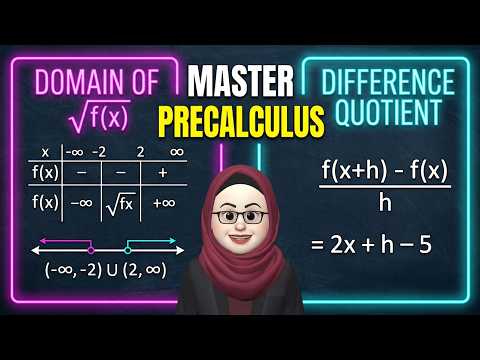
Shahera Jannah reviews exam logistics, graphing and function operations, then develops a systematic method for finding function domains: require radicands to be nonnegative, denominators to be nonzero, and intersect all resulting restrictions on a number line. She then derives the difference quotient for quadratic functions, explains its meaning as the slope through two points on a curve, and distinguishes it from the derivative, which requires taking a limit as h approaches zero.
Key takeaways
- A function domain is found by enforcing every restriction at once: square-root radicands must be nonnegative, while denominators must be nonzero.
- A radical in a denominator requires a strictly positive radicand; for example, √(4−x²) in the denominator gives −2<x<2.
- For √(x+1)/(x−3), the radical allows x≥−1 while the denominator excludes 3, producing [−1,3)∪(3,∞).
- The difference quotient [f(x+h)−f(x)]/h is a secant-line slope between (x,f(x)) and (x+h,f(x+h)); it is not yet a derivative.
- For f(x)=2x²−3x+4, expansion and cancellation produce the difference quotient 4x+2h−3; for f(x)=x²+5x, it is 2x+h+5.
- Domain interval endpoints must be checked in the original function: a valid zero under a radical can be included, but a value that makes a denominator zero must be excluded.
Chapters
0:00
Exam Timing, Format, and Study Guidance
- The first in-class exam is scheduled for exactly two weeks later, with the material cutoff to be set the following Tuesday.
- The exam will be on paper for the full class period; roughly one-third of questions will allow partial credit and two-thirds will not.
- In-class exams are section-based, while the final exam is cumulative; studying the green worked examples in the lecture notes is the main preparation advice.
5:00
Course Sequence and Homework Confusion
- Shahera Jannah notes uncertainty about which sections will be included in the exam and plans to post a review sheet if possible.
- Homework includes function-composition questions even though the class has not yet reached that topic, so the due date may be extended.
- Students are encouraged to report assignments that cover material outside the section currently being taught.
6:00
Reading Function-Operation Questions
- For a homework exercise, the functions are identified as f(x)=x/2 and g(x)=x−6, with questions about graphing and combining them.
- The notation (f+g)(1) means calculate f(1)+g(1); (f/g)(3) means calculate f(3)/g(3).
- For function operations, first form the new expression or evaluate each function at the requested input, then combine the results.
8:00
Graphing f, g, and Their Sum
- A line can be graphed from two points; for f(x)=x/2, convenient points include (0,0) and (2,1).
- Adding f(x)=x/2 and g(x)=x−6 gives (f+g)(x)=3x/2−6.
- For the sum, use the y-intercept −6 and slope 3/2: move up 3 units and right 2 units to locate another point.
10:50
Composition and Evaluating Functions from Graphs
- Composition f(g(x)) means substitute the entire expression g(x)=x−6 into f, giving f(g(x))=(x−6)/2.
- For f(g(1)) from graphs, read g(1) first and use that output as the input to f.
- For g(f(3)), read f(3) first and then use the resulting value as the input to g.
15:00
Domain as Allowed Inputs
- A function's domain is the set of x-values that can be substituted without making the expression undefined.
- The two main restrictions in these examples are that a square-root radicand cannot be negative and a denominator cannot equal zero.
- The class turns each restriction into an allowed set of x-values and removes disallowed values from the number line.
16:00
Basic Square-Root Domains
- For √x, require x≥0, so the domain is [0,∞); zero is included because √0 is defined.
- For √(x−1), require x−1≥0, so x≥1 and the domain is [1,∞).
- The general method is to set the expression inside the radical greater than or equal to zero and solve for x.
20:00
Quadratic Radicands and Factoring
- For √(7x²−8x+1), the radicand must satisfy 7x²−8x+1≥0.
- Factoring gives (7x−1)(x−1), with critical values x=1/7 and x=1.
- These critical values divide the number line into intervals where the product's sign can be tested.
23:00
Sign Testing for a Quadratic-Radical Domain
- Testing the intervals around 1/7 and 1 shows the product is nonnegative for x≤1/7 or x≥1.
- Both endpoints are included because the radicand may equal zero, making the square root defined.
- The domain is therefore (−∞,1/7]∪[1,∞); interval testing avoids relying on an inequality shortcut that may select the wrong regions.
34:30
Rational Functions Exclude Denominator Zeros
- For expressions such as 1/x and 7/(x+5), set each denominator unequal to zero.
- The restrictions are x≠0 and x≠−5, so all other real inputs are allowed.
- The domain in interval notation is (−∞,−5)∪(−5,0)∪(0,∞), with parentheses at excluded values.
37:00
Combining a Radical Numerator with a Denominator
- For √(x+1)/(x−3), the numerator requires x+1≥0, so x≥−1.
- The denominator requires x−3≠0, so x cannot equal 3.
- Combining both conditions gives [−1,3)∪(3,∞); the radical permits −1, but the denominator excludes 3.
41:00
Radicals in Denominators and Endpoint Tests
- When a square root is in the denominator, its radicand must be strictly positive: zero would make the denominator zero.
- For a denominator √(x+1), require x+1>0, giving x>−1 and domain (−1,∞).
- At any boundary, substitute the value into the original expression to decide whether the endpoint uses a bracket or parenthesis.
51:00
Combining √x with a Restricted Denominator
- For √x/(1−√x), the radical requires x≥0.
- The denominator cannot be zero, so 1−√x≠0, which excludes x=1.
- The domain is [0,1)∪(1,∞); x=0 remains valid because the denominator is then 1.
58:00
Domain of a Denominator √(4−x²)
- For a function with √(4−x²) in the denominator, require 4−x²>0, not merely ≥0.
- Factoring gives (2+x)(2−x), with boundary values −2 and 2.
- The radicand is positive between the boundaries, while x=−2 and x=2 make the denominator zero, so the domain is (−2,2).
1:08:30
Difference Quotient: Three-Step Procedure
- For a function f, the difference quotient is [f(x+h)−f(x)]/h, with h≠0.
- First replace every x in f(x) with x+h and simplify; next subtract the original f(x), changing the sign of every term.
- Finally divide the simplified numerator by h and cancel common factors.
1:11:00
Expanding a Quadratic Difference Quotient
- For f(x)=2x²−3x+4, substitute x+h to obtain f(x+h)=2(x+h)²−3(x+h)+4.
- Expand (x+h)² as x²+2xh+h²; powers do not distribute across addition, while the coefficient 2 does distribute.
- Subtracting f(x) cancels the matching x², x, and constant terms, leaving 4xh+2h²−3h.
1:18:00
Simplifying the Quotient to 4x+2h−3
- Divide 4xh+2h²−3h by h and cancel the common factor h from each term.
- The difference quotient for f(x)=2x²−3x+4 is 4x+2h−3.
- The condition h≠0 matters because the original quotient has h in its denominator.
1:20:00
Difference Quotient as a Secant-Line Slope
- The two points on the graph have coordinates (x,f(x)) and (x+h,f(x+h)).
- Using the slope formula (y₂−y₁)/(x₂−x₁) gives [f(x+h)−f(x)]/h because (x+h)−x=h.
- This expression is the slope of a secant line through two points on the curve; the derivative requires additionally taking the limit as h approaches zero.
1:29:00
Second Example: f(x)=x²+5x
- Substitute x+h into f to get (x+h)²+5(x+h), then subtract the original x²+5x.
- After expanding and canceling, the numerator is 2xh+h²+5h.
- Dividing by h gives the difference quotient 2x+h+5.
1:33:00
Reviewing Domain Endpoints and the Derivative Distinction
- For domain questions, separately check radical restrictions and denominator restrictions, then test whether each boundary value is valid in the original function.
- For √x/(1−√x), x=0 is allowed but x=1 is not, illustrating why one interval endpoint is included and the other excluded.
- The class has found difference quotients, not derivatives: a derivative adds the limit notation h→0 to the quotient.
Summary, takeaways, and chapters were generated by AI from the video's transcript and may contain errors. The video belongs to its creator, Shahera Jannah's Math World! 😁😎.