Lec4 Sec1.4,5 M2001 Odd Even Functions, Domain & Range of Functions
 Watch on YouTube →
Overview
Shahera Jannah teaches odd/even function tests, interval notation, and how to find domains and ranges from graphs and formulas. She demonstrates the symmetry test with polynomial and rational examples, then explains how holes and open or closed endpoints affect graph intervals and how to combine restrictions from even roots and zero denominators.
Key takeaways
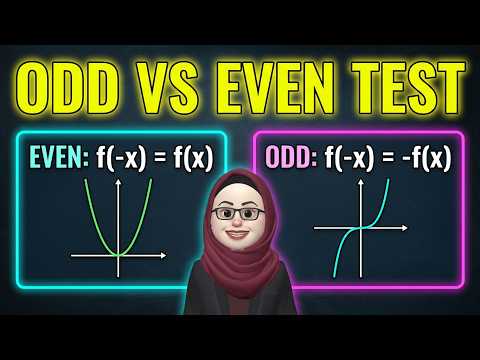
- To test parity, compute f(−x): equality with f(x) means even, equality with −f(x) means odd, and neither match means neither.
- Sums of odd functions remain odd and sums of even functions remain even, but combining odd and even terms requires direct substitution.
- For graph-based domains and ranges, open circles exclude endpoints, closed circles include them, and disconnected intervals must be written as a union.
- An input belongs to a graph’s domain whenever it has at least one y-value, even if another part of the graph has a hole at that same x-coordinate.
- For an even root in a numerator, require the radicand to be nonnegative; if the root is in a denominator, require it to be positive.
- A rational denominator cannot equal zero; when a formula has multiple restrictions, intersect the allowed input sets, as in √(x + 1)/(x − 1), whose domain is [−1, 1) ∪ (1, ∞).
Chapters
0:00
Correcting the Negative-Sign Rule for Rational Functions
- A negative rational expression can be written with the negative on the numerator or on the denominator, but not both.
- For f(x) = x³/(x² + 1), substituting −x gives −x³/(x² + 1); the denominator remains positive.
- Shahera Jannah corrects the earlier sign error before restarting the odd/even analysis.
4:54
Test Parity by Substituting −x into the Function
- The first step for testing parity is to calculate f(−x) by replacing every x with −x.
- An even function satisfies f(−x) = f(x); an odd function satisfies f(−x) = −f(x).
- For x³/(x² + 1), the substitution produces −x³/(x² + 1), which is the negative of the original function, so it is odd.
9:00
Recognize When Sums of Odd Functions Stay Odd
- Adding odd functions without horizontal shifts preserves odd symmetry; examples include sums of odd powers such as x³ and x⁵.
- Adding a constant to an odd function generally destroys origin symmetry; the example 2x³ + 3 is not odd.
- A horizontal shift such as (x − 3)³ also changes the symmetry, so the simple sum rule does not apply.
12:00
Apply the Addition Rules for Even Functions
- The sum of even functions remains even; x² + x⁴ is symmetric about the y-axis.
- Adding or subtracting a constant from an even function preserves y-axis symmetry, as in x² − 3.
- Coefficients can stretch or compress the graphs without changing their parity.
16:30
Check Mixed Odd-and-Even Combinations Directly
- A sum containing both odd and even terms cannot be classified by the same-function addition shortcuts.
- For a mixed expression, substitute −x and compare the result first with f(x), then with −f(x).
- The rational example x³/(x² + 1) shows that combinations of odd and even parts can still produce an odd function.
20:00
Practice Five Odd, Even, or Neither Classifications
- The practice set includes x⁷ + x⁵ − 1, x⁷ + x⁵, x¹⁰⁰ − 3, and x¹⁰⁰ − x²⁰⁰.
- The fifth exercise is the rational function x²/(x³ − 1), which requires substitution rather than a sum shortcut.
- Shahera asks students to give a reason with each classification, not just the label.
26:10
Classify the Practice Polynomials and Rational Function
- x⁷ + x⁵ − 1 is neither: the odd terms sum to an odd function, but subtracting 1 breaks odd symmetry.
- x⁷ + x⁵ is odd; x¹⁰⁰ − 3 and x¹⁰⁰ − x²⁰⁰ are even.
- For x²/(x³ − 1), substituting −x does not yield either the original function or its negative, so it is neither.
33:00
Use Substitution to Resolve a Mixed-Parity Polynomial
- For x⁵ + x², substituting −x gives −x⁵ + x², which is neither the original expression nor its negative.
- Changing the expression to x⁵ − x² still gives neither result after substitution, so it is also neither.
- The example reinforces that mixed odd-and-even combinations must be tested rather than guessed.
41:00
Connect Odd and Even Functions to Graph Symmetry
- Odd functions are symmetric about the origin, while even functions are symmetric about the y-axis.
- A graph shifted vertically generally loses origin symmetry, whereas vertical shifts preserve the y-axis symmetry of even functions.
- A function that is neither odd nor even lacks both of those symmetry patterns.
50:00
Define Domain, Range, and Interval Endpoints
- The domain contains allowable x-values; the range contains the y-values produced by those inputs.
- For graph intervals, read domain from left to right and range from the lowest y-value to the highest.
- Use brackets for included endpoints and parentheses for excluded endpoints or infinity; use curly braces when a set contains just one value.
56:00
Read Domain and Range from Continuous Graphs
- A graph extending indefinitely in both horizontal directions has domain (−∞, ∞).
- In the example with a lowest y-value of 3 shown as a closed point, the range begins at 3 with a bracket and extends upward without bound.
- A horizontal graph at y = 3 has range {3}, since it produces only one y-value.
59:00
Handle Single-Point Graphs and Missing Inputs
- A graph consisting of a single point at x = 8 has domain {8}.
- A graph with a vertical asymptote at x = 0 excludes that x-value, so its domain splits into (−∞, 0) ∪ (0, ∞).
- For a range endpoint shown by an open circle, use a parenthesis because that y-value is not attained.
1:03:00
Write Intervals for Graphs with Holes and Disconnected Pieces
- A graph with horizontal pieces from −2 to 1 and from 1 to 3 excludes x = −2 and x = 1 where there are holes, but includes x = 3 if its endpoint is closed.
- Its domain is (−2, 1) ∪ (1, 3], with each interval endpoint determined by the corresponding open or closed circle.
- For the associated range, compare the lowest and highest y-values and check whether each endpoint is actually included.
1:07:30
Treat Isolated Filled Points as Valid Domain Inputs
- An x-value remains in the domain if the graph gives it at least one y-value, even when another nearby piece has a hole there.
- In the modified graph, filled points at x = 1 and x = 5 mean those inputs are defined; the domain can remain continuous from −2 to 5.
- A gap in a drawn curve does not automatically create a domain break if a filled point supplies a function value at that x.
1:13:00
Find Disconnected Ranges by Tracking Attained Y-Values
- The graph’s y-values cover the interval from −4 up to, but not including, 3, then resume from 5 through, but not including, 7.
- The resulting range is [−4, 3) ∪ [5, 7), reflecting the missing y-values between 3 and 5.
- To avoid overlooking gaps, inspect the full graph for each y-value rather than judging only one branch.
1:19:00
Start Algebraic Domain Checks with Even Roots
- For an even root in a numerator, require the radicand to be greater than or equal to zero.
- For √(x + 1), solving x + 1 ≥ 0 gives the domain [−1, ∞); the endpoint is included because √0 is defined.
- The lesson shifts to finding domains from equations, since graphically determining a formula’s range is more difficult.
1:21:00
Distinguish Root Restrictions from Denominator Restrictions
- For 1/√(x + 1), the radicand must be positive rather than merely nonnegative because the square root is in the denominator.
- This changes the boundary from a bracket to a parenthesis, giving (−1, ∞).
- For a rational denominator such as x + 1, exclude the value x = −1 that makes the denominator zero, leaving (−∞, −1) ∪ (−1, ∞).
1:25:50
Combine Root and Denominator Restrictions by Intersection
- For √(x + 1)/(x − 1), the numerator requires x ≥ −1 while the denominator requires x ≠ 1.
- The valid inputs satisfy both conditions, so the domain is [−1, 1) ∪ (1, ∞).
- The endpoint −1 is included because the numerator may equal zero; x = 1 is excluded because the denominator would be zero.
1:31:50
Review Boundary Rules and Homework Timing
- The final review contrasts bracketed endpoints from an allowed square-root numerator with excluded points from denominator restrictions.
- Students clarify that Section 1.3 homework is due that night and Sections 1.4 and 1.5 are assigned for the following Tuesday.
- The class confirms there is no Friday meeting that week.
Summary, takeaways, and chapters were generated by AI from the video's transcript and may contain errors. The video belongs to its creator, Shahera Jannah's Math World! 😁😎.