Lec12 Sec2.1 M2001 Graphing Polynomial with x-intercepts, Multiplicity and End Behavior
 Watch on YouTube →
Overview
Shahera Jannah explains how polynomial factor multiplicities determine whether a graph crosses or touches an x-intercept, and how higher odd and even multiplicities change the graph’s shape near each root. She applies these rules to a degree-10 polynomial with roots 0, -1, -2, and 3, sketches its positive-leading-coefficient end behavior, and closes with a multiple-choice discussion of a separate cubic graph.
Key takeaways
- A polynomial factor’s exponent gives the multiplicity of its corresponding root: for example, (x + 2)³ gives root -2 with multiplicity 3.
- Odd multiplicity means the graph crosses the x-axis, while even multiplicity means it touches the axis and reverses direction.
- As multiplicity increases, the graph appears flatter near the root: multiplicity 3 crosses with flattening, while multiplicity 4 makes a flattened touch.
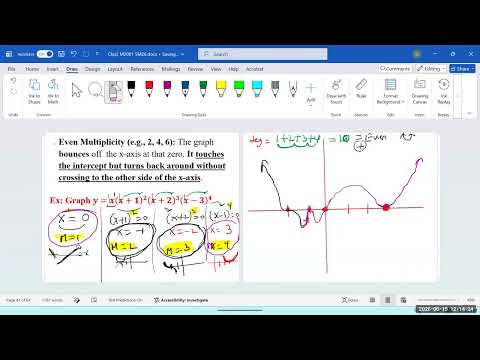
- For x(x + 1)²(x + 2)³(x - 3)⁴, the roots are 0, -1, -2, and 3, and the multiplicities sum to degree 10.
- An even-degree polynomial with positive leading coefficient rises at both ends; this end behavior combines with root multiplicities to guide a sketch.
- A graph with two turning points must have degree at least 3; the number of turning points does not by itself establish a maximum degree.
Chapters
0:00
Multiplicity Predicts How a Polynomial Meets Each Root
- The exponent on each factored term is its multiplicity: for example, x has multiplicity 1 and (x + 1)² has multiplicity 2.
- Odd multiplicities cross the x-axis; multiplicity 1 crosses directly, while multiplicity 3 crosses with a flattened, cubic-like shape.
- Even multiplicities touch the x-axis and turn back; multiplicity 4 produces a flatter touch than multiplicity 2.
- For the example factors, the roots are 0, -1, -2, and 3, with multiplicities 1, 2, 3, and 4 respectively.
5:00
Sketching the Degree-10 Polynomial from Roots and End Behavior
- Adding the exponents 1 + 2 + 3 + 4 gives a total degree of 10, an even degree.
- With a positive leading coefficient and even degree, both ends of the graph point upward.
- The sketch crosses at x = -2 with flattening, touches and turns at x = -1, crosses directly at x = 0, and touches with greater flattening at x = 3.
- Comparing the sketch with the graph of x(x + 1)²(x + 2)³(x - 3)⁴ confirms the predicted intercept behavior; multiplicity does not determine how high or low turning points lie.
11:00
Using Turning Points and End Behavior to Assess a Cubic
- The final multiple-choice discussion considers a separate graph described as having two turning points and left-down, right-up end behavior.
- Left-down and right-up behavior indicates an odd degree with a positive leading coefficient, consistent with a positive cubic.
- The discussion selects options 1 and 2, including a degree-at-most-three claim; two turning points alone establish a degree of at least three, not at most three.
Summary, takeaways, and chapters were generated by AI from the video's transcript and may contain errors. The video belongs to its creator, Shahera Jannah's Math World! 😁😎.