Lec10 Sec2.1 M2001 Quadratic Equation, Vertex, Solving XY Intercepts
 Watch on YouTube →
Overview
Shahera Jannah introduces quadratic functions as parabolas and develops their vertex, axis of symmetry, domain, range, transformations, and maximum or minimum values. She demonstrates how to find intercepts using factoring, multiplicity, completing the square, radical equations, and rational-function simplification, then works through examples including y = -x² + 6x - 8 and reconstructing a quadratic from a vertex and another point.
Key takeaways
- For ax² + bx + c, the vertex lies at x = −b/(2a); substituting that x-value yields the vertex’s y-coordinate and the parabola’s extremum.
- A parabola’s domain is all real numbers, while its range depends on its vertex and opening direction: [k, ∞) if it opens up, or (−∞, k] if it opens down.
- Root multiplicity predicts graph behavior: odd multiplicities cross the x-axis, even multiplicities touch and turn, and higher multiplicities flatten the curve near the root.
- For rational functions, simplify before identifying features: zeros of the simplified numerator give x-intercepts, while zeros of the simplified denominator identify vertical asymptotes.
- A real x-intercept must have a real x-value, so a factor such as x² + 1 = 0 contributes no x-intercept on the real plane.
- Vertex form makes the vertex visible immediately, but finding intercepts may require additional algebra; for y = ½(x + 2)² − 1, the x-intercepts are −2 ± √2 and the y-intercept is 1.
Chapters
0:00
Lecture 10 Opens the Quadratic Functions Unit
- Shahera Jannah says the class is beginning Chapter 2 on polynomials and rational functions, starting with quadratic functions.
- She explains that course notes are posted and that material appearing in homework but not class may need independent study.
2:46
Quadratic Functions and Their Two Main Forms
- A quadratic function has degree 2 and graphs as a parabola.
- The general form is f(x) = ax² + bx + c; the vertex form is a(x − h)² + k.
- In vertex form, the vertex can be read directly as (h, k), while the general form requires calculation.
4:14
Parabola Direction, Vertices, and Symmetry
- When a > 0, the parabola opens upward and its vertex is the minimum; when a < 0, it opens downward and its vertex is the maximum.
- A parabola is symmetric about a vertical axis through its vertex.
- The x-intercepts, y-intercept, vertex, and axis of symmetry are identified as key graph features.
7:25
Vertex Coordinates and the Axis Formula x = −b/(2a)
- For f(x) = ax² + bx + c, the vertex’s x-coordinate is h = −b/(2a).
- Find the y-coordinate by substituting h into the function: k = f(−b/(2a)).
- The axis of symmetry is the vertical line x = −b/(2a); the vertex’s y-coordinate gives the maximum or minimum value.
11:24
Quadratic Domains and Ranges from the Vertex
- The domain of a full parabola is all real numbers, written (−∞, ∞).
- An upward-opening parabola with vertex y-coordinate k has range [k, ∞); a downward-opening parabola has range (−∞, k].
- The range endpoint is included because the vertex lies on the graph.
16:07
Reflections and Shifts in Vertex Form
- A negative coefficient outside the squared expression reflects the parabola across the x-axis.
- Adding a constant outside the square shifts the graph vertically: +k moves it up and −k moves it down.
- A horizontal shift inside the parentheses acts in the opposite direction from its sign: x − h shifts right by h.
18:06
How the Coefficient a Changes Parabola Width
- A coefficient with magnitude greater than 1 makes the parabola narrower than y = x².
- A fractional coefficient between 0 and 1 makes the parabola wider.
- Shahera Jannah notes that scaling appears in the homework, though she is unsure whether it will be tested.
20:23
Sketching Transformed Parabolas from Their Vertices
- For y = −(x − 4)² + 2, the negative sign reflects the graph downward and the vertex is (4, 2).
- For y = −(x + 4)² − 2, the vertex is (−4, −2), with a downward opening.
- Sketches should show the shift directions and vertex; an accurate graph requires more precision than a diagram.
24:20
Roots, Zeros, and x-Intercepts Mean the Same Solution
- Finding roots, zeros, solutions, or x-intercepts means solving for x after setting y = 0.
- Factorable quadratics can be solved using a greatest common factor, direct factoring, the AC method, or trial and error.
- If factoring is unavailable, completing the square or the quadratic formula can find the roots.
26:06
Completing the Square and the Quadratic Formula
- For x² + bx + c, completing the square uses (x + b/2)² and compensates by subtracting (b/2)².
- After isolating the squared expression, take square roots to solve for x.
- The quadratic formula is x = (−b ± √(b² − 4ac))/(2a), giving the two possible roots.
34:00
Set y to Zero and Factor to Find Intercepts
- For an x-intercept, set the function equal to zero and solve each factor.
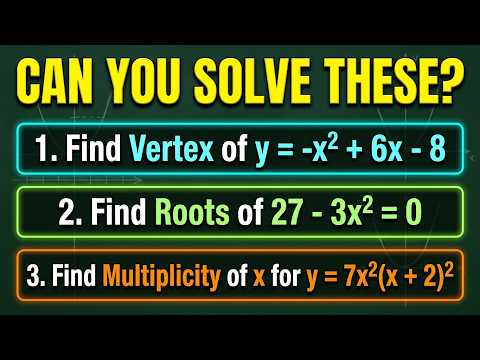
- In 7x²(x + 2)² = 0, the roots are x = 0 and x = −2; each has multiplicity 2.
- The factor’s exponent records a root’s multiplicity, which predicts how the graph meets the x-axis.
37:16
Root Multiplicity Predicts Whether the Graph Crosses
- A root with odd multiplicity crosses the x-axis; a root with even multiplicity touches the axis and turns back.
- Higher multiplicity makes the curve flatten more near the root; multiplicity 3 crosses with more flattening than multiplicity 1.
- Shahera Jannah uses roots at −4, 0, 2, and 5 to sketch crossings and touches from their multiplicities.
44:06
Factoring Examples: Roots and Multiplicity in Practice
- For x² − 5x + 4, direct factoring gives (x − 1)(x − 4), so the x-intercepts are 1 and 4.
- The vertex’s x-coordinate is 5/2, or 2.5, halfway between the roots.
- For x⁴ − x³ − 20x², factoring out x² reveals a root at 0 with multiplicity 2 and additional roots from the remaining quadratic.
53:05
Nonreal Roots Do Not Create Real x-Intercepts
- The worked factoring reaches a factor x² + 1 = 0, which has no real solutions.
- Although x² + 1 = 0 has complex solutions, an x-intercept on the real coordinate plane must have a real x-value.
- A factor with no real roots contributes no real x-intercept.
56:33
Rational and Radical Functions: Finding x-Intercepts
- For a rational function, factor and simplify first; zeros of the simplified numerator give x-intercepts, while denominator zeros indicate vertical asymptotes.
- For (27 − 3x²)/(4x² − 20x), the numerator factors as 3(3 + x)(3 − x), giving intercepts x = −3 and x = 3; the denominator gives x = 0 and x = 5.
- For the radical example, set y = 0, isolate x by reversing operations, and retain both solutions when taking a square root, such as x = ±√10.
1:08:36
Complete Quadratic Analysis of y = −x² + 6x − 8
- Using a = −1 and b = 6 gives vertex x-coordinate 3; substituting yields vertex (3, 1).
- The axis of symmetry is x = 3, and the downward-opening parabola has maximum value 1.
- Factoring −x² + 6x − 8 = 0 gives x-intercepts 2 and 4; setting x = 0 gives y-intercept −8.
1:17:26
Vertex-Form Example: Range and Intercepts
- For y = ½(x + 2)² − 1, the vertex is (−2, −1), the axis is x = −2, and the upward-opening graph has minimum value −1.
- Its domain is (−∞, ∞) and range is [−1, ∞).
- Setting y = 0 gives x = −2 ± √2; setting x = 0 gives y = 1.
1:26:24
Build a Quadratic from a Vertex and a Point
- Given vertex (−4, 11), start with y = a(x + 4)² + 11.
- Substitute the point (−6, 15): 15 = a(−6 + 4)² + 11, which gives a = 1.
- The resulting function is y = (x + 4)² + 11; the lesson ends with a reminder to continue Assignment 2.1 and check homework deadlines.
Summary, takeaways, and chapters were generated by AI from the video's transcript and may contain errors. The video belongs to its creator, Shahera Jannah's Math World! 😁😎.