LDL and cholesterol, BIO105 Introductory Biology, David Champlin, USM
 Watch on YouTube →
Overview
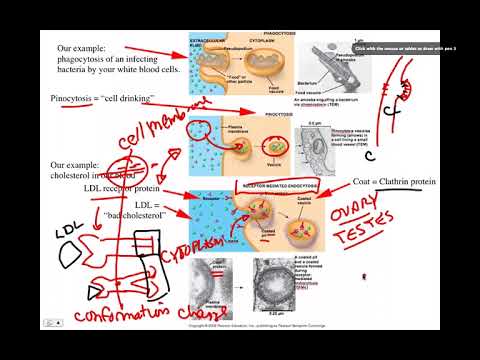
David Champlin explains receptor-mediated endocytosis through the delivery of cholesterol to cells in low-density lipoprotein (LDL) particles. He traces LDL binding to cell-surface receptors, clathrin-coated vesicle formation, lysosomal processing, and receptor recycling, then connects disruptions in this pathway to inherited high blood cholesterol.
Key takeaways
- LDL’s phospholipid surface makes a particle carrying hydrophobic cholesterol compatible with transport through watery blood.
- The LDL receptor makes cholesterol uptake selective: it binds LDL outside the cell and uses a conformational change to promote receptor clustering inside the membrane.
- Clathrin helps shape the membrane into a coated pit and vesicle, which then loses its coat after entering the cell.
- After LDL is sent to a lysosome for breakdown, its receptor is recycled to the plasma membrane rather than discarded with the LDL.
- Inherited problems in several proteins along the LDL uptake pathway—not only the LDL receptor—can reduce cellular cholesterol uptake and contribute to elevated blood cholesterol.
Chapters
0:00
Why Hydrophobic Cholesterol Travels in LDL Particles
- Cholesterol is largely hydrophobic, so it does not dissolve readily in the watery environment of blood.
- The liver synthesizes and packages cholesterol into LDL particles, whose phospholipid outer surface faces water and whose hydrophobic core carries cholesterol.
- An LDL-associated protein provides a binding handle for cell-surface LDL receptors; cells use cholesterol in membranes and as a precursor for steroid hormones such as estrogen and testosterone.
5:43
LDL Receptors Recruit Clathrin-Coated Vesicles
- Receptor-mediated endocytosis selectively brings LDL into cells, unlike pinocytosis, which takes up extracellular material more randomly.
- LDL binding changes the receptor’s conformation and exposes cytoplasmic binding sites that help receptors cluster in the membrane.
- Clathrin assembles at the clustered receptors to form a coated pit; its multi-protein structure helps bend the membrane into a budding vesicle.
- Energy is required for vesicle formation and pinching off; after the clathrin coat is removed, the vesicle carries LDL bound to its receptor.
13:42
Lysosomal Cholesterol Delivery and LDL-Receptor Recycling
- Inside the cell, LDL separates from its receptor and is delivered to a lysosome for breakdown.
- Cholesterol can then be sent to the smooth endoplasmic reticulum for metabolism, including use in producing modified molecules such as steroid hormones.
- The LDL receptor returns to the cell surface by vesicle transport and exocytosis, ready to bind more LDL.
- Inherited defects in the LDL receptor, clathrin, or other vesicle-formation and uncoating proteins can impair cholesterol uptake and contribute to high blood cholesterol.
Summary, takeaways, and chapters were generated by AI from the video's transcript and may contain errors. The video belongs to its creator, The New Evolution for Everyone.