L15 Metabolism II
 Watch on YouTube →
Overview
Dr. Chris Black explains how immediate phosphagen pathways and glycolysis supply ATP during exercise, focusing on each pathway’s substrates, enzymes, energy yield, and limits. He connects phosphocreatine recovery to aerobic metabolism and weight-training rest periods, then introduces glycolysis, including why blood glucose yields a net 2 ATP while muscle glycogen yields 3.
Key takeaways
- Creatine kinase transfers phosphate from phosphocreatine to ADP in one step, making PCr a rapid ATP source that supports roughly 10–20 seconds of very high-intensity exercise.
- PCr recovery depends on oxidative ATP production: its typical 30–90-second half-life helps explain why two minutes of rest restores much, but not all, phosphocreatine.
- Faster phosphocreatine resynthesis is associated with stronger aerobic capacity, helping trained athletes repeat high-intensity efforts with less recovery time.
- Creatine supplementation may improve training volume by enabling an extra repetition or set; it is not itself a direct trigger of muscle protein synthesis.
- Glycolysis yields net 2 ATP from blood glucose and 3 ATP from muscle glycogen because glycogen-derived substrate bypasses an ATP-consuming phosphorylation step.
Chapters
0:00
Metabolism II: Comparing Exercise Energy Pathways
- For a five-minute bout, immediate phosphagen systems contribute first, glycolysis rises next, and oxygen-dependent metabolism becomes increasingly prominent.
- Dr. Chris Black frames pathway comparisons around three questions: what substrate enters, which enzyme drives the reaction, and how much ATP is produced.
3:09
Phosphocreatine and Creatine Kinase Replenish ATP
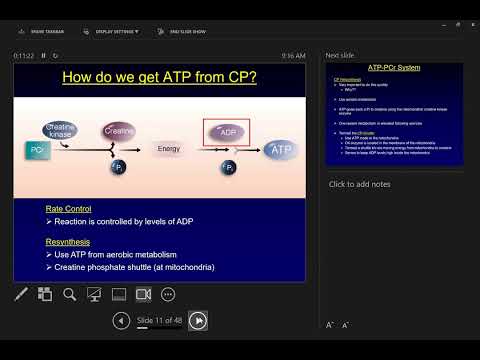
- Phosphocreatine (PCr) donates a phosphate to ADP through creatine kinase, rapidly reforming ATP during muscle contraction.
- The reaction is fast because it requires a single transfer step, but PCr stores support only about 10–20 seconds of very high-intensity exercise.
- About 98% of the body’s creatine is in skeletal muscle; dietary sources include meat and fish, and supplementation can increase muscle PCr by roughly 20% in responders.
10:30
ADP Concentration, Random Collisions, and Exercise Intensity
- As ATP is used by contraction and ion pumps, rising ADP increases the chance of interaction with PCr and creatine kinase, promoting ATP resynthesis.
- A classroom movement demonstration models how higher concentrations increase molecular collision likelihood.
- High force production drives higher energy use: walking, jogging, and sprinting place progressively greater demands on PCr stores.
20:00
Phosphocreatine Resynthesis Uses Aerobic ATP
- When force production falls, free creatine is recombined with phosphate to restore PCr; this recovery process is called resynthesis.
- ATP produced through oxidative metabolism supports PCr restoration, linking the phosphagen system to mitochondrial aerobic metabolism.
- A mitochondrial creatine kinase variant participates in the creatine phosphate shuttle, moving energy from mitochondrial ATP onto creatine.
24:00
PCr Recovery Rates Explain Rest Between Sets
- Magnetic resonance spectroscopy can track muscle PCr during exercise and recovery, including during repeated plantar flexion in a scanner.
- PCr resynthesis has a typical half-life of about 30–90 seconds: after one half-life, roughly half is restored; after another, about 75% is restored.
- Around two minutes of rest can restore roughly 75–80% of PCr, while four to five minutes allows recovery to approach 100%.
- Better aerobic fitness is associated with faster PCr recovery, supporting repeated high-intensity efforts; the class discussion notes that PCr amount broadly relates to muscle size.
29:50
Myokinase Converts ADP into ATP and AMP
- The myokinase reaction, also called the adenylate kinase reaction, transfers a phosphate between two ADP molecules to produce ATP and AMP.
- This pathway can supply extra ATP during high-intensity exercise, although using it also produces AMP that must later be recycled.
- The lecture’s relative-capacity comparison assigns PCr about 8.4 units, stored ATP 1.8, and the myokinase reaction roughly half the stored-ATP contribution.
33:40
Creatine Supplementation Can Increase Training Work
- Creatine does not directly drive muscle protein synthesis; additional PCr may let a responder complete another repetition or set.
- The proposed benefit is greater training work and fatigue-related signaling, which may support muscle growth over time.
- Creatine can also increase muscle water and body weight; the lecture notes possible relevance for sprinters and 400–800-meter runners.
36:20
Glycolysis Breaks Down Glucose in the Cytoplasm
- Glycolysis is a multistep cytoplasmic pathway that breaks down glucose, captures electrons, and produces ATP; it is slower than the one-step PCr reaction.
- Glucose from blood yields a net 2 ATP, whereas glucose derived from muscle glycogen yields 3 ATP because it enters the pathway past an ATP-consuming step.
- Glycolysis contributes more ATP per glucose than the immediate phosphagen reactions but less rapidly than PCr can supply ATP.
41:13
Glucose Phosphorylation Starts the Embden–Meyerhof Pathway
- Blood glucose is phosphorylated by hexokinase using ATP to form glucose 6-phosphate, which traps it inside the muscle cell.
- Muscle glycogen-derived glucose enters as a phosphorylated intermediate, bypassing that initial ATP cost and increasing net yield.
- The Embden–Meyerhof pathway proceeds through fructose 6-phosphate and fructose 1,6-bisphosphate before continuing toward pyruvate.
- Lactate is not always the final product of glycolysis; when produced, lactate-associated hydrogen ions can contribute to feedback inhibition of the pathway.
Summary, takeaways, and chapters were generated by AI from the video's transcript and may contain errors. The video belongs to its creator, Exercise Physiology with Dr. Chris Black.