L15 Entanglement IBM Quantum Circuit, Entanglement Swapping, Midterm Review
 Watch on YouTube →
Overview
Hiu-Yung Wong completes quantum teleportation by explaining IBM Quantum/Qiskit execution, Bell-basis measurements implemented with Hadamard gates, and classical feed-forward corrections, then shows how teleporting one member of an entangled pair swaps entanglement to a distant qubit. The midterm review revisits state vectors, inner products, normalization, Pauli operators, adjoints, eigenvalue diagonalization, basis changes, tensor products, quantum gates, and trace, ending with a two-qubit circuit worked in both ket and matrix notation.
Key takeaways
- Quantum teleportation combines shared entanglement, two classical measurement results, and conditional X and Z corrections to transfer a qubit state; it does not copy the original state.
- Applying a Hadamard before a computational-basis measurement is equivalent to measuring in the |+⟩, |−⟩ basis, allowing standard hardware measurements to implement a different measurement basis.
- Entanglement swapping uses teleportation to make Bob and Carlos entangled even though Alice and Carlos held the original entangled pair.
- For an ideal teleportation circuit with input |0⟩, Bob’s output qubit must be |0⟩; deviations on IBM Quantum hardware can reflect noise and execution conditions.
- Midterm calculations rely on consistent complex conjugation, normalization, basis ordering, and left-to-right circuit sequencing; the review’s worked example applies these in both ket and matrix form.
Chapters
0:00
IBM Quantum Assignment: Run the Teleportation Circuit on Real Hardware
- Hiu-Yung Wong asks students to submit the circuit, measurement histogram, and any required calculation from the teleportation assignment.
- Running on a real IBM Quantum device exposes hardware noise, queue times, circuit layouts, and transpilation into native gates.
- A simulator may produce cleaner results, but the assignment is intended to give students experience with real-device execution.
2:21
Preparing the Teleportation Resource and Conditional X Correction
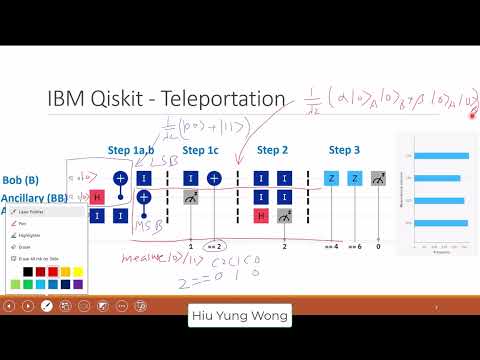
- The circuit initializes its qubits to |0⟩; the unknown input state is modeled as |0⟩ for this example.
- Bob’s qubit pair is entangled into a Bell state, with one qubit sent to Alice so they share an entangled resource.
- After Alice measures in the computational basis, classical feed-forward conditionally applies an X gate to Bob’s qubit.
- Because the measurement is stored in one bit of a three-bit classical register, the circuit checks the corresponding register values rather than an isolated bit.
11:15
Hadamard Gates Turn Computational Measurements into Bell-Basis Measurements
- Applying H before a computational-basis measurement implements a measurement in the |+⟩, |−⟩ basis.
- Wong expands a general two-qubit state in both bases to show how measurement outcomes correspond between them.
- The outcome mapping is |+⟩ ↔ 0 and |−⟩ ↔ 1 when the Hadamard-plus-computational-measurement circuit is used.
- Expanding and regrouping amplitudes provides a direct check of how the measured outcome changes the remaining qubit’s state.
23:05
Classical Feed-Forward Applies the Teleportation Z Correction
- A measurement outcome of 1 after the Hadamard requires a Z correction on Bob’s qubit; the other measurement result requires no Z gate.
- The circuit checks classical-register values 4 and 6 because either can encode the relevant measured bit as 1, while another measured bit varies.
- For the example input |0⟩, Bob should recover |0⟩ in an ideal noiseless run, even though intermediate measurement bits vary.
- Teleporting a known basis state does not violate no-cloning: the no-cloning theorem forbids copying an arbitrary unknown state while retaining the original.
31:28
Entanglement Swapping Transfers Correlations from Alice–Carlos to Bob–Carlos
- The setup begins with Carlos entangled with Alice while Alice also shares a teleportation resource with Bob.
- Teleporting Alice’s qubit state to Bob leaves Bob and Carlos entangled, enabling entanglement between distant parties.
- In the illustrated example, measuring Carlos and Bob yields correlated outcomes such as 00 or 11; other entangled states can instead produce anticorrelation.
- The shared outcomes are correlations, not copies of an arbitrary unknown state, so the process does not violate no-cloning.
38:03
Midterm Review: State Vectors, Superposition, and Measurement Probabilities
- A quantum state is represented by a vector whose coefficients multiply basis states; indexing from 0 through n gives n + 1 entries.
- Measurement probabilities are the squared magnitudes of amplitudes, including complex amplitudes such as 3 + 2i.
- For bra-ket inner products, taking a ket to a bra requires complex conjugation of its coefficients.
- An orthonormal basis has unit self-inner-products and zero inner-products between distinct basis vectors.
41:33
Normalization, Basis Changes, and Complex Inner-Product Rules
- Normalize a state by dividing its vector by its length, just as a three-dimensional vector is divided by √(a² + b² + c²).
- Changing basis is performed by substituting one basis representation for another and tracking the resulting coefficients.
- The inner-product identity ⟨A|B⟩ = ⟨B|A⟩* requires complex conjugation; the values are equal without it when the relevant inner products are real.
- Wong recommends checking normalization and conjugation explicitly to avoid common calculation errors under exam time pressure.
43:33
Pauli Matrices, Anticommutation, and the Adjoint Operation
- The Pauli matrices σx, σy, and σz are key qubit operators, and their anticommutator obeys {σi, σj} = 2δijI.
- The Kronecker delta δij equals 1 when i = j and 0 otherwise, compactly expressing the Pauli anticommutation rule.
- A matrix adjoint takes the complex conjugate and transpose, matching the conjugation-and-transposition rules for bras and kets.
- A Hermitian matrix satisfies A† = A and has real eigenvalues; a unitary matrix preserves inner products.
49:18
Eigenvalues, Diagonalization, and Coordinate Transformations
- An eigenvector retains its direction under a matrix operation, while its eigenvalue gives the multiplying scalar; eigenvalues can be found from det(A − λI) = 0.
- The review expects eigenvalue or diagonalization problems no larger than 2 × 2.
- For a basis-change matrix U, vector coordinates transform as v′ = Uv, while operator matrices transform by a basis-change sandwich using U and U†.
- Representing a matrix in its eigenbasis diagonalizes it because the eigenvectors become the coordinate basis.
53:42
Projection Operators and Tensor Products for Multiple Qubits
- An outer product |v⟩⟨v| combines a column ket and row bra to form an operator that projects onto a state.
- Projection operators connect state amplitudes to the probabilities of obtaining measurement outcomes.
- For multiple qubits, tensor products build larger state spaces and operators by replacing each matrix entry with a scaled copy of the other matrix.
- Careful basis ordering is essential when arranging tensor-product results for a multi-qubit system.
55:52
Quantum Gates: X, CNOT, SWAP, and XOR as Modulo-Two Addition
- The X gate exchanges computational basis states: |0⟩ becomes |1⟩ and |1⟩ becomes |0⟩.
- A CNOT applies X to its target only when its control qubit is 1; its classical action is target ⊕ control.
- XOR can be understood as addition modulo 2, or as testing whether the number of 1s is odd—an interpretation useful for algorithms.
- Wong also reviews the SWAP gate and emphasizes identifying the control and target wires before applying a gate.
59:10
Trace Cyclicity Explains Why Trace Equals the Sum of Eigenvalues
- The trace of a matrix is the sum of its diagonal entries, and trace is unchanged under cyclic rearrangement: tr(AB) = tr(BA).
- Ordinary matrices generally do not commute; cyclic rearrangement is valid here because the expression is inside a trace.
- A matrix transformed into its diagonal eigenbasis has eigenvalues on its diagonal, so its trace equals their sum.
- The derivation uses a unitary basis transformation and the identity U†U = I.
1:03:30
Phase Gates, Toffoli Controls, and Hadamard Transformations
- The one-qubit phase-shift gate becomes the Z gate when its phase angle is π.
- A Toffoli gate flips its target only when both control bits are 1, matching the Boolean condition a · b = 1.
- A control marked with an open circle activates when that control is 0, rather than 1.
- The Hadamard gate is its own inverse, creates superpositions, and connects binary-vector inner products to parity through modulo-two arithmetic.
1:07:10
ChatGPT Practice: Evaluate a Two-Qubit Circuit Step by Step
- Wong prompts ChatGPT to generate an introductory two-qubit circuit for students to evaluate, then stresses solving it independently rather than relying on a supplied answer.
- The example starts from |00⟩, applies H to the most-significant qubit, then applies CNOT and a final X operation.
- Applying H and CNOT produces an entangled superposition; applying X to the appropriate qubit changes it to a different entangled state.
- The exercise reinforces reading circuit order and applying each gate to the correct qubit.
1:12:13
Matrix-Form Circuit Calculation and Midterm Preparation
- The input |00⟩ is represented by the column vector (1, 0, 0, 0)ᵀ, with gates multiplying the state vector from the left.
- The first operation is H ⊗ I; the CNOT matrix is then applied using the course’s qubit-ordering convention.
- Students should verify that the final state is normalized and that its nonzero amplitudes match the ket-notation calculation.
- Wong expects a deeper circuit question on the midterm, but says it will not require an impractical three- or four-qubit calculation.
Summary, takeaways, and chapters were generated by AI from the video's transcript and may contain errors. The video belongs to its creator, Quantum Computing, TCAD, Semicond by Hiu-Yung Wong.