L14 Quantum Teleportation
 Watch on YouTube →
Overview
Hiu-Yung Wong teaches quantum teleportation through a simplified two-qubit model, then introduces a distributed three-qubit setup using a Bell pair, CNOT gates, measurement, and classical feed-forward. The lecture also explains how Qiskit stores measurement outcomes in classical bits and applies conditional gates; the full teleportation circuit is deferred to the next class, and the detailed three-qubit derivation focuses on creating Alice–Bob entanglement rather than completing the standard two-bit teleportation protocol.
Key takeaways
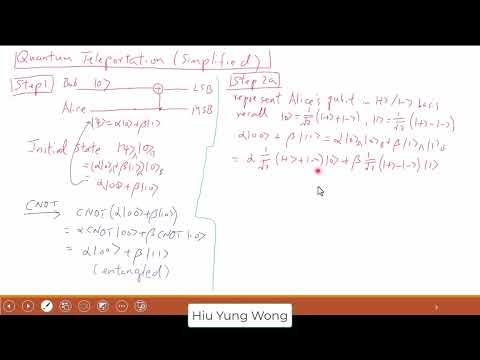
- The simplified two-qubit derivation maps Alice’s plus outcome to Bob’s α|0⟩ + β|1⟩ and her minus outcome to α|0⟩ − β|1⟩, which Bob corrects with Z.
- Quantum teleportation does not clone an unknown state: Alice’s measurement changes her qubit, while Bob reconstructs the state using entanglement and communicated measurement results.
- A practical distributed setup prepares a Bell pair locally with H on BB and CNOT from BB to B, then sends BB to Alice rather than attempting a direct long-distance CNOT.
- Classical feed-forward is essential: Bob cannot know which correction to apply until Alice sends her result, so teleportation cannot transmit usable information faster than light.
- In Qiskit, quantum and classical register indices are independent; a measurement can write Q2 into C3, and conditional gates evaluate the stored classical register value.
- The lecture’s detailed three-qubit calculation measures BB and derives Alice–Bob entanglement, but defers the complete standard two-bit teleportation circuit and its full state-by-state derivation.
Chapters
0:00
Quantum Teleportation and the No-Cloning Constraint
- Wong frames teleportation as transferring an unknown qubit state, S = α|0⟩ + β|1⟩, from Alice to Bob.
- Bob’s qubit begins in |0⟩; Alice does not know α or β, so copying the state directly is not an option.
- The protocol must destroy or alter Alice’s original state, consistent with the no-cloning theorem.
3:00
Two-Qubit State Ordering and the First CNOT
- The initial joint state is (α|0⟩ + β|1⟩) ⊗ |0⟩, which expands to α|00⟩ + β|10⟩.
- Applying CNOT with Alice as control and Bob as target gives α|00⟩ + β|11⟩.
- The resulting qubits are entangled; the derivation emphasizes tracking which qubit is control, target, and which tensor factor comes first.
6:30
Creating the Entangled State for the Simplified Model
- CNOT leaves |00⟩ unchanged and maps |10⟩ to |11⟩, producing α|00⟩ + β|11⟩.
- Wong uses this correlation to introduce the teleportation steps, while noting that directly operating on qubits in separate labs is not practical.
- The discussion distinguishes an entangled joint state from a pair of independently describable qubit states.
9:30
Rewriting Alice’s Qubit in the Plus–Minus Basis
- The basis relations are |0⟩ = (|+⟩ + |−⟩)/√2 and |1⟩ = (|+⟩ − |−⟩)/√2.
- Rewriting Alice’s factor groups the joint state by her |+⟩ and |−⟩ outcomes, without applying a gate or changing the state.
- The expansion becomes (1/√2)[|+⟩(α|0⟩ + β|1⟩) + |−⟩(α|0⟩ − β|1⟩)]; careful qubit ordering prevents swapping Alice’s and Bob’s factors.
17:00
Alice’s Measurement and Bob’s Z Correction
- Alice measures in the plus–minus basis; the simplified derivation assigns each outcome a 50% probability.
- For |+⟩, Bob’s conditional state is proportional to α|0⟩ + β|1⟩, matching Alice’s original state after normalization.
- For |−⟩, Bob has α|0⟩ − β|1⟩; a Z gate, diag(1, −1), restores the original relative phase.
- Alice’s measured qubit collapses to |+⟩ or |−⟩, so the procedure transfers rather than copies the state.
22:00
Why the State Transfer Is Not Faster Than Light
- Alice must send Bob the measurement result over a classical channel before he knows whether to apply Z.
- The simplified example transfers a quantum state, not an electron or other matter, and the source state is altered by measurement.
- Wong’s matter-transfer analogy requires pre-existing corresponding particles at the destination and does not describe literal instant transport.
26:00
Limits of the Direct Remote-CNOT Model
- The first model assumes a CNOT can entangle Alice’s and Bob’s distant qubits, which is not a practical operation across separate labs.
- Wong describes physical quantum gates as interactions such as electromagnetic or laser pulses; coupling Earth- and Mars-based qubits directly would be impractical.
- This motivates preparing entanglement locally and physically sending one qubit to Alice.
31:00
Preparing a Bell Pair and Sending Its Ancilla
- Bob adds an auxiliary qubit, BB, and prepares entanglement between BB and his qubit B using a Hadamard followed by CNOT.
- Bob sends BB to Alice while retaining B, so the two entangled qubits can be brought into Alice’s lab.
- The setup now has three qubits: Alice’s unknown state, the received BB qubit, and Bob’s retained B qubit.
35:00
Tracking the Three-Qubit State Through Hadamard
- The initial three-qubit state is (α|0⟩ + β|1⟩)|00⟩, with Alice’s input and Bob’s two qubits represented separately.
- Applying H to BB changes |0⟩ into (|0⟩ + |1⟩)/√2; identity operations on the other qubits leave them unchanged.
- Wong expands the tensor products to show how the state evolves and stresses that unaffected qubits still occupy positions in the full register.
43:00
Bob’s CNOT and Alice’s CNOT on the Shared Pair
- Bob applies CNOT with BB as control and B as target, creating the Bell-pair component (|00⟩ + |11⟩)/√2.
- After BB reaches Alice, she applies CNOT with her unknown qubit as control and BB as target.
- The resulting four-term expansion makes the three qubit roles explicit and sets up measurement of BB.
51:00
Measuring BB and Applying a Conditional X Gate
- Alice measures BB in the computational basis, obtaining either 0 or 1.
- For outcome 1, the remaining Alice–Bob terms are anti-correlated; an X gate on Bob’s qubit flips B and converts them to correlated terms.
- For outcome 0, the derivation gives correlated Alice–Bob terms directly, so Bob needs no X correction.
- Alice must communicate the measurement outcome; the lecture’s derivation establishes entanglement here and does not show the complete standard two-bit teleportation derivation.
58:00
Classical Communication, Matter Transport, and Protocol Timing
- The distributed setup requires physically transporting BB to Alice before the local operations can proceed.
- Classical messages are also needed so Bob knows which correction to apply and whether Alice has completed her measurement.
- Neither the classical feed-forward nor the required matter transport is faster than light, so entanglement does not provide instant messaging.
1:01:00
Qiskit Measurement Results and Classical-Bit Indexing
- Qiskit measurements write outcomes into classical bits, which begin at zero and remain unchanged until a measurement writes to them.
- A circuit can have four classical bits, C3 through C0, and store a measurement from Q2 in C2 or C3; the destination need not match the qubit index.
- In the example, measuring Q2 = 1 into C2 yields 0100 when displayed as C3C2C1C0; a later measurement into C3 changes the register to 1100.
1:06:00
Conditional Gates, Register Values, and the Deferred Full Circuit
- A classically conditioned X gate acts on Q1 only when the stored register matches the specified value; 0100 represents decimal 4.
- If the condition instead checks for decimal 3, represented by 0011, the gate does not run when the register contains 0100.
- A conditional action based on one bit, such as C0 = 1, can require enumerating matching register values such as 1, 3, 5, and 7 in the demonstrated framework.
- Wong ends before walking through the complete teleportation circuit, leaving its detailed state evolution and further linear-algebra review for the next class.
Summary, takeaways, and chapters were generated by AI from the video's transcript and may contain errors. The video belongs to its creator, Quantum Computing, TCAD, Semicond by Hiu-Yung Wong.