L13 No Cloning Theorem, Quantum Circuit, and IBM Quantum
 Watch on YouTube →
Overview
The lecture reviews the Hadamard transform for n qubits, then proves the no-cloning theorem by showing that a linear unitary copier cannot consistently clone arbitrary superpositions. It applies the algebra to Bell-state preparation, IBM Quantum circuit simulations and measurement, and the construction of a SWAP gate from three CNOT gates.
Key takeaways
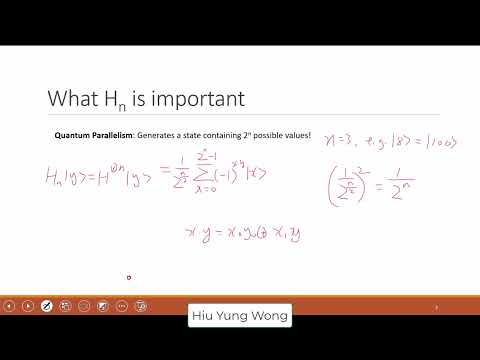
- The n-qubit Hadamard transform maps |y⟩ to an equal superposition with amplitudes (-1)^(x·y)/√(2^n), where the binary inner product sets each phase.
- No-cloning follows from linearity: copying (|a⟩+|b⟩)/√2 as a whole creates cross terms that do not appear when a linear operation copies |a⟩ and |b⟩ separately.
- The no-cloning theorem does not prevent copying known computational-basis values such as |0⟩ and |1⟩; it prevents a universal copier for arbitrary unknown states.
- A Hadamard followed by CNOT prepares Bell states; starting from |00⟩ yields (|00⟩+|11⟩)/√2, whose ideal measurements contain only 00 and 11.
- Quantum circuit diagrams run left to right, but their matrix products act right to left; consistent MSB/LSB conventions are essential for interpreting operators and measurement strings.
- A SWAP operation can be built from three CNOT gates with alternating controls: MSB, LSB, then MSB.
Chapters
0:00
Course Deadlines, Midterm Scope, and IBM Quantum Assignment
- Assignment 2 requires IBM Quantum use and is due October 11; late submissions receive zero.
- The midterm is scheduled for October 30 and covers material through the following week, including Homework 1 and Homework 2.
- The course recommends about 10 study hours per week and suggests using AI to generate practice questions, then checking their correctness.
1:49
The n-Qubit Hadamard Transform and Its Normalization
- Applying H to each of n qubits produces an equal-magnitude superposition of all 2^n computational basis states.
- The normalized coefficient is 1/√(2^n), since each basis state has probability 1/2^n and the probabilities sum to 1.
- The transform includes the phase factor (-1)^(x·y), where x·y is the bitwise inner product modulo 2.
7:30
Expanding H⊗H on the Two-Qubit State |3⟩
- The example represents decimal 3 as binary |11⟩ in a two-qubit system.
- Applying H to each qubit gives (|0⟩−|1⟩)/√2 on both wires, then distributes the tensor product across four basis terms.
- The resulting amplitudes have signs +, −, −, + for |00⟩, |01⟩, |10⟩, and |11⟩.
10:47
Computing H⊗H with Matrices and Tensor Products
- The one-qubit Hadamard matrix is 1/√2 times the matrix with rows (1, 1) and (1, −1).
- Taking H⊗H produces a four-by-four matrix with an overall factor of 1/2.
- Multiplying that matrix by the |11⟩ column vector selects the fourth matrix column and reproduces the same signed superposition.
15:38
Using the Hadamard Formula and Binary XOR Phases
- For n qubits, the coefficient on |x⟩ after applying H^⊗n to |y⟩ is determined by (-1)^(x·y).
- The two-bit example expands the sum over x = 0, 1, 2, 3 for input y = 3.
- The dot product is computed from corresponding binary digits, with the products added modulo 2; an even number of 1s yields phase +1, and an odd number yields −1.
23:49
Why Arbitrary Quantum States Cannot Be Cloned
- The no-cloning theorem rules out a physical operation that copies every unknown state while preserving the original.
- Measuring an unknown superposition such as α|0⟩ + β|1⟩ collapses it, so measurement cannot provide a nondestructive copy.
- The lecture motivates the theorem with faster-than-light signaling claims that depended on assuming quantum states could be copied.
26:15
Setting Up the No-Cloning Contradiction
- Assume a unitary U can copy an arbitrary state |a⟩ when paired with a blank qubit |0⟩: U(|a⟩|0⟩) = |a⟩|a⟩.
- The same copier must also copy another state |b⟩, mapping |b⟩|0⟩ to |b⟩|b⟩.
- The argument relies on quantum operations being linear, so U must act consistently on superpositions of |a⟩ and |b⟩.
29:07
Linearity Exposes the No-Cloning Contradiction
- For the superposition (|a⟩+|b⟩)/√2, copying the whole state would produce paired superpositions containing cross terms |a⟩|b⟩ and |b⟩|a⟩.
- Applying U linearly to the individual components instead produces only |a⟩|a⟩ and |b⟩|b⟩.
- Because these results differ for arbitrary |a⟩ and |b⟩, the assumed universal copier cannot exist.
34:05
What the No-Cloning Theorem Still Allows
- Known computational-basis states such as |0⟩ and |1⟩ can be copied; the theorem forbids copying arbitrary unknown superpositions.
- Copying a basis state is effectively classical because its value is already definite and can be reproduced without preserving unknown amplitudes.
- A proposed quantum algorithm that requires copying an arbitrary state should be checked for an invalid assumption.
37:07
Quantum Circuit Notation and Bell-State Targets
- The lecture reviews the two-qubit computational basis |00⟩, |01⟩, |10⟩, and |11⟩, alongside the four Bell states.
- A circuit uses a Hadamard on one qubit followed by a CNOT to convert computational-basis inputs into Bell states.
- Wire placement and MSB/LSB conventions determine how a drawn circuit corresponds to tensor-product operators.
43:25
Deriving the Bell-State Circuit Matrix
- The circuit operator is written CNOT·(H⊗I) when the Hadamard acts first, because matrix multiplication applies the rightmost operator first.
- The two-qubit CNOT matrix permutes computational-basis states, while H⊗I mixes amplitudes on the Hadamard target wire.
- Applying the combined matrix to each computational-basis vector yields the Bell-state columns, including |00⟩ mapping to (|00⟩+|11⟩)/√2.
53:23
Running Bell-State Preparation on IBM Quantum
- The IBM Quantum circuit interface provides quantum wires, classical bits, gates, and measurement; qubits begin in |00⟩ by default.
- Applying the Hadamard–CNOT circuit to |00⟩ prepares the Bell state (|00⟩+|11⟩)/√2.
- Across 1,000 simulator shots, measurement results appear as approximately equal counts of 00 and 11, with no 01 or 10 outcomes in the ideal simulation.
59:21
Changing the IBM Circuit Input and Reading Bit Order
- Adding an X gate before the Bell-state circuit changes the input from |00⟩ to |01⟩ without changing the circuit being studied.
- For the stated wire convention, |01⟩ maps to the Bell state (|01⟩+|10⟩)/√2, so measurements produce 01 and 10.
- Measurement stores classical outcomes in separate bits; the lecture stresses checking which wire is the MSB and which is the LSB before interpreting bit strings.
1:02:49
Reversing the CNOT Control and Decomposing SWAP
- With the LSB as control, the CNOT transformation is |a,b⟩ → |a⊕b,b⟩: the control bit remains unchanged and the target flips only when the control is 1.
- Its matrix leaves |00⟩ and |10⟩ unchanged and swaps |01⟩ with |11⟩.
- A SWAP gate can be implemented as three CNOTs: control on the MSB, then on the LSB, then on the MSB again.
1:12:48
Verifying the Three-CNOT SWAP with Matrices
- The three-CNOT sequence is checked on all four two-qubit basis states, confirming |00⟩ and |11⟩ stay fixed while |01⟩ and |10⟩ exchange.
- Matrix multiplication proceeds right to left even though circuit signals are drawn left to right.
- The resulting four-by-four matrix has ones on the diagonal for |00⟩ and |11⟩ and exchanges the |01⟩ and |10⟩ basis components.
Summary, takeaways, and chapters were generated by AI from the video's transcript and may contain errors. The video belongs to its creator, Quantum Computing, TCAD, Semicond by Hiu-Yung Wong.