L10 Partial Measurement, Entanglement, NOT Gate
 Watch on YouTube →
Overview
Hiu-Yung Wong explains how partial measurement changes a two-qubit state, how to distinguish product states from entangled states, and why Bell states cannot be factored into single-qubit states. The lecture then connects entanglement to the EPR hidden-variable debate and develops quantum gates from unitary evolution, ending with the single-qubit NOT gate and its two-qubit tensor-product form.
Key takeaways
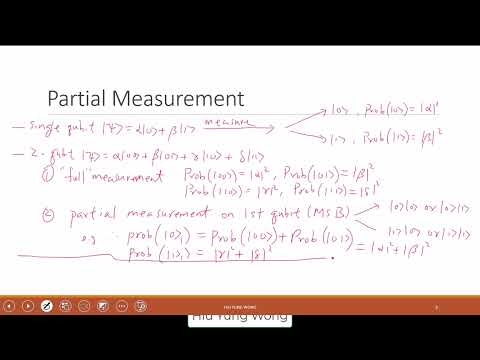
- When only the first qubit is measured, the probability of outcome 0 is |α|² + |β|²; the surviving state α|00⟩ + β|01⟩ must be normalized by √(|α|² + |β|²).
- A pure two-qubit state is unentangled precisely when it factors into one single-qubit state for each subsystem; the Bell state Φ⁺ cannot factor because its required zero cross-terms contradict its nonzero |00⟩ and |11⟩ coefficients.
- Measuring one member of a Φ⁺ pair as 0 leaves the joint state |00⟩, but entangled correlations cannot be used to transmit controllable information faster than light.
- Bell-inequality experiments rule out local hidden-variable accounts of quantum correlations; the 2022 Nobel Prize in Physics recognized experimental work on these tests.
- For a time-independent Hermitian Hamiltonian, quantum evolution is U(t) = e^(−iHt/ℏ), a unitary operation that can be reversed before measurement.
- The two-qubit NOT operation is X ⊗ X: it swaps |00⟩ with |11⟩ and |01⟩ with |10⟩, reversing the order of amplitudes in the standard computational basis.
Chapters
0:00
Assignment Deadline and Review of Quantum Measurement
- Assignments are due by 11:59; submissions after the deadline receive 50% credit, and submissions three days late receive zero without a valid reason.
- The lecture begins a review of measurement before introducing partial measurement, entanglement, and the NOT gate.
1:07
Measurement Probabilities for One and Two Qubits
- For a one-qubit state α|0⟩ + β|1⟩, measurement yields 0 or 1 with probabilities |α|² and |β|².
- A full measurement of α|00⟩ + β|01⟩ + γ|10⟩ + δ|11⟩ yields one of four basis states with probabilities given by the squared coefficient magnitudes.
4:30
Partial Measurement of the First Qubit
- Measuring only the left, most-significant qubit produces outcome 0 for either |00⟩ or |01⟩, and outcome 1 for either |10⟩ or |11⟩.
- The first-qubit outcome probabilities are |α|² + |β|² for 0 and |γ|² + |δ|² for 1.
8:54
Normalize the State After a Partial Measurement
- If the first qubit is measured as 0, the remaining two-qubit state is proportional to α|00⟩ + β|01⟩.
- The post-measurement state must be divided by its norm, √(|α|² + |β|²), so its probabilities sum to one.
12:18
Entanglement as Failure to Factor a Two-Qubit State
- A two-qubit pure state is unentangled when it can be written as a tensor product of one state from each qubit's C² space.
- If no such product decomposition exists, the state is entangled; the combined state cannot be fully described by independent states for the two qubits.
18:29
Factoring a Product State into Plus and Minus States
- The example (|00⟩ − |01⟩ + |10⟩ − |11⟩)/2 factors into (|0⟩ + |1⟩)/√2 ⊗ (|0⟩ − |1⟩)/√2.
- Tensor-product order matters: the first factor describes qubit 1 and the second describes qubit 2.
- Because the state separates into |+⟩ for qubit 1 and |−⟩ for qubit 2, it is unentangled.
23:40
The Four Bell States as an Alternative Basis
- The Bell basis consists of Φ⁺ = (|00⟩ + |11⟩)/√2, Φ⁻ = (|00⟩ − |11⟩)/√2, Ψ⁺ = (|01⟩ + |10⟩)/√2, and Ψ⁻ = (|01⟩ − |10⟩)/√2.
- These four vectors form a basis for the two-qubit C⁴ space and are expressed using the computational basis states.
- Unlike the factored example, each Bell state is entangled and cannot be written as a product of two single-qubit states.
27:23
Proving Φ⁺ Cannot Be Factored into Single-Qubit States
- Assume Φ⁺ is a product (a₀|0⟩ + a₁|1⟩) ⊗ (b₀|0⟩ + b₁|1⟩).
- Matching coefficients requires a₀b₀ and a₁b₁ to be nonzero while a₀b₁ and a₁b₀ are zero.
- Those conditions contradict one another, proving Φ⁺ is entangled; the same type of reasoning applies to the other Bell states.
34:29
Distant Bell Pairs and Correlated Measurement Outcomes
- A pair prepared in Φ⁺ = (|00⟩ + |11⟩)/√2 remains entangled even when its electrons are separated by a great distance.
- Measuring the first qubit as 0 leaves the joint state |00⟩; measuring it as 1 leaves |11⟩, so the outcomes are perfectly correlated.
- The glove-pair analogy illustrates correlation, but entanglement is not a method for sending controllable information faster than light.
44:31
The EPR Challenge, Hidden Variables, and Bell Tests
- The EPR argument asks how distant qubits can show correlated outcomes when measurements are made in different bases, such as the computational and plus/minus bases.
- Einstein favored the possibility that quantum mechanics was incomplete and that hidden variables determined outcomes in advance.
- Bell-inequality experiments reject local hidden-variable explanations; the 2022 Nobel Prize in Physics recognized work testing these foundations.
- Entanglement does not enable faster-than-light communication, so the correlations do not violate causality.
51:49
Quantum Circuits as Sequences of Reversible Unitary Gates
- Quantum computation applies a sequence of unitary transformations, such as U₁ followed by U₂, to evolve a state reversibly.
- A gate may be implemented physically with a microwave or laser pulse rather than a literal mechanical switch.
- Measurement is different from unitary evolution: collapse generally prevents reversing the computation to recover the original superposition.
- The lecture cites an IBM planning example of 2,000 logical qubits, about 1,800 square feet, and 12 megawatts, largely to illustrate cooling and hardware overhead.
54:04
The Schrödinger Equation Connects Energy to State Evolution
- The Schrödinger equation describes how a quantum state changes over time according to the system's Hamiltonian, which represents its energy.
- The Hamiltonian plays a role analogous to an energy landscape determining how a physical system evolves.
- The lecture uses the equation to connect the physical evolution of a qubit to the mathematical operations used in quantum computing.
57:14
Time Evolution Produces a Unitary Quantum Gate
- For a time-independent Hamiltonian H, the evolution operator is U(t) = e^(−iHt/ℏ).
- Because a Hamiltonian is Hermitian, this evolution operator is unitary: U†U = I.
- Applying a control pulse changes the effective Hamiltonian and pulse duration, allowing hardware to implement gates such as NOT or SWAP.
1:02:25
The Single-Qubit NOT Gate Is the Pauli-X Matrix
- The NOT gate is defined by its action on the computational basis: |0⟩ maps to |1⟩ and |1⟩ maps to |0⟩.
- Its matrix is the Pauli-X operator, [[0, 1], [1, 0]], which swaps the two basis-vector components.
- By linearity, X(α|0⟩ + β|1⟩) = β|0⟩ + α|1⟩, and X is unitary because X†X = I.
1:08:32
Applying NOT to Both Qubits with X Tensor X
- Applying NOT independently to two qubits gives the operator X ⊗ X, constructed by taking the tensor product of the single-qubit matrices.
- For a general state α|00⟩ + β|01⟩ + γ|10⟩ + δ|11⟩, the output is δ|00⟩ + γ|01⟩ + β|10⟩ + α|11⟩.
- Equivalently, X ⊗ X maps |00⟩↔|11⟩ and |01⟩↔|10⟩; the lecture closes by representing this as an X gate on each qubit.
Summary, takeaways, and chapters were generated by AI from the video's transcript and may contain errors. The video belongs to its creator, Quantum Computing, TCAD, Semicond by Hiu-Yung Wong.