Khabib Nurmagomedov: Dagestan, MMA, UFC, Islam, Conor, Fedor & Football | Lex Fridman Podcast #500
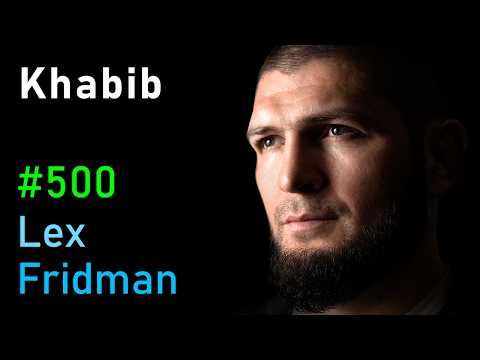 Watch on YouTube →
Overview
Khabib Nurmagomedov discusses his journey from Dagestan, the harsh training conditions that forged champions, and the cultural and historical factors contributing to Dagestan's wrestling prowess. He reflects on his career, the mental fortitude required to be a champion, his admiration for fighters like Fedor Emelianenko and Georges St-Pierre, and his passion for football, particularly Real Madrid and Cristiano Ronaldo. Khabib also shares insights into his deep Islamic faith, his father's profound influence, and his role as a leader guiding the next generation of fighters like Islam Makhachev.
Key takeaways
- Khabib Nurmagomedov attributes his success to Dagestan's harsh training conditions, high competition, and a deep cultural emphasis on fighting and resilience.
- Maintaining championship status requires immense mental fortitude, a constant drive against complacency, and the ability to manage fame and wealth without losing focus.
- Khabib's deep Islamic faith provides a moral compass, humility, and strength, guiding his life decisions and helping him cope with loss and success.
- The rivalry between Cristiano Ronaldo and Lionel Messi elevated football globally, pushing both players to achieve unprecedented levels of performance and recognition.
- Khabib's father instilled a strong work ethic and intellectual curiosity through methods like reciting facts from 'Countries and Peoples' for rewards.
- The UAE, particularly Dubai and Abu Dhabi, has become a vital hub for MMA, offering significant government support and world-class training facilities.
Chapters
- Lex Fridman introduces Khabib Nurmagomedov, an undefeated UFC fighter.
- The conversation is conducted entirely in Russian with English dubbing available.
- Thanks are extended to ElevenLabs for translation and dubbing assistance.
- Khabib describes the spartan conditions of the gym in Makhachkala (2000-2010).
- Facilities included only mats, a punching bag, a climbing rope, and a basketball court.
- Even earlier, training occurred in a home gym built by his father in their village.
- Khabib believes champions are born from difficult conditions, not comfort.
- Comfort can be the enemy of champions, removing the necessary hunger and need.
- This applies less to sports like football, which require better facilities.
- Brazil's football success is attributed to huge population numbers and deep love for the sport.
- Dagestan lacks an organized football ecosystem, unlike its strong combat sports infrastructure.
- Dagestan has numerous combat sports gyms, creating a competitive ladder from local to world levels.
- Competition level in Dagestani gyms is incredibly high, with 10-15 good wrestlers per weight class.
- The region benefits from a legacy of great coaches, starting with figures like Ali Aliyev.
- Many retired wrestlers became coaches, passing down knowledge and philosophy.
- Fighting and wrestling are deeply ingrained in Dagestani culture, a tradition spanning centuries.
- The region's history of invasions and survival necessitated a strong fighting spirit.
- Geographical location and historical invasions (Khazars, Mongols, Russians) shaped the people.
- Derbent, 'the Gate of Gates,' was a crucial historical trade and military route.
- Dagestan's history led to over thirty different languages spoken in the region.
- Islam is the primary religion, but Dagestan has absorbed diverse cultures and faiths.
- The mountainous terrain historically protected highlanders from invaders.
- Villages were built in rugged areas for defense, with farming terraces in accessible locations.
- This environment fostered physical, psychological, and mental toughness.
- Khabib's father dreamed of a mountain sports complex in Sildi.
- The complex, built from 2016, is located at 1500-1600 meters altitude for high-performance training.
- Khabib continued the project after his father's passing, expanding its scale.
- Building the complex in his home village provides happiness and meaning beyond financial profit.
- It creates jobs and fulfills his father's dream.
- The mountains offer a unique environment for spiritual and physical improvement.
- Distractions like contracts, travel, and media attention can lead to missed training.
- The hunger and drive diminish once a fighter reaches the top.
- Handling success requires immense mental strength and a delicate mindset.
- Becoming a champion is one challenge; staying one is significantly harder.
- Many fighters switch to fitness or quit after initial success, finding comfort.
- Each subsequent championship win becomes progressively more difficult.
- Amateur success is a springboard to professional careers.
- Becoming a professional champion requires a different level of dedication.
- Staying a champion demands exceptional talent and a unique mindset.
- Champions must be unique individuals capable of accepting guidance.
- Criticism can be difficult, especially after achieving success.
- True qualities are often discovered when faced with limitations like wealth or power.
- Khabib's goal was to prove himself to his father, not to be crowned king.
- He emphasizes that true importance lies in serving God, not personal ego.
- Controlling basic needs highlights human limitations, regardless of fame or wealth.
- Khabib's primary motivation was a hatred of losing, not just a love of winning.
- He describes a near-addictive commitment to perfect preparation 100 days before a fight.
- Training involved meticulous scheduling, fitting workouts around travel and other commitments.
- Khabib trained 4-5 hours daily, often adding a third session.
- He met with legendary wrestler Sadulaev, sharing wisdom that aided his Olympic success.
- Victory is not enough; some athletes, like Sadulaev, seek domination through relentless training.
- Khabib's father enforced rigorous training, starting before dawn (after Fajr prayer).
- Morning sessions included 5km runs, sprints, resistance bands, and bodyweight exercises.
- Khabib often added extra training sessions, sometimes without his father's knowledge.
- To be among the world's best, athletes need a 'crazy' yet positive, fanatical approach.
- Simply showing up and working out isn't enough; standing out requires extreme dedication.
- John Danaher's students train three times a day, demonstrating this fanatical dedication.
- John Danaher's system produces champions, not just average athletes.
- Many enter his 'black room' (uncomfortable training environment) but break mentally and leave.
- Enduring the grind for 10-15 years is necessary to become the best.
- Khabib trained with older, world-champion fighters from age 15 in combat Sambo camps.
- The rule was that the youngest had to do everything and was always wrong, hardening him.
- His father emphasized reading and writing, ensuring a well-rounded education alongside physical training.
- Khabib's father motivated him to learn by offering money for reciting facts from the book 'Countries and Peoples'.
- This method developed his geography knowledge and instilled a work ethic.
- Parents are advised to use challenges and rewards to motivate children's learning.
- Summer training camps involved building facilities and performing manual labor, like digging pits.
- The philosophy was to keep children busy and developing skills, avoiding idle time.
- Constant development and investment in one's chosen path are crucial by age 16.
- Khabib never initiated street fights but acted as protection for his brother Abubakar.
- Living with over ten brothers in one house fostered discipline and self-sufficiency.
- Fights often occurred during football games when their team was losing.
- Street fights lack rules, referees, and points, making them fundamentally different from regulated sports.
- Many street fighters would perform poorly in controlled sparring or MMA.
- Khabib transitioned to combat Sambo after witnessing a submission victory via triangle choke.
- Khabib switched to combat Sambo at 14/15, balancing it with wrestling training.
- He realized MMA's potential, where wrestling skills transition to ground fighting.
- His father insisted he compete in various sports (freestyle, judo, grappling, combat Sambo) to gain experience.
- Khabib's youth competitions, though sometimes resulting in losses, built psychological resilience.
- He gained confidence through extensive amateur and professional fights (16+ before UFC).
- The mental game is crucial; fighting yourself precedes fighting your opponent.
- Khabib learned to use his strength effectively, forcing opponents to expend energy escaping difficult positions.
- He compares this to Aikido's philosophy of using an opponent's force against them.
- Fighters must identify and relentlessly pressure an opponent's weak spots.
- The Khabib vs. Conor McGregor fight transcended MMA, impacting all sports due to its magnitude.
- Boxing's history shows legendary rivalries like Ali vs. Frazier, but Tyson lacked a signature rival.
- The Conor fight combined athlete prowess with cultural and personal narratives, creating unprecedented interest.
- Khabib maintained emotional control before and during the Conor fight, despite provocation.
- He attributes this calmness to his father's guidance and traditional Dagestani father-son distance.
- His father's words, comparing pressure to diamond formation, provided mental strength.
- The fight against Justin Gaethje was Khabib's toughest due to losing his father and multiple injuries.
- Training without his father, the person he fought to prove himself to, was emotionally draining.
- Khabib knew it was his last fight, having agreed with his mother to retire.
- Khabib experienced unique, unrepeatable feelings during his final fight against Gaethje.
- Athletes live for these peak moments, which are fleeting and intensely felt.
- Happiness is often experienced in short bursts, tied to achieving significant goals.
- Legacy is defined by public recognition and inspiring the next generation.
- Some successful athletes fail to inspire because they are not seen as good people.
- Sports can be a double-edged sword, offering success but also the potential to lose oneself.
- Khabib admires Mauricio 'Shogun' Rua for his striking, Thai clinch, and calm demeanor.
- Georges St-Pierre (GSP) impressed with his timing, takedowns after striking, and distance management.
- Fedor Emelianenko inspired Khabib as a Russian Sambo fighter who dominated Pride FC.
- Fedor Emelianenko competed in the 2004 Dagestan Combat Sambo Championship while reigning as Pride champion.
- Khabib, then 15, witnessed Fedor's warm-up, including unusual facial exercises.
- Fedor's presence and calm demeanor, despite fighting giants, left a lasting impression.
- Fedor's calmness ('aura') allowed him to knock out formidable opponents.
- Khabib contrasts Fedor's outward calm with his own internal intensity.
- Handling multiple emotions (fear, nerves, pressure) is key to high-level competition.
- Athletes must confront and overcome fear, not ignore it.
- Experience from consistent competition helps channel nerves and build confidence.
- Patience and endurance are required to process challenges mentally and physically.
- GSP, one of history's greatest fighters, admitted to feeling fear before every fight.
- He is described as sensitive, contrasting with fighters who take competition lightly.
- Khabib's own calmness allowed him to sleep before fights, unlike some who suffer insomnia.
Summary, takeaways, and chapters were generated by AI from the video's transcript and may contain errors. The video belongs to its creator, Lex Fridman.