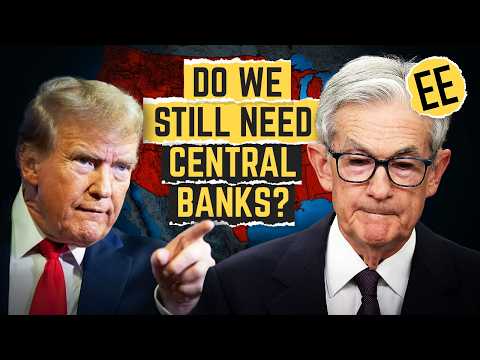
Is the US Central Bank Losing Its Independence?
 Watch on YouTube →
Overview
Economics Explained details the historical necessity and evolving role of central banks, particularly the US Federal Reserve, highlighting their dual mandate of price stability and maximum employment. The analysis emphasizes how increasing government debt, wealth inequality, and political pressure are compromising the Fed's independence and effectiveness, making it difficult to manage inflation and economic growth through traditional tools like interest rates and open market operations.
Key takeaways
- Central banks, like the US Federal Reserve, were established to manage currency, stabilize prices, and maintain employment, acting as a check on economic recklessness.
- The Fed primarily uses interest rate adjustments and open market operations (including quantitative easing) to influence economic activity.
- Soaring levels of debt and increasing wealth inequality significantly complicate the Fed's ability to manage inflation and economic growth effectively.
- The Fed's independence is challenged by governments employing expansionary fiscal policies that directly contradict monetary policy goals, creating conflicting economic signals.
- Political pressure to avoid unpopular decisions, such as raising interest rates, can undermine a central bank's ability to perform its essential functions, potentially leading to severe economic consequences.
- While the Fed can technically run at a loss due to its ability to create money, this financial state can be politically weaponized to question management and independence.
Chapters
0:00
The Universal Role and Historical Formation of Central Banks
- Central banks are nearly universal, serving as checks on economic recklessness, emergency backstops, and regulators of inflation/employment.
- Early central banks like the Bank of England (1694) and the Riksbank (1688) managed debts, issued coinage, and facilitated trade.
- The US experienced early central banking attempts (1791-1811, 1816-1836) that struggled with balancing profit motives and national interest.
- The 1907 financial crisis led to the Federal Reserve's formation in 1913 to provide a centralized system and prevent bank runs.
12:30
Federal Reserve Tools: Interest Rates and Open Market Operations
- The Fed's primary tools are interest rates (influencing borrowing/saving) and open market operations (buying/selling government bonds).
- Raising interest rates cools inflation by encouraging saving and discouraging spending, while lowering rates stimulates demand.
- Open market operations, including quantitative easing (QE), involve injecting liquidity by purchasing assets like government bonds.
- The Fed's profits typically go to the US Treasury after covering operating expenses and dividends to shareholders.
Summary, takeaways, and chapters were generated by AI from the video's transcript and may contain errors. The video belongs to its creator, Economics Explained.