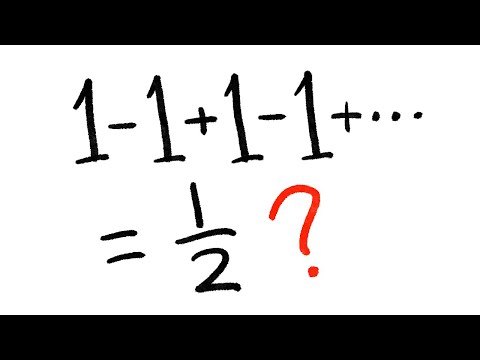
Is 1-1+1-1+1-1+...=1/2 really true?
 Watch on YouTube →
Overview
blackpenredpen explains that Grandi’s series, 1 − 1 + 1 − 1 + …, diverges in the ordinary sense because its partial sums alternate between 1 and 0, so none of the proposed ordinary sums is correct. The value 1/2 is meaningful under Cesàro summation, which averages the partial sums; blackpenredpen also distinguishes this extended assignment from invalid regrouping or applying the geometric-series formula when the common ratio is −1.
Key takeaways
- Grandi’s series has partial sums 1, 0, 1, 0, …, so it diverges in the ordinary sense rather than summing to 0, 1, or 1/2.
- Regrouping an infinite series can change the apparent result when the series is divergent; pairing terms in Grandi’s series cannot establish an ordinary sum.
- The geometric-series formula 1/(1 − r) requires |r| < 1; Grandi’s ratio r = −1 fails that condition.
- Under Cesàro summation, averaging Grandi’s partial sums yields 1/2, a generalized value distinct from ordinary convergence.
- Generalized summation methods can assign useful values to divergent expressions, as illustrated by Ramanujan summation assigning −1/12 to 1 + 2 + 3 + … and the Cauchy principal value assigning 0 to the symmetric integral of x over the real line.
Chapters
0:00
Grandi’s Series and Its Oscillating Partial Sums
- The series 1 − 1 + 1 − 1 + … is Grandi’s series.
- Grouping adjacent terms as (1 − 1) + (1 − 1) + … suggests 0, while saving the first 1 and pairing the rest suggests 1.
- Its partial sums alternate between 1 and 0, so they do not converge to a finite value; the ordinary series therefore diverges.
2:30
Why the Geometric-Series Formula Does Not Give 1/2 Here
- Writing Grandi’s series as the geometric series ∑(−1)^n gives first term 1 and common ratio r = −1.
- The infinite geometric-series formula 1/(1 − r) is valid only when |r| < 1.
- Because |−1| = 1, the convergence condition fails, so using the formula to claim an ordinary sum of 1/2 is invalid.
5:30
Cesàro Summation and Other Extended Assignments
- Cesàro summation averages the partial sums; averaging the alternating sequence 1, 0, 1, 0, … gives 1/2.
- This assigns Grandi’s series a value under a different summation method, without changing the fact that it diverges ordinarily.
- blackpenredpen compares extended assignments with the imaginary unit i, the Ramanujan-summation value 1 + 2 + 3 + … = −1/12, and the Cauchy principal value of the symmetric integral ∫ from −∞ to ∞ of x, which is 0.
Summary, takeaways, and chapters were generated by AI from the video's transcript and may contain errors. The video belongs to its creator, blackpenredpen.