Inverse trigonometric functions (Calc 1; Lecture 2-3; Fall 26)
 Watch on YouTube →
Overview
Beard Meets Calculus reviews inverse-function differentiation and logarithmic differentiation before deriving the derivatives of arctangent and arcsine. The lecture shows how logarithms simplify variable exponents and products, then restricts periodic sine and tangent to invertible intervals and obtains the formulas for their inverse derivatives through implicit differentiation.
Key takeaways
- For an invertible function h, the inverse-function rule is (h⁻¹)′(x) = 1/h′(h⁻¹(x)); nested inverses require applying this rule and the chain rule at each layer.
- Logarithmic differentiation is especially useful when a variable occurs in both the base and exponent, as in (x^x)′ = x^x(ln x + 1).
- Logarithms separate products, quotients, and powers, but not sums; taking logs of an entire expression such as x^x + e^x does not simplify it into separate terms.
- The inverse of tangent is defined using the restricted branch (−π/2, π/2), producing an arctangent function on all real inputs with derivative 1/(1 + x²).
- Restricting sine to [−π/2, π/2] makes its inverse well-defined and ensures cosine is nonnegative there, yielding arcsin′(x) = 1/√(1 − x²) for interior inputs.
- Effective calculus study depends on solving problems and reviewing mistakes, not merely accumulating study hours; Beard Meets Calculus recommends attempting old exam problems before looking at solutions.
Chapters
0:00
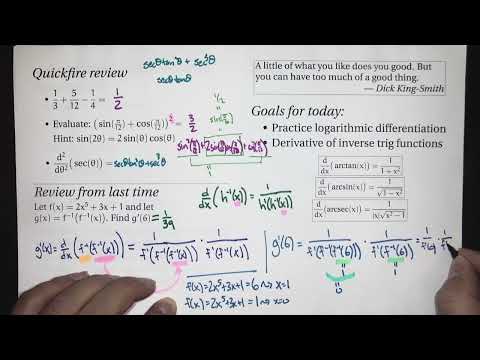
Quickfire Trigonometry: Identities and the Second Derivative of Secant
- Rewrites (sin(π/12) + cos(π/12))² using sin²θ + cos²θ = 1 and the double-angle identity, obtaining 3/2.
- Finds the second derivative of secant by differentiating sec θ tan θ with the product rule: sec θ tan²θ + sec³θ.
- Emphasizes simplifying trigonometric expressions only when there is a clear reason.
6:00
Applying the Inverse-Function Derivative Rule Twice
- Uses g(x) = f⁻¹(f⁻¹(x)) for f(x) = 2x⁵ + 3x + 1, applying the chain rule and inverse-derivative formula at both layers.
- Evaluates f⁻¹(6) = 1 and then f⁻¹(1) = 0 by finding inputs that produce those outputs.
- Since f′(x) = 10x⁴ + 3, calculates g′(6) = 1/f′(0) · 1/f′(1) = 1/39.
13:00
Study for Calculus with Quality, Practice, and Pacing
- Warns that excessive studying can cause burnout and diminishing returns, even when students are motivated to improve after an exam.
- Prioritizes focused, effective study over simply measuring time spent at a desk.
- Recommends periodically reviewing notes and attempting old exam problems before consulting solutions; productive frustration can reveal sticking points.
16:00
Inverse-Trigonometric Notation and Logarithmic Differentiation
- Introduces derivatives of arctangent, arcsine, and arcsecant, while identifying arctangent as the inverse-trig derivative to know especially well.
- Distinguishes inverse tangent, arctan x (sometimes written tan⁻¹x), from reciprocal tangent, 1/tan x.
- Explains why logarithms help differentiate: products become sums, quotients become differences, and powers can be brought down as factors.
20:00
Differentiate x^x by Taking the Logarithmic Derivative
- Identifies x^x as a case requiring logarithmic differentiation because the variable appears both as the base and the exponent.
- Uses (x^x)′ = x^x · d/dx[ln(x^x)] = x^x(ln x + 1).
- Connects the result to the two familiar-looking contributions from treating a power and an exponential, while showing that the logarithmic method handles both together.
25:00
Why Taking Logs of Both Sides Is Not Always the Best Method
- Contrasts the direct identity f′(x) = f(x) · (ln f(x))′ with the textbook procedure of setting y = f(x), taking logs, and using implicit differentiation.
- Uses y = x^x + e^x to show that taking the logarithm of both sides does not split a sum into simpler terms.
- Argues that the direct formula is more flexible when logarithms can simplify parts of an expression but do not apply cleanly to the entire function.
29:00
Expand Logarithms to Differentiate a Product, Quotient, and Variable Power
- Works through a complicated function involving e^(3x), cos(2x), a square-root factor, and (x² + 1)^x to illustrate when logarithmic differentiation is useful.
- Applies logarithm rules before differentiating: products become sums, denominator factors become subtractions, and ln((x² + 1)^x) becomes x ln(x² + 1).
- Differentiates the separated terms using the chain and product rules, including d/dx[ln(cos 2x)] = −2 sin(2x)/cos(2x).
- Stresses careful algebra and notation: most of the work is expanding logarithms correctly before taking derivatives.
35:00
Restrict Tangent to Derive the Arctangent Derivative
- Explains that tangent is periodic and fails the horizontal-line test on its full domain, so its inverse uses the interval (−π/2, π/2).
- Describes reflecting that tangent branch across y = x to obtain arctangent, whose domain is all real numbers and whose range is (−π/2, π/2).
- Uses x = tan y and implicit differentiation: 1 = sec²(y)y′; substituting sec²(y) = 1 + tan²(y) gives d/dx[arctan x] = 1/(1 + x²).
- Applies the chain rule to arctan(e^x) and arctan(√x), obtaining e^x/(1 + e^(2x)) and 1/[2√x(1 + x)], respectively.
43:00
Restrict Sine and Derive the Arcsine Derivative
- Restricts sine to [−π/2, π/2], where it is one-to-one and covers outputs from −1 to 1; the inverse arcsine therefore has domain [−1, 1].
- Uses x = sin y and implicit differentiation to obtain 1 = cos(y)y′; cosine is positive on the chosen interval, so cos(y) = √(1 − x²).
- Derives d/dx[arcsin x] = 1/√(1 − x²), noting that this formula is used less often than the arctangent derivative.
- Applies the formula and chain rule to arcsin(1 − x²), giving −2x/√(2x² − x⁴) after simplifying the radicand.
Summary, takeaways, and chapters were generated by AI from the video's transcript and may contain errors. The video belongs to its creator, Beard Meets Calculus.