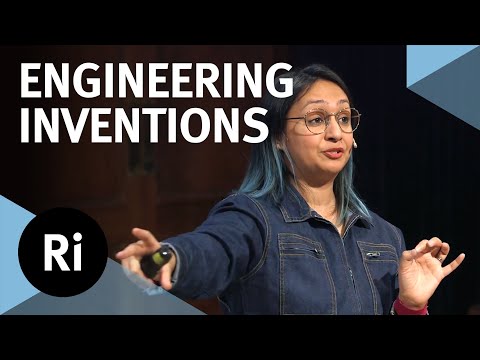
Inventions that changed the world – with Roma Agrawal
 Watch on YouTube →
Overview
Roma Agrawal, writing and engineering communicator at The Royal Institution, argues that modern “black boxes” become understandable—and more repairable—when their core components are deconstructed. Using three inventions from her book Nuts and Bolts (nail, magnet, pump), she connects hands-on forging to material science and manufacturing history (e.g., Roman iron nails and a 870,000-nail hoard), then to magnetism-driven communications technologies (telegraph/William O’Shaughnessy, telephone/Alexander Graham Bell, automatic telephone exchanges/Strowger, cathode-ray-tube television), and finally to pump engineering as a way to extend beyond human limits (heart-lung machine by John Gibbon and Mary Hopkinson; space-suit oxygen pressure and NASA liquid cooling garments inspired by Alexei Leonov’s 1965 near-disaster).
Key takeaways
- Metal nails changed structural history by enabling robust joining via hammering and friction/sheer resistance—before metal nails, durable fastening across materials was limited to carving, digging, caves, rope tying, or tool-based approaches.
- Nail-making depended on global geography and politics: copper-to-bronze supply chains required distant tin sourcing, and Middle East disruptions could collapse the availability of key components, shifting which nail materials dominated.
- Rivets replaced nails for sheet-metal because nails rely on friction/anchoring in wood; the rivet design (pre-drill, insert shaft with dome head, clamp by heating and hammering) made high-strength metal-to-metal fastening possible for modern warplanes like the Spitfire (35 km/h speed difference tied to dome shape tests).
- Magnetism’s engineering value is communication and control: electromagnetic pulses (linked to William O’Shaughnessy’s telegraph system in India) encoded language by varying current strength/polarity, turning distant signaling into near-instant messaging.
- CRT television used magnet-controlled electron-beam raster scanning: coils shape a moving line-by-line electron pattern fast enough that the brain perceives a coherent moving image.
- Pumps extend human capability across medicine and space: the John Gibbon–Mary Hopkinson heart-lung machine (after ~20 years of cat experiments and successful 1950s–1960s use) enabled bypass surgery and organ support, while Alexei Leonov’s 1965 crisis led NASA to improve life-support and liquid cooling garment technology.
Chapters
- Roma Agrawal frames engineering as reusable “core elements” inside everyday objects (pen, blender, buildings), inspired by lockdown curiosity.
- She selects three inventions for Nuts and Bolts: nail, magnet, pump, promising later discussion on why other candidates (e.g., levers) weren’t covered.
- The talk emphasizes hands-on learning: lighting/heat exposure, practical forging, and later demonstrations involving magnets and a cathode-ray tube.
- A live nail-forging sequence heats steel until the tip glows red, reaching over ~1,000°C before hammering to create a tapered nail shape.
- Steel is quenched in cold water after forging cycles; differences between slower multi-cycle forging and faster forge work are highlighted.
- Roma connects nails to the historical leap from weak joining (rope/caves/tools) to robust fastening that enabled ships, furniture, and large timber buildings.
- Material evolution: Egyptians began with copper nails (soft), then bronze required copper and tin from different regions, and Middle East political shifts reduced tin supply.
- Iron Age trade patterns: iron from southern India and Sri Lanka supplied Romans, who imported iron and made famous Roman nails; a Scotland discovery included 870,000 iron nails abandoned and buried nearly ~2,000 years earlier.
- Steel strengthening is explained via carbon atoms blocking deformation, plus heating/hitting and quenching that changes crystal arrangement for hardness.
- Roma contrasts forging with later mass production: Thomas Jefferson-era machine cutting and Industrial Revolution mass-produced nails that are cheap today.
- Thin metal joining problem: nails rely on friction and shearing resistance in wood, but fail for sheet-metal because the nail body lacks anchoring contact.
- Rivet solution: pre-drill holes, insert cylindrical shaft with dome head, heat, and hammer to clamp sheets—applied in aircraft; a Spitfire rivet experiment showed round-headed domes reduced maximum speed by 35 km/h.
- Roma describes magnetism as “magical” due to its invisible forces, but reframes the engineering question as: what can we do with it rather than fully explaining how it works.
- Family-linked telegraph story: telegrams as early instant long-distance communication; the Indian telegraph system used electromagnetic pulses to switch magnet-driven signals.
- Historical context and implications: the telegraph system was built by British rulers and specifically William O’Shaughnessy, used for governance and suppressing rebellion; peak telegram use occurred around the 1970s–1980s and declined about a decade before the talk.
- Roma explains CRT operation using a vacuum glass tube and electron beam controlled by coils/electromagnets to create a raster pattern line-by-line.
- Television is presented as the next communication frontier: converting symbols/sound into moving images via rapid scanning that the brain perceives as motion.
- Attribution correction: Japanese engineer Takayanagi Kenjiro adapted the “brown tube” concept into an all-electric television; Roma notes Philo Farnsworth is often credited, but Takayanagi’s work predates it, while war and patent issues helped obscure him.
- Roma presents pumps as a route to surpassing what human bodies can do: the heart is framed as a reliable ~four-chamber pump, with athletes training larger pumping capacity.
- Heart-lung machine development: John Gibbon and Mary Hopkinson pursued a pump that bypasses heart/lungs; after ~20 years of cat experiments, successful human use occurred in the 1950s–1960s.
- Space application: Alexei Leonov’s 1965 spacewalk nearly killed him when suit pressure caused glove/boot detachment in vacuum; NASA later developed the liquid cooling and ventilation garment (LCVG) with water-pipe “onesie” cooling to manage temperature.
- Roma’s concluding message: engineering complexity makes people intimidated by repair; “breaking open the black box” reduces fear and supports maintenance rather than disposal.
- She connects the incentive to sustainability and relationships with objects: knitting/crochet research for all seven objects, including a nut-and-bolt crochet pattern, to rebuild curiosity about components.
- Closing call-to-action includes continued engagement (Q&A), showing balloon pumps later, and directing attendees to her books Built, Nuts and Bolts, and How Was That Built?
Summary, takeaways, and chapters were generated by AI from the video's transcript and may contain errors. The video belongs to its creator, The Royal Institution.