Introduction to Using Trigonometric Identities (Precalculus - Trigonometry 23)
 Watch on YouTube →
Overview
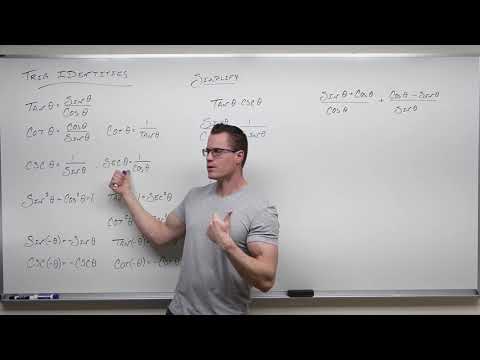
Professor Leonard introduces fundamental trigonometric identities, emphasizing their utility in simplifying complex expressions and facilitating future calculus studies. He categorizes identities into reciprocal, Pythagorean, and even/odd types, demonstrating their application through simplification examples. The core strategy involves transforming expressions into sines and cosines, combining fractions, and applying known identities, with factoring presented as a key simplification technique when expressions are already in a single function's terms.
Key takeaways
- Trigonometric identities are fundamental tools for simplifying expressions, essential for advanced mathematics like calculus.
- The primary strategy for simplification involves converting expressions to sines and cosines, combining fractions, and applying known identities.
- Pythagorean identities, such as sin² θ + cos² θ = 1, can be rearranged to solve for different terms (e.g., sin² θ = 1 - cos² θ).
- Cosine and secant are the only even trigonometric functions; the rest (sine, cosecant, tangent, cotangent) are odd.
- When an expression is already in terms of a single trigonometric function (e.g., all cosines), factoring is often a more effective simplification strategy than direct identity substitution.
- Trigonometric identities function as two-way streets: if A = B, then B = A, allowing for flexible manipulation.
Chapters
0:00
Introduction to Trigonometric Identities and Their Importance
- Trigonometric identities are crucial for simplifying mathematical expressions and are essential for advanced calculus courses.
- Identities can seem challenging but ultimately make complex problems more manageable.
- This introduction covers basic identities: reciprocal, Pythagorean, and even/odd.
2:18
Reciprocal, Pythagorean, and Even/Odd Identities Explained
- Reciprocal identities relate functions like tangent to sine/cosine (e.g., tan θ = sin θ / cos θ) and others to their reciprocals (e.g., csc θ = 1/sin θ).
- Pythagorean identities involve squared terms, such as sin² θ + cos² θ = 1, and their algebraic manipulations.
- Even/odd identities define behavior with negative angles: cosine and secant are even (f(-θ) = f(θ)), while sine, cosecant, tangent, and cotangent are odd (f(-θ) = -f(θ)).
6:57
Strategy for Simplifying Trigonometric Expressions
- Start with the more complex side of an identity (if applicable) or the given expression.
- If multiple fractions exist, combine them using a common denominator.
- If stuck, rewrite all terms as sines and cosines and simplify.
- Factoring is a powerful simplification tool when an expression is already in terms of a single trigonometric function.
9:06
Simplification Examples and Advanced Techniques
- Example 1: Simplifying tan θ * csc θ by converting to sin θ/cos θ * 1/sin θ, resulting in 1/cos θ, which simplifies to sec θ.
- Example 2: Combining fractions with different denominators by finding a common denominator (sin θ * cos θ) and simplifying the numerator using Pythagorean identities.
- Example 3: Simplifying (cos² θ - 1) / (cos² θ - cos θ) by factoring the numerator as a difference of squares and the denominator by GCF, leading to (cos θ + 1) / cos θ, then to 1 + sec θ.
Summary, takeaways, and chapters were generated by AI from the video's transcript and may contain errors. The video belongs to its creator, Professor Leonard.