Introduction to Polar Coordinates (Precalculus - Trigonometry 36)
 Watch on YouTube →
Overview
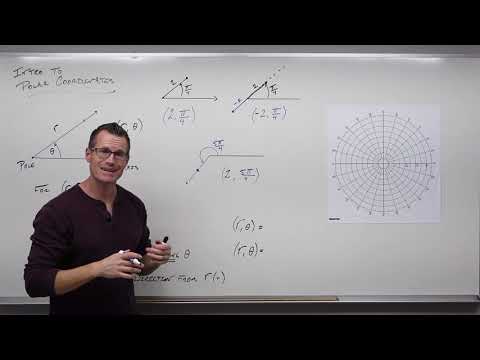
Professor Leonard introduces polar coordinates as an alternative graphing system to Cartesian (x, y) coordinates, emphasizing its utility in simplifying complex mathematical concepts, particularly in calculus. He explains that polar coordinates use an angle (theta) and a distance (r) from a central 'pole' and 'polar axis', analogous to the origin and x-axis. The explanation covers plotting points with positive and negative r and theta, and demonstrates how the same point can be represented by multiple polar coordinate pairs.
Key takeaways
- Polar coordinates (r, theta) simplify graphing by using distance from a pole and an angle, useful for non-function shapes and advanced calculus.
- Positive 'r' is measured along the angle's ray; negative 'r' is measured in the opposite direction, reflecting through the pole.
- The same point can be represented by multiple polar coordinate pairs, achieved by adding/subtracting multiples of 2*pi to the angle or by changing the sign of 'r' and adding/subtracting pi to the angle.
- Negative angles are measured clockwise from the polar axis, while positive angles are counterclockwise.
- Polar graph paper aids accurate plotting by providing pre-marked angles and concentric circles for distance.
- Converting between different representations (e.g., negative 'r' to positive 'r') is possible by adjusting the angle by multiples of pi or 2*pi.
Chapters
0:00
Introduction to Polar Coordinates and Their Utility
- Polar coordinates offer a new way to graph points using an angle and distance, simplifying certain mathematical problems.
- They are particularly useful in calculus (Calculus 2 and 3) for graphing non-functions and understanding concepts like cylindrical and spherical coordinates.
- Polar coordinates can make graphing easier than x-y coordinates, especially for shapes that don't pass the vertical line test.
2:14
Defining the Polar Coordinate System: Pole and Polar Axis
- The polar coordinate system consists of a 'pole' (like the origin) and a 'polar axis' (like the x-axis).
- Points are represented by an ordered pair (r, theta), where 'r' is the distance from the pole and 'theta' is the angle from the polar axis.
- Positive angles are measured counterclockwise, and negative angles are measured clockwise from the polar axis.
5:45
Plotting Points with Positive and Negative 'r'
- The first number in a polar coordinate pair (r, theta) is the distance from the pole.
- Positive 'r' is measured along the ray defined by the angle 'theta'.
- Negative 'r' is measured in the opposite direction of the ray defined by 'theta', effectively reflecting the point through the pole.
14:15
Multiple Representations of the Same Point in Polar Coordinates
- The same point can be represented by different polar coordinate pairs.
- The relationship r, theta = -r, theta ± pi shows that adding or subtracting pi to the angle and reversing the sign of 'r' leads to the same point.
- Adding or subtracting multiples of 2*pi to the angle also results in the same point.
23:47
Graphing Polar Coordinates with Negative Angles
- Negative angles (e.g., -pi/3) are measured clockwise from the polar axis.
- Positive 'r' is measured along the ray created by the angle.
- For example, 3, -pi/3 means going clockwise pi/3 and then 3 units along that ray.
30:17
Converting Negative 'r' to Positive 'r' Coordinates
- A coordinate with a negative 'r' can be converted to one with a positive 'r' by adding or subtracting pi to the angle.
- For example, -3, 2*pi/3 is equivalent to 3, 2*pi/3 + pi = 3, 5*pi/3.
- This conversion is useful for simplifying representations and understanding the geometric relationship.
33:28
Using Polar Graph Paper for Accurate Plotting
- Polar graph paper features concentric circles for distance (r) and radial lines for angles (theta).
- Angles are pre-marked, eliminating estimation, and circles represent units of 'r'.
- Plotting involves locating the angle and then moving along the corresponding ray to the specified distance 'r'.
Summary, takeaways, and chapters were generated by AI from the video's transcript and may contain errors. The video belongs to its creator, Professor Leonard.