Introduction to Plato - Purposes of College Education, Lecture 3
 Watch on YouTube →
Overview
This lecture introduces Plato's Republic, focusing on the central question of justice. It begins with a self-assessment on virtues, then delves into Book I's exploration of common-sense definitions of justice offered by Cephalus and Polemarchus, which are subsequently challenged by Socrates. The core of the discussion revolves around Thrasymachus's radical critique that justice is merely the "advantage of the stronger," a view Socrates systematically deconstructs, setting the stage for a deeper inquiry into justice as a virtue in the subsequent books.
Key takeaways
- Plato's Republic begins by exploring commonsense definitions of justice, such as truth-telling and returning debts (Cephalus), and helping friends/harming enemies (Polemarchus).
- Socrates systematically deconstructs these initial definitions, demonstrating their inadequacy through logical challenges and counterexamples.
- Thrasymachus presents a radical challenge, arguing that justice is merely the "advantage of the stronger" and that it is inherently foolish and disadvantageous to be just.
- Socrates refutes Thrasymachus by using analogies of professions (doctor, pilot) to show that true practitioners act for the benefit of those they serve, not for their own gain.
- The lecture highlights the importance of character (ethos) and virtue ethics, emphasizing habit and training in the pursuit of a good life.
- Plato's work explores justice in both a narrow political/legal sense and a broader moral sense concerning how one should live, with a key theme being the education and control of desires.
Chapters
0:00
Introduction to Plato's Republic and the Question of Justice
- Lecture 3 focuses on Book I of Plato's Republic and introduces Plato's general philosophy.
- The central theme is 'What is justice?', explored through commonsense views and Thrasymachus's challenge.
- The lecture aims to understand if justice is desirable and beneficial.
2:05
Self-Assessment: Identifying and Developing Virtues
- Students are asked to list three current virtues and three they wish to develop.
- Commonly cited virtues include kindness, loyalty, compassion, respect, empathy, honesty, integrity, and courage.
- Angela Duckworth's theory of 'grit' (persistence and passion for long-term goals) is mentioned as a key predictor of success.
10:20
Virtue Ethics and the Centrality of Justice in Plato
- The month's focus is on character (ethos) and virtue ethics, emphasizing habit and training.
- Aristotle's concept of eudaimonia (flourishing) is linked to human excellence and virtues.
- For Plato, justice is the overriding virtue, an excellence distinctively human.
14:00
Historical Context: Plato, Socrates, and The Republic
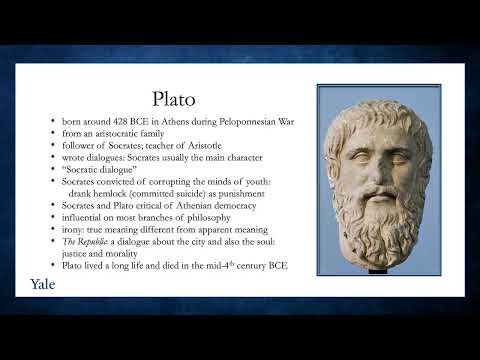
- Plato was born into an aristocratic family and was a student of Socrates.
- The Republic is set during Socrates's life, written by Plato after Socrates's death in 399 BC.
- The dialogue form and irony are key features of Plato's writing.
17:01
The Republic: Politics, Ethics, and the City-Soul Analogy
- The Republic concerns the city-state (polis) but extends to ethics and morality.
- A central analogy is developed between the city and the soul from Book II onwards.
- Athens was a democracy during the Peloponnesian War, contrasting with Sparta's oligarchy.
20:55
Characters and the Opening Scene: Force vs. Persuasion
- Key characters include Socrates, Cephalus (wealthy foreigner), Polemarchus (Cephalus's son), Glaucon (Plato's brother), and Thrasymachus (sophist).
- The dialogue begins with Socrates being stopped by a slave boy, introducing a tension between force and persuasion.
- Socrates agrees to go to Cephalus's house for a conversation, highlighting the nature of dialogue and convincing others.
29:06
Cephalus's Commonsense View: Truth-Telling and Returning Debts
- Cephalus, an older, wealthy foreigner, presents justice as speaking the truth and returning what is owed.
- He believes wealth enables honesty and avoids the need for deceit.
- Socrates challenges this by posing the scenario of returning weapons to a madman, showing this definition is insufficient.
41:54
Polemarchus's Refinement: Helping Friends and Harming Enemies
- Polemarchus refines justice to mean helping friends and harming enemies.
- This view is critiqued for its potential to harm good people if they are mistakenly identified as enemies.
- Socrates questions whether justice is a skill (techne) or a virtue (arete), and if it applies broadly or only to specific relationships.
Summary, takeaways, and chapters were generated by AI from the video's transcript and may contain errors. The video belongs to its creator, YaleCourses.