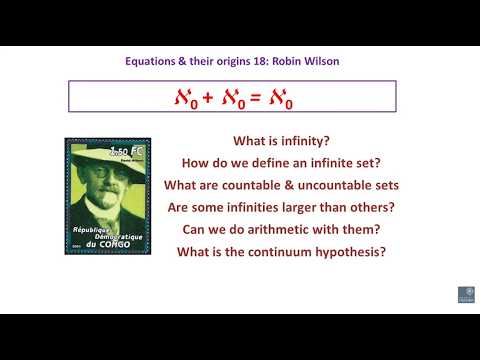
Infinity (ℵ₀+ℵ₀=ℵ₀)
 Watch on YouTube →
Overview
Oxford Mathematics explores the concept of infinity, tracing its mathematical development from early paradoxes noted by Galileo Galilei to Georg Cantor's formalization of countable and uncountable sets. The presentation details Cantor's proof of the uncountability of real numbers and the concept of different sizes of infinity, illustrated by Hilbert's hotel paradox and Cantor's work on matching points in a line to a plane. It concludes with the undecidability of the Continuum Hypothesis, a result stemming from Gödel's incompleteness theorems and Paul Cohen's work.
Key takeaways
- Richard Dedekind defined an infinite set as one that can be put into one-to-one correspondence with a proper subset of itself.
- Georg Cantor demonstrated that the set of rational numbers is countable (aleph-null), while the set of real numbers is uncountable (C).
- Cantor proved that different infinite sets can have different sizes, establishing a hierarchy of infinities.
- Hilbert's hotel paradox illustrates that aleph-null + n = aleph-null for any finite n, and aleph-null + aleph-null = aleph-null.
- Bertrand Russell's paradox led to the development of more rigorous axiomatic set theories like Zermelo-Fraenkel (ZF).
- The Continuum Hypothesis, positing no set cardinality exists strictly between aleph-null and C, was proven undecidable by Gödel and Cohen.
Chapters
0:00
Early Paradoxes and the Definition of Infinity
- Galileo Galilei noted paradoxes with infinite sets, like matching counting numbers to their squares.
- Richard Dedekind defined an infinite set as one that can be matched with a proper part of itself.
- Georg Cantor's work in the 1870s was crucial for understanding infinite sets.
15:14
Arithmetic of Infinities, Paradoxes, and Undecidability
- Hilbert's hotel illustrates arithmetic with infinities, showing aleph-zero + 1 = aleph-zero and aleph-zero + aleph-zero = aleph-zero.
- Bertrand Russell's barber paradox highlighted logical issues in early set theory, leading to Zermelo-Fraenkel set theory.
- Gödel's incompleteness theorems and Paul Cohen's work established the Continuum Hypothesis as undecidable within ZFC.
Summary, takeaways, and chapters were generated by AI from the video's transcript and may contain errors. The video belongs to its creator, Oxford Mathematics.