In Search of Human Origins: A Paleontologist’s Perspective
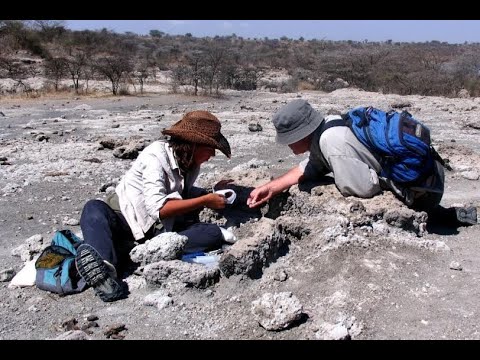 Watch on YouTube →
Overview
A paleontologist presents a personal account of human origins, emphasizing the critical role of the fossil record in understanding evolutionary transformations and extinct relatives. The talk highlights key skeletal specializations of hominins, such as bipedalism and reduced canines, and explores specific case studies like Australopithecus afarensis (Lucy) and early hominins like Ardipithecus ramidus, as well as Homo erectus in southern China, underscoring the dynamic and complex nature of human evolution.
Key takeaways
- The paleontological record provides crucial evidence of evolutionary transformations, the order of changes, and extinct hominin relatives, complementing genomic data.
- Australopithecus afarensis, exemplified by 'Lucy', was bipedal 3-4 million years ago, with skeletal and footprint evidence confirming a human-like gait.
- Early hominins like Ardipithecus ramidus (4.4 mya) show a mosaic of traits, including bipedalism and arboreal adaptations, indicating a complex evolutionary path.
- Homo erectus's long legs and improved locomotion enabled the first major 'Out of Africa' migration ~1.8 million years ago.
- The disappearance of Gigantopithecus in southern China ~320,000 years ago may be linked to the arrival and predatory behavior of Homo erectus.
Chapters
0:00
Introduction to Paleontology and Human Origins
- The speaker, a paleontologist, studies the fossil record of human evolution.
- Genomic data indicates humans diverged from chimpanzees 6-8 million years ago.
- The paleontological record reveals evolutionary transformations, their order, and extinct relatives.
2:13
Genomic Data and Hominin Divergence
- Genomic data highlights relationships between modern humans and closest relatives.
- Molecular clock models suggest divergence from chimpanzees 6-8 million years ago.
- Gorillas, orangutans, and gibbons diverged much earlier.
5:10
Defining Hominins and Key Skeletal Specializations
- Hominoids are apes and humans; hominids include great apes and humans; hominins are humans and extinct relatives since divergence from chimpanzees.
- Key skeletal specializations include brain expansion, shortened face, reduced canines, specialized lower premolars, altered limb proportions, and modifications for bipedalism.
- Early changes include canine reduction and the move to bipedalism.
13:20
Diversity of Early Hominins
- The human lineage has featured incredible diversity, with over 20 early hominin species described.
- Evolutionary history is not linear but a 'bushy affair' with many extinct side branches.
- Earlier hominins tend to be more primitive than later ones.
16:55
Case Study: Australopithecus afarensis (Lucy)
- Australopithecus afarensis lived 3-4 million years ago and is known from ~3000 specimens.
- Specimens like 'Lucy' show small brain cases, robust faces, small canines, and adaptations for bipedalism.
- Evidence suggests adeptness at climbing trees while also capable of human-style locomotion on the ground.
21:55
The Laetoli Site and its Geological Context
- Laetoli, in Tanzania, is a significant site for Australopithecus afarensis, located in the East African Rift Valley.
- The Rift Valley's geological activity, including volcanic eruptions, produces sediments that preserve fossils.
- Laetoli is characterized by volcanic ash deposits, indicating a drier, less wooded environment than other East African sites.
39:10
Laetoli Footprints: Evidence of Bipedalism
- Fossilized footprints discovered at Laetoli provide direct evidence of bipedal locomotion in Australopithecus afarensis.
- The footprints exhibit a human-like gait with heel strike, arch, and toe-off, distinct from ape feet.
- Newer discoveries in 2016 revealed additional footprints, suggesting individuals were moving north, possibly to escape volcanic activity.
Summary, takeaways, and chapters were generated by AI from the video's transcript and may contain errors. The video belongs to its creator, NYUAD Institute.