Important Overview, BIO105 Introductory Biology, David Champlin, USM
 Watch on YouTube →
Overview
David Champlin outlines BIO105’s Week 4 focus on cell signaling and the cell cycle, connecting protein-regulated information flow to the decision for a cell to grow and divide. He previews a skin-cancer example in which a mutation creates a defective protein that drives excessive division, and explains how studies of yeast revealed conserved cell-cycle regulators across eukaryotes.
Key takeaways
- Cell-cycle regulation is an information-flow problem: protein pathways determine whether a cell should grow and divide.
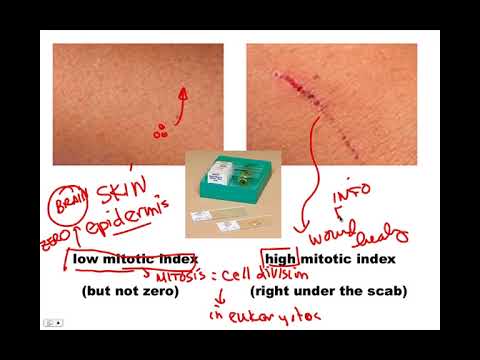
- The mitotic index distinguishes normal cell behavior: it is low in skin, nearly zero in the brain, higher during wound healing, and excessive in cancer.
- A mutation that joins sections of two proteins can produce a defective protein that stimulates too much cell division, as in Champlin’s skin-cancer example.
- DNA’s role in this example is consequential because it codes for proteins; a DNA change can alter a protein that controls cell division.
- Cell-cycle regulators are shared across eukaryotes, and studies of bread-making and brewer’s yeast helped reveal these conserved proteins.
Chapters
0:00
BIO105 Week 4: Cell Signaling and the Cell Cycle
- Week 4 covers cell signaling in Chapter 11 and the cell cycle in Chapter 12; Chapter 13 is a minor course topic.
- Champlin recommends the mini-lectures because they complement material in the book.
- The course will continue from cell biology into genetics before wrapping up.
1:45
Protein Pathways Regulate the Choice to Divide
- The cell cycle illustrates the principle that all cells come from pre-existing cells: one cell grows and divides into two.
- Proteins regulate whether a cell divides, transmitting information in pathways analogous to the enzyme-controlled pathways that regulate metabolism.
- When cell-cycle regulation fails, division can become uncontrolled and lead to cancer; the course will examine both normal regulation and cancer biology.
4:08
Skin Cancer, Mitotic Index, and Conserved Yeast Regulators
- Skin cells undergo slow, ongoing mitosis; brain-cell division is close to zero, while wound healing temporarily raises the skin’s mitotic index.
- Champlin previews a woman with skin cancer in the 1950s whose mutation joined parts of two proteins, creating a defective protein that stimulated excessive cell division.
- Cell-cycle regulators are conserved across eukaryotes: researchers studied bread-making and brewer’s yeast to identify proteins controlling whether cells divide, work recognized with Nobel Prizes in Physiology or Medicine.
Summary, takeaways, and chapters were generated by AI from the video's transcript and may contain errors. The video belongs to its creator, The New Evolution for Everyone.