Implicit differentiation (Calc 1; Lecture 2-1; Fall 26)
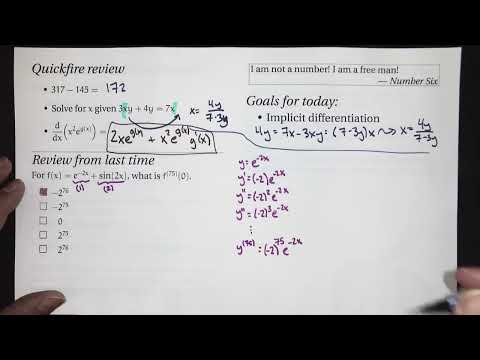 Watch on YouTube →
Overview
Beard Meets Calculus introduces implicit differentiation as a way to find derivatives when an equation relates x and y but cannot easily be solved for y. The lecture develops the method—differentiate both sides with respect to x, apply the chain rule wherever y depends on x, and solve for y′—through a circle, a more complex exponential equation, and tangent- and normal-line calculations.
Key takeaways
- Implicit differentiation works by treating y as a function of x even when no explicit formula for y is available; differentiating a term such as y² therefore produces 2yy′.
- For x² + y² = 25, implicit differentiation gives y′ = −x/y, which yields the tangent slope at a point on either half of the circle without selecting a square-root branch.
- The 75th derivative of e⁻²ˣ + sin(2x), evaluated at zero, is −2⁷⁶: the exponential contributes (−2)⁷⁵, and the sine term’s four-step cycle contributes −2⁷⁵.
- When a derivative is required at a known point, substituting the point before isolating y′ can simplify the work; for 2x² + y³ = 3xy + 3 at (2, 1), this gives y′ = 5/3 directly.
- For the curve 2x² + y³ = 3xy + 3 at (2, 1), the tangent slope is 5/3 and the perpendicular normal slope is its negative reciprocal, −3/5.
Chapters
0:00
Algebra, Product Rule, and Chain Rule Review
- The algebra review solves 3xy + 4y = 7x for x by grouping the x terms: x = 4y/(7 − 3y).
- For x²e^{g(x)}, the product rule and chain rule give 2xe^{g(x)} + x²e^{g(x)}g′(x).
- The review stresses that applying the chain rule is essential, including on exam problems.
3:38
Finding the 75th Derivative of e⁻²ˣ + sin(2x)
- Repeated differentiation of e⁻²ˣ produces a factor of (−2)ⁿ, so its 75th derivative is (−2)⁷⁵e⁻²ˣ.
- For sin(2x), each derivative contributes a factor of 2 while the sine/cosine and sign pattern repeats every four derivatives.
- Because 75 leaves remainder 3 when divided by 4, the sine term’s 75th derivative is −2⁷⁵cos(2x).
- At x = 0, the two terms sum to −2⁷⁵ − 2⁷⁵ = −2⁷⁶.
12:33
Exam Scores, Study Habits, and Course Perspective
- Beard Meets Calculus emphasizes that students are not defined by their exam scores, while still treating grades as useful feedback.
- The exam is described as an indicator—not a perfect predictor—of future course performance.
- Students satisfied with their results are encouraged to continue their current habits; students who are not should change their approach before the next exam, which is less than a month away.
16:04
Implicit Differentiation: Treating y as an Unknown Function of x
- Explicit functions provide a formula for the output, while an implicit relationship can involve x and y together without a convenient way to isolate y.
- The key assumption is to regard y as an unknown function of x, so differentiating y expressions requires the chain rule and introduces y′ or dy/dx.
- The method is to differentiate both sides, collect terms involving y′, and solve for the derivative in terms of x and y.
- When a derivative is needed at a specific point, evaluate early when practical so the rearrangement uses numbers rather than longer expressions.
22:39
Circle x² + y² = 25: Solving Explicitly for the Upper Half
- The circle of radius 5 is not a function of x because it fails the vertical line test.
- Solving for y gives y = ±√(25 − x²); the point (3, 4) lies on the upper branch, so use the positive square root.
- Differentiating y = (25 − x²)^{1/2} gives y′ = −x/√(25 − x²).
- At (3, 4), the tangent slope is −3/4.
28:43
Circle x² + y² = 25: Implicit Derivative Works on Both Halves
- Treat y as y(x) and differentiate x² + y² = 25 with respect to x to obtain 2x + 2yy′ = 0.
- Solving for the derivative gives y′ = −x/y, without choosing a positive or negative square-root branch.
- Substituting (x, y) = (3, 4) again gives slope −3/4, matching the explicit method.
- Unlike the explicit upper-half formula, the implicit relationship applies to the whole circle wherever the derivative is defined.
33:12
Differentiating an Implicit Equation with an Exponential and Product
- For e^{xy} + xy² + cos(2x) = 2, the terms combine x and y in ways that make solving explicitly for y impractical.
- The chain rule gives d/dx[e^{xy}] = e^{xy}(y + xy′), using the product rule on xy.
- The product and chain rules give d/dx[xy²] = y² + 2xyy′, while d/dx[cos(2x)] = −2sin(2x).
- Differentiating the constant right-hand side gives 0.
38:04
Isolating y′ in the Exponential Implicit Equation
- After differentiation, collect all terms containing y′ on one side and the remaining terms on the other.
- Factor y′ from the left-hand side to get (xe^{xy} + 2xy)y′ = 2sin(2x) − y² − ye^{xy}.
- Divide by the coefficient of y′ to obtain y′ = [2sin(2x) − y² − ye^{xy}]/[xe^{xy} + 2xy].
- The resulting derivative in x and y can be evaluated at a point to determine the slope of the implicit curve there.
41:08
Tangent and Normal Lines to 2x² + y³ = 3xy + 3
- For the curve at (2, 1), differentiation gives 4x + 3y²y′ = 3y + 3xy′.
- Evaluating at (2, 1) before rearranging yields 8 + 3y′ = 3 + 6y′, so the tangent slope is 5/3.
- The tangent line is y − 1 = (5/3)(x − 2).
- A normal line is perpendicular to the tangent, so its slope is the negative reciprocal, −3/5, and its equation is y − 1 = (−3/5)(x − 2).
Summary, takeaways, and chapters were generated by AI from the video's transcript and may contain errors. The video belongs to its creator, Beard Meets Calculus.