Immunology Fall 2026: Lecture 5 Cellular Innate Immunity
 Watch on YouTube →
Overview
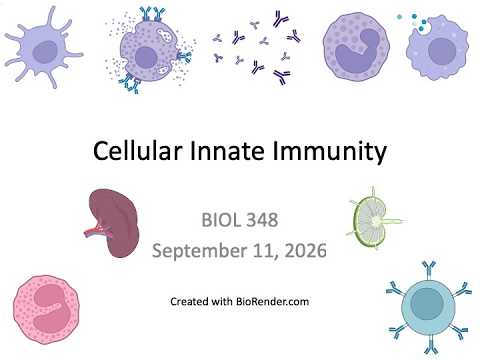
Brianne Barker explains how innate immune cells turn microbial or tissue-damage recognition into inflammation, recruit neutrophils, and contain or destroy microbes. The lecture distinguishes resident macrophages from short-lived neutrophils and connects PRRs, MAMPs/DAMPs, cytokines, blood-vessel changes, phagosome chemistry, fever, pus, and neutrophil extracellular traps (NETs).
Key takeaways
- Resident macrophages detect microbial MAMPs or tissue-damage DAMPs through PRRs, linking infection and sterile injury to overlapping inflammatory responses.
- TNF-α, IL-6, and IL-1β drive local vascular changes that produce cardinal signs of inflammation and enable immune cells and blood proteins to enter tissue.
- Cytokines also produce systemic effects: they can induce fever, increase liver acute-phase proteins, release bone-marrow neutrophils, and cause sickness behaviors.
- Neutrophils specialize in microbial killing through phagocytosis, acidic phagosomes, reactive oxygen and nitrogen species, and antimicrobial peptides.
- Neutrophils are short-lived; their death contributes to pus, while macrophages clear and recycle their remains.
- NETs are DNA-rich extracellular traps that immobilize microbes, and their production appears connected to neutrophil death.
Chapters
0:00
From Immediate Innate Defenses to Cellular Inflammation
- Preformed humoral proteins provide an immediate response; if they are insufficient, induced innate responses develop over roughly 4 hours to 4 days.
- The lecture focuses on neutrophils and macrophages as innate immune cells that phagocytose and kill microorganisms.
- Inflammation is a protective response to infection, tissue injury, or stress that supports defense, repair, and restoration of homeostasis.
4:00
The Four Cardinal Signs and Resident Macrophages
- The four cardinal signs are swelling, redness, heat, and pain; the traditional Latin terms are tumor, rubor, calor, and dolor.
- Inflammation follows a broadly similar process in skin and mucosal tissues, including the gastrointestinal tract and lungs.
- Resident tissue macrophages can initiate the response; examples include microglia in the brain, Langerhans cells in skin, and Kupffer cells in the liver.
8:45
Tissue Macrophages Detect Microbes with PRRs
- Macrophages are present in healthy tissue before infection; monocytes are their related blood-circulating counterparts.
- Pattern recognition receptors (PRRs) bind microbial features and allow macrophages to detect non-self.
- Innate cells are generalists: a macrophage can carry many receptor types and respond to a range of microbial features.
13:00
MAMPs, LPS, and Why Innate Recognition Targets Patterns
- A microbe-associated molecular pattern (MAMP) is a microbial molecule recognized by a PRR; receptors often target conserved features that microbes cannot readily change.
- Examples include lipopolysaccharide (LPS) in Gram-negative bacterial cell walls, flagellin in bacterial flagella, and peptidoglycan in prokaryotic cell walls.
- The older term PAMP means pathogen-associated molecular pattern, but MAMP is more accurate because some recognized features occur on nonpathogenic microbes too.
18:30
DAMPs Explain Inflammation Without Infection
- Damage-associated molecular patterns (DAMPs) can trigger similar inflammatory processes when tissue is injured without a microbe.
- Inflammation without infection, such as after a twisted ankle, is called sterile inflammation.
- MAMPs and DAMPs provide distinct signals for microbial presence and tissue damage, respectively.
24:50
PRR Signaling Triggers Phagocytosis and Cytokine Production
- PRR activation can stimulate phagocytosis, allowing a macrophage to engulf a detected microbe.
- PRR signaling can also alter gene transcription, leading cells to produce and release cytokines.
- Cytokines are immune signaling proteins; inflammatory cytokines coordinate inflammation, while other cytokines have different functions.
29:20
Cytokine Balance, Clotting, and Chemotactic Signals
- Immune responses require a Goldilocks balance: too little or too much cytokine activity can be harmful.
- PRR signaling is linked to blood clotting; excessive cytokine production during COVID-19 was associated with clotting problems.
- Chemokines are chemotactic cytokines that direct cell movement toward an affected site.
33:30
TNF-α, IL-6, and IL-1β Drive Local Inflammatory Signs
- The main inflammatory cytokines highlighted are TNF-α, IL-6, and IL-1β, which collectively produce many effects of inflammation.
- These cytokines cause vasodilation and increased vascular permeability, bringing more blood, immune cells, and proteins into affected tissue.
- Local fluid accumulation contributes to swelling; increased warm blood contributes to heat and redness, while cytokine effects on nerves contribute to pain.
- Complement proteins C3a and C5a can produce similar local effects, including vasodilation, vessel leakiness, and immune-cell recruitment.
41:30
Chemokines Recruit Cells Locally; Cytokines Can Act Systemically
- Inflammatory signals change blood-vessel adhesion molecules and help recruit immune cells into tissue.
- Chemokines attract moving cells to the affected area, while the vessel changes improve their access to tissue.
- Local inflammation, such as redness and swelling in an injured hand, does not necessarily mean the entire body has systemic inflammation.
45:30
Systemic Cytokines Cause Fever and Sickness Behaviors
- TNF-α, IL-6, and IL-1β can act on the brain, fat, muscle, liver, and bone marrow beyond the local infection site.
- Cytokine-driven fever can hinder temperature-sensitive microbes and improve white-blood-cell recruitment and other immune functions.
- The liver mounts an acute-phase response, increasing proteins including mannose-binding lectin and clotting-related proteins; cytokines also prompt bone marrow to release neutrophils.
- Sleepiness, lethargy, aches, reduced appetite, and nausea are sickness behaviors caused by immune signaling, and can also occur after vaccination.
52:45
Neutrophils Arrive as Specialized Phagocytes
- After macrophages recognize microbes and produce inflammatory signals, recruited neutrophils help kill the microbes.
- In Barker's comparison, macrophages can both phagocytose and produce cytokines, whereas neutrophils responding through PRRs primarily perform phagocytosis.
- Macrophages, neutrophils, and dendritic cells are the three major cell types classically identified as capable of phagocytosis.
57:20
Phagocytosis Builds an Acidic, Microbe-Digesting Phagosome
- During phagocytosis, a cell membrane surrounds a microbe and encloses it in a new compartment called a phagosome.
- The phagosome matures and becomes acidic, helping kill and digest the captured microbe.
- Digestion breaks microbes into components such as amino acids, sugars, fatty acids, and nucleotide bases that can be recycled.
1:01:20
Neutrophil Granules Use ROS, RNS, and Antimicrobial Peptides
- Neutrophil granules supply enzymes that generate reactive oxygen species and reactive nitrogen species inside the phagosome.
- Examples include superoxide, hydrogen peroxide, hydroxyl radicals, and hypochlorous acid—the active ingredient in bleach.
- Confining these toxic chemicals to the phagosome helps destroy microbes while limiting damage to the body's own tissues.
- Antimicrobial peptides provide another killing mechanism alongside reactive chemicals and the phagosome's acidic environment.
1:05:20
Neutrophil Death, Pus, NETs, and the Shift Toward Repair
- Neutrophils are short-lived and commonly die after attacking microbes; accumulated dead neutrophils contribute to pus.
- Macrophages can clear dead neutrophils and recycle their components, while retaining broader functions than neutrophils.
- Neutrophils can release DNA-rich neutrophil extracellular traps (NETs), which trap microbes; NET formation is called NETosis and appears linked to cell death.
- Macrophages can receive different signals that favor inflammation or tissue repair, an emerging area connecting immune responses with wound healing.
Summary, takeaways, and chapters were generated by AI from the video's transcript and may contain errors. The video belongs to its creator, Brianne Barker.