Immunology Fall 2026: Lecture 3 Cells and Organs of the Immune System Part 2
 Watch on YouTube →
Overview
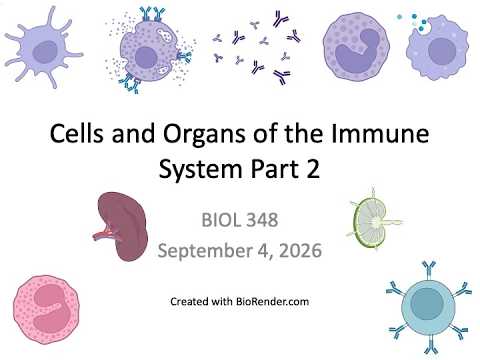
Brianne Barker maps immune-cell lineages to the organs and circulation that coordinate their activity: myeloid cells such as neutrophils, macrophages, and dendritic cells support innate defense, while B and T lymphocytes drive adaptive responses. She explains how primary lymphoid organs support cell development and how lymph nodes, the spleen, and mucosal tissues help pathogens meet specific lymphocytes, then previews the immediate role of preformed innate immune proteins.
Key takeaways
- Neutrophils dominate healthy blood white-cell counts at approximately 40–75%, while eosinophils and basophils are much rarer and therefore less extensively studied.
- Mast cells are tissue-resident granulocytes whose histamine-rich granules support parasite defense but also cause many allergic reactions.
- Dendritic cells are innate myeloid cells that activate adaptive T cells, making them a key bridge between the two broad arms of immunity.
- Primary lymphoid organs support immune-cell development: hematopoietic development occurs in bone marrow, and T cells receive additional development in the thymus.
- Secondary lymphoid organs solve the search problem for rare, pathogen-specific lymphocytes by concentrating immune cells and material from defined drainage regions.
- Preformed innate immune proteins can act immediately after infection, before immune cells become active, and may sometimes stop an infection without later responses.
Chapters
0:00
Hematopoiesis Splits into Myeloid and Lymphoid Lineages
- Hematopoietic stem cells in bone marrow give rise to myeloid and lymphoid branches.
- For an introductory framework, Brianne Barker associates myeloid cells mainly with innate immunity and lymphoid cells mainly with adaptive immunity, while noting the distinction is simplified.
2:10
Blood Granulocytes: Neutrophils, Eosinophils, and Basophils
- Granulocytes are named for visible granules; their three common blood types are neutrophils, eosinophils, and basophils.
- Neutrophils phagocytose and kill microorganisms; eosinophils target antibody-coated parasites, while basophils also participate in parasite responses.
- Neutrophils make up roughly 40–75% of healthy blood white cells, compared with much smaller proportions of eosinophils and basophils.
8:30
Tissue Mast Cells Release Histamine and Other Granules
- Mast cells are granulocytes found mainly in tissues such as skin and lungs, so routine blood counts rarely capture them.
- Their granules contain histamine and other toxic substances that help attack parasites too large to engulf.
- Mast-cell activation also drives many allergic reactions, with symptoms depending on which tissue’s mast cells respond.
11:10
Monocytes Become Tissue Macrophages
- Monocytes circulate in blood, while closely related macrophages are more commonly found in tissues; both belong to the myeloid innate immune lineage.
- Both cell types have a characteristic kidney-bean-shaped nucleus and can phagocytose and kill microorganisms.
- Barker contrasts macrophages’ broader response capabilities with neutrophils’ rapid microbe-killing role, reserving further comparison for later lectures.
15:50
Dendritic Cells Connect Innate Defense to T Cells
- Dendritic cells are tissue-associated myeloid cells named for their long, branching processes, which resemble neuronal dendrites but are unrelated to the nervous system.
- Their shape suits tissue surveillance better than fast-moving blood circulation, where projecting processes could be damaged by flow.
- Although innate immune cells, dendritic cells are especially important because they activate T cells and connect innate responses to adaptive immunity.
22:00
B Cells and T Cells Define the Adaptive Lymphocyte Branch
- The lymphoid branch produces lymphocytes, especially B cells and T cells, which are introduced as the main adaptive immune cells.
- B cells make antibodies; T cells have diverse roles that are not captured by a single simple definition.
- Lymphocytes vary by subtype and developmental or activation state; natural killer cells are another lymphocyte type, though their classification complicates the introductory innate/adaptive split.
27:40
Immune Cells Vary Across Blood, Tissues, and Organs
- Blood-cell percentages are broad reference ranges, not precise measures of what is optimal for an individual; a complete blood count compares results with ranges such as 40–75% neutrophils.
- A reference-person study showed that immune-cell proportions by cell count differ from proportions by total mass; macrophages contribute unusually large mass because they are relatively heavy.
- Immune cells occur throughout the body, but some organs are much more immune-cell-dense than others, and tissue-resident populations are harder to study than blood cells.
34:50
Primary and Secondary Lymphoid Organs Have Different Jobs
- Bone marrow and thymus are primary lymphoid organs, where immune cells develop; T cells undergo additional development in the thymus.
- Secondary lymphoid organs include lymph nodes, spleen, tonsils, adenoids, appendix, and other lymphatic tissues.
- Secondary organs are meeting places where lymphocytes encounter pathogens and initiate responses, helping specific cells find rare targets without searching the whole body.
38:45
Lymphatic Vessels Reclaim Fluid from the Circulation
- Blood pressure pushes fluid and some dissolved proteins out of arteries into tissues; this interstitial fluid delivers nutrients but must be collected again.
- Open-ended lymphatic vessels have one-way valves but no central pump; body movement helps move fluid into and through them.
- Lymphatic vessels join into larger channels and return collected fluid to the bloodstream near the heart, preventing fluid from accumulating in tissues.
48:55
Lymph Nodes and the Spleen Provide Immune Surveillance
- Lymph nodes act as checkpoints along lymphatic drainage routes, where material from specific body regions can be inspected before lymph returns to circulation.
- Regional drainage lets lymphocytes search a relevant node—for example, nodes near the neck receive drainage from sinus regions—instead of surveying every tissue.
- The spleen functions in immune surveillance of the blood and shares organizational features with lymph nodes, alongside its role in red blood cell maintenance.
55:40
GALT, Peyer’s Patches, and Other Mucosal Lymphoid Tissues
- GALT means gastrointestinal-associated lymphoid tissue; Peyer’s patches are organized immune sites in the intestinal wall that monitor the gut.
- MALT includes mucosal immune tissues, with NALT in nasal regions and BALT in lung-associated regions; tonsils and adenoids are examples of specialized surveillance sites.
- Gut, nasal, and lung tissues face frequent exposure to the outside world, while their dispersed immune structures can be difficult to isolate and quantify experimentally.
59:45
Tertiary Lymphoid Sites Form During Active Responses
- A tertiary lymphoid organ is any body site actively mounting an immune response; an infected liver or inflamed patch of skin can temporarily fit the definition.
- In a draining lymph node, activated antigen-specific B or T cells proliferate into many copies, producing the swelling commonly associated with infection.
- Unlike primary and secondary lymphoid organs, tertiary sites are defined by an active response rather than by being permanent, specialized organs.
1:03:25
Preformed Innate Proteins Act Before Cellular Responses
- Humoral innate defenses include proteins already present in the body, allowing them to act immediately after a microbe enters.
- Innate immune cells take several hours to become active, while preformed proteins can provide early defense and sometimes contain an infection without further response.
- These proteins are especially useful against extracellular pathogens; invertebrates and plants also rely on innate defenses, underscoring their importance beyond vertebrate adaptive immunity.
Summary, takeaways, and chapters were generated by AI from the video's transcript and may contain errors. The video belongs to its creator, Brianne Barker.