IEE 475: Lecture B1 (2026-09-01): Fundamental Concepts of Discrete-Event Simulation
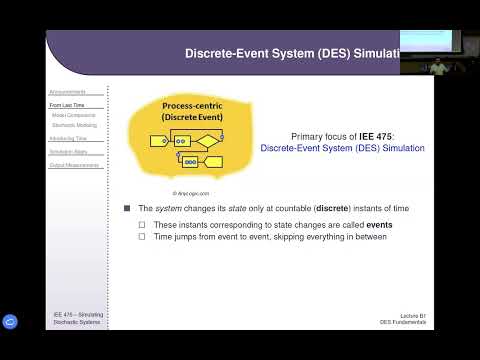 Watch on YouTube →
Overview
IEE 475 Lecture B1 establishes the core vocabulary and mechanics of discrete-event simulation: entities move through process-defined flows, resources constrain their progress, and system state changes at scheduled events. Ted Pavlic connects these ideas to Arena and the B1 hand-simulation homework, explaining how input distributions generate variable outcomes and how a future event list builds a car-wash simulation one event at a time.
Key takeaways
- Discrete-event simulation advances only when a scheduled event changes system state, avoiding fixed time-step calculations during periods when nothing happens.
- Entities are passive objects moved by process logic, while resources impose capacity constraints; entities seize and release resource capacity as they move through the system.
- Activities are unimpeded resource-use times supplied as model inputs, whereas delays emerge from interactions such as queues and must be measured from simulation runs.
- Input distributions determine the simulated operating conditions, so even a well-built Arena model can produce untrustworthy results when its arrival or service assumptions are wrong.
- The future event list is a simulator-managed priority queue ordered by event time; hand simulation should add events only as current events are processed.
- Randomized inputs produce variable outputs, making repeated runs and statistical analysis necessary to draw conclusions about performance.
Chapters
0:00
IEE 475 B1 Assignments, Lab Support, and Arena Tournament
- Homework B1 combines entity/activity/resource identification across three systems with a hand simulation of an M/M/1 queue.
- Lab 2 and homework B1 are individual assignments; the lab session is extended TA office hours, not a required lecture.
- Canvas contains a hand-simulation walkthrough, tutor bots, and additional assignment resources; the Arena tournament offers a possible final-project topic.
7:25
Discrete-Event Simulation as a Process-Centric Model
- Discrete-event systems change state at countable instants, such as a classroom arrival or departure, rather than continuously.
- Events trigger state changes, while process logic determines when activities finish and entities move.
- Arena flowchart blocks contain the rules; entities are passive objects routed and aggregated by those processes.
11:09
Choosing Entities and Representing Real or Virtual Objects
- Entities are the focal objects flowing through processes and are often the subjects of the research question, such as restaurant customers or airport passengers.
- A model can represent variation with separate entity types, such as business and standard travelers, or with attributes on one entity type.
- Virtual entities can simplify modeling: a traffic-light controller can be represented as an entity moving between north–south and east–west states.
17:44
Entity Attributes: Arrival Times, Due Dates, and Priorities
- Attributes distinguish entities without requiring separate types; examples include customer order type, patient blood pressure, or traveler status.
- Arena automatically records each entity's arrival time, enabling time-in-system calculations when it exits.
- Due dates and priorities can affect routing and queue order; an airport passenger flagged for a second metal-detector check could receive higher priority.
23:03
Resources, Capacity, and Seizing Limited System Space
- Resources are limited people, equipment, or space required to perform activities; a traffic intersection and its available roadway space can both constrain cars.
- Entities seize resource capacity while using it and release capacity when they move on, allowing waiting entities to proceed.
- A resource with capacity two can admit two ordinary cars, while a wide-load truck needing both units must wait until both are available.
27:44
Changing the Modeling Reference Frame: Vacuum Cleaners and Moving Resources
- For an autonomous vacuum, dirt can be modeled as arriving to a stationary vacuum rather than modeling the vacuum's physical motion.
- This reference-frame shift makes the dirt the entity and the vacuum the resource that limits the rate of collection.
- The same approach applies to underwater search vehicles, manufacturing robots, and quail searching for prey when resource motion is central to the research question.
32:28
State Variables and the Simulation State Vector
- A state vector collects the variables relevant to the research question, such as queue length, fabrication temperature, or the list of entities waiting.
- The simulation clock is also a changing state variable, even when model logic does not directly use it.
- In a discrete-event model, state variables change at events; some variables may remain constant in a particular system, such as a queue that always stays empty.
34:58
Separating Resource Activities from System-Induced Delays
- An activity is the unimpeded time to use a resource; for a car, it is the time to pass through an intersection when nothing blocks the route.
- A delay is waiting caused by system conditions, such as cars ahead preventing entry to the intersection.
- Activity-time distributions are model inputs, while queueing delays depend on other entities and must be measured from simulation output.
38:32
Stochastic Input Modeling and Variable Simulation Outputs
- Input modeling represents real-world variation with fitted probability distributions instead of tracking every vehicle or customer individually.
- Stochastic modeling treats complicated variation as random for modeling convenience; a busy airport differs from an idle one through its passenger interarrival-time input.
- Random inputs make results vary across runs, so output analysis requires repeated computational experiments and statistical methods such as t-tests or ANOVA.
46:19
Intersection Quiz: Classifying Waiting Time as a Delay
- The intersection question distinguishes time spent waiting to enter from time spent traversing the intersection.
- Waiting is a delay because its duration depends on traffic and cannot be known from the vehicle's unimpeded travel time alone.
- A simulated queueing-time distribution can later become an input to another model that does not represent every car.
50:34
Event Scheduling, Irregular Time Jumps, and the Future Event List
- An event is an instant, such as a concert's start or end; the concert's duration is an activity, not an event.
- Discrete-event simulation jumps directly to the next scheduled state change instead of checking the system at fixed one-second intervals.
- The event calendar, or future event list (FEL), is a time-ordered priority queue used by the simulator for bookkeeping and debugging, not a model state variable.
56:36
Car-Wash Walkthrough: Building the Event Calendar Incrementally
- The example models cars as entities and the car wash and vacuum as single-capacity resources, with travel times between stations.
- When car A arrives, the model schedules its travel to the wash and the next arrival; entering the wash schedules an exit using the service-time input.
- If car B reaches the occupied wash, it joins the queue; when A exits, B can enter and receive a scheduled wash departure, while A proceeds toward the vacuum.
1:06:21
Hand-Simulation Discipline: Let the Future Event List Build Itself
- Do not schedule arrivals several steps ahead: process the current arrival first, then schedule only the next arrival using the interarrival time.
- Interarrival times describe gaps between arrivals, while service times describe activity durations at resources; homework B1 and Lab 2 provide values in lists.
- Following the event-by-event procedure prevents hand simulators from doing hidden future work that the simulation itself has not yet processed.
1:08:02
Arrival, Departure, and End-Event Rules for the Hand Simulation
- Initialize the future event list with the first arrival and an artificial end event, then repeatedly process the earliest scheduled event.
- On arrival, schedule the next arrival; if a server is available, schedule the entity's departure, otherwise add the entity to the queue.
- On departure, move a waiting entity into the resource and schedule its departure; if end and other events coincide, process the other events before ending the simulation.
- Track server and queue counts, entity arrival times, waiting performance, and resource utilization as outputs for statistical analysis.
Summary, takeaways, and chapters were generated by AI from the video's transcript and may contain errors. The video belongs to its creator, Ted Pavlic.