IEE 475: Lecture A2 (2026-08-27): Introduction to Simulation Modeling
 Watch on YouTube →
Overview
IEE 475 introduces simulation modeling by distinguishing models that answer what-if questions, static outcomes from dynamic trajectories, and three major dynamic-modeling approaches: system dynamics, agent-based modeling, and discrete-event simulation. The lecture focuses on discrete-event simulation, explaining how entities, resources, state, events, activities, and delays fit together, and why stochastic inputs can approximate complex real-world variability.
Key takeaways
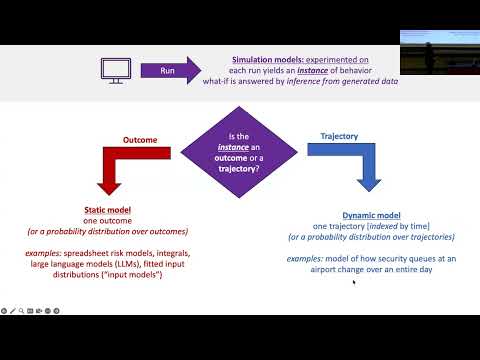
- A static model produces an outcome or outcome distribution, whereas a dynamic model produces a time-indexed trajectory; repeated runs can therefore reveal how often extreme queueing behavior occurs.
- System dynamics aggregates populations into continuous stocks and flows, agent-based modeling simulates individuals making decisions, and discrete-event simulation moves entities through processes at scheduled state changes.
- In discrete-event simulation, an event calendar makes execution efficient by skipping intervals in which the modeled state cannot change.
- Activities are input service durations that are modeled independently of system congestion, while delays are state-dependent waits that emerge as simulation outputs.
- Stochastic modeling often represents complexity rather than literal randomness: sampling from fitted distributions can approximate arrival and service variation without modeling every causal detail.
- Simulation roles depend on the research question: passengers are entities in a customer-service model, while the employees serving them may be resources—or entities in a model of employee experience.
Chapters
0:00
Models Answer What-If Questions
- A model is anything that helps answer a what-if question; a useful model makes predictions that align with reality.
- Mental models draw on personal experience but can be difficult to explain or transfer to another person.
- Quantitative models formalize assumptions so their predictions can be generated mechanically, by solving equations or running a simulation.
5:00
Solved Mathematical Models vs. Executed Simulations
- Mathematical models can yield symbolic relationships; a projectile trajectory, for example, predicts when a ball returns to the ground by finding when its height reaches zero.
- Simulation models are executed rather than solved, and each run produces one instance of system behavior.
- Repeated simulation runs create data from which analysts infer patterns and make recommendations.
12:00
Static Outcomes and Dynamic Trajectories
- A static model produces one outcome or a distribution of outcomes, as in a profit-risk model or a single answer sampled from a language model.
- A dynamic model produces a time-indexed trajectory, such as airport security queue length throughout a day.
- Repeated airport-model runs may produce different trajectories; an extreme 90-minute security wait matters partly because analysts need to estimate how often it occurs.
15:25
Building Dynamic Models from Inputs and State Updates
- A dynamic model combines static input models, such as the distribution of time between airport arrivals, with rules that update system state.
- State variables can include the number of people waiting for security and the number already in the gate area.
- Arrival bursts generated by the input model can produce downstream queue buildup through the state-update rules.
18:45
Three Core Types of Dynamic Simulation
- Dynamic models differ in what carries their state and how that state advances over time.
- System dynamics, agent-based modeling, and discrete-event system simulation are presented as the three core approaches.
- IEE 475 concentrates on discrete-event simulation; system dynamics is covered in IEE 477, and agent-based modeling appears in Lab 4.
23:20
System Dynamics: Aggregate Stocks and Continuous Flows
- The Bass innovation-diffusion model tracks aggregate stocks such as potential adopters and adopters rather than individual customers.
- Stock-and-flow diagrams represent state quantities and the differential-equation flows that transfer quantity between them over continuous time.
- Epidemiological SIR models similarly track counts of susceptible, infectious, and recovered people, with infection flows depending on the current counts.
27:20
Agent-Based Models: Individual Decisions and Spatial Variation
- Agent-based models represent individuals explicitly and commonly update them at fixed time steps, repeatedly asking agents whether they will act.
- An airport example uses 496 passenger agents, random movement, and security lanes whose availability affects passenger progress.
- Explicit spatial behavior can represent possibilities such as a forest fire spreading along different routes, but every modeled behavior must be justified and validated.
36:30
Discrete-Event Simulation: Jumping Between State Changes
- Discrete-event simulation advances from one scheduled event to the next instead of computing every moment between events.
- An event calendar or future-event list stores possible state-changing events, such as passenger arrivals and service completions.
- Entities follow process logic rather than making autonomous decisions, enabling efficient simulation while retaining individual variation.
47:00
Arena Airport and Emergency-Room Examples
- Arena models represent queues, resources, and work in progress, with visualizations that help stakeholders relate simulated behavior to familiar settings.
- An emergency-room model routes patients according to condition severity and the availability of beds, doctors, and nurses.
- Tracking resource use allows analysts to compare outcomes with costs, such as the expense of routing more patients to doctors.
51:00
Stochastic Models vs. Deterministic Computation
- A stochastic model uses probability to simplify a complex system, even when the underlying process—such as a bank transaction—is not fundamentally random.
- Analytic queueing methods solve formulas, while simulation samples from input distributions and analyzes the resulting runs.
- Monte Carlo methods can also estimate deterministic quantities: Lab 3 uses random sampling to estimate π, although π itself is fixed.
57:00
System Boundaries, State Variables, and State
- A system is a group of connected objects with a joint purpose, and its boundary determines which details—such as airport passengers’ appetite—must be modeled.
- A state variable is a quantity such as classroom occupancy; its current value, such as 50 people, is the system’s state at that moment.
- IEE 475 focuses on discrete-event systems whose state changes at events, rather than continuously changing quantities such as room temperature.
1:03:00
Resources, Entities, Activities, and Delays
- Resources are limited-capacity model components, such as an airport X-ray scanner; entities such as passengers compete for access.
- An activity is the time spent receiving service at a resource, while a delay is the state-dependent time spent waiting to access it.
- The same object can be an entity or resource depending on the question: airport document checkers are resources in a passenger-service model but entities in an employee-experience model.
1:04:00
Activities Are Inputs; Delays Are System Outputs
- Activity duration is modeled as an input that does not depend on how busy the system is; using an X-ray scanner takes its modeled service time either way.
- Delay depends on system state: the time to reach a scanner is short when it is free and longer when a queue has formed.
- Queue wait time should generally be measured as a simulation output, not supplied as an input distribution, because it emerges from arrivals and resource availability.
1:07:30
Entity Attributes, State Snapshots, and Flowchart Blocks
- Manufacturing parts can carry attributes such as part number, color, type, and arrival time, allowing the model to calculate each part’s time in the system.
- Machine busy/idle indicators can form a state vector; additional state variables may track queue lengths or resource availability.
- Simulation flowcharts use creation blocks for arrivals, process blocks for activities and resource use, decision blocks for routing, and disposal blocks to record completed-entity statistics.
1:13:00
Randomized Arrival Inputs and the Closing Clicker Question
- A deterministic arrival model might impose exactly 20 minutes between passengers, while a stochastic model samples intervals around a fitted distribution with a 20-minute average.
- Random input models replace impractical rules based on every traveler’s circumstances; later lectures cover mapping random numbers to arrival times and outcomes such as an 80% security-pass rate.
- The closing clicker checks the key terminology: time spent waiting to enter a resource is a delay, not an activity.
Summary, takeaways, and chapters were generated by AI from the video's transcript and may contain errors. The video belongs to its creator, Ted Pavlic.