IEE 475: Lecture A1 (2026-08-25): Introduction to Modeling
 Watch on YouTube →
Overview
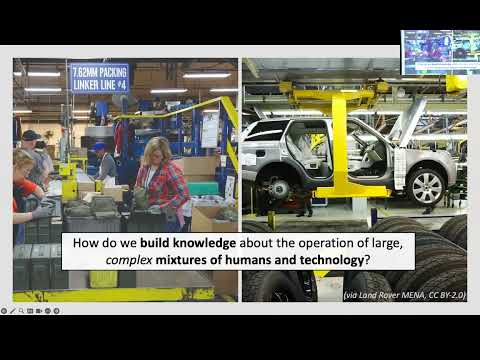
Ted Pavlic frames industrial and systems engineering as both a scientific and engineering discipline: IEs build and test models of complex human–technology systems, then use those models to improve real operations. The lecture defines a model as anything that helps answer a “what if?” question and argues that useful models need not reproduce reality perfectly; they must make assumptions explicit, support insight and communication, and be validated against real systems.
Key takeaways
- A model is any representation that helps answer a “what if?” question, whether it is a fashion model, a graph, a physical setup, or a computer simulation.
- Model quality is judged by usefulness and validation, not by perfect realism; a model is valuable when it supports insight or improves decisions in the real system.
- Simplifying a model can improve its generalizability by focusing on features shared across systems rather than overfitting one location, such as a single New York City intersection.
- Industrial and systems engineering combines scientific work—building and validating models—with engineering work—using those models to improve human–technology systems.
- Mental models embed experience-based assumptions about causes, people, and systems; making those assumptions explicit is essential before encoding them in a quantitative simulation.
- Simulation can expose operational effects that intuition misses, including Southwest Airlines’ finding that routing cargo through an available hub-bound flight can beat waiting for a direct route.
Chapters
0:00
Course Logistics: Unit Zero, A2, Lab One, and Homework B1
- Unit Zero consists of two syllabus exercises that unlock the rest of the course and count toward lab and lecture attendance grades.
- Short assignment A2 is due before the next lecture; Lab One is due Sunday and does not require lab hardware.
- The lab TA is sick for Tuesday but is expected Thursday; students can seek help by email, appointment, office hours, or online.
- Homework B1 is released with a tailored tutor bot and a hand-simulation walkthrough video.
3:43
Science, Engineering, and Industrial Engineering’s Dual Role
- Science develops knowledge about nature through hypotheses and experiments; engineering applies science and mathematics to create useful, durable systems for people.
- Engineering must account for constraints such as cost and manufacturing: a filter design using one resistor value may be cheaper to produce than one using five values.
- Industrial and systems engineering draws on multiple fields because human–technology systems have no single established science that explains every context.
- IEs develop and validate their own models, then use them to design processes and improve efficiency; the lecture cites the t-test’s origins in Guinness production research.
14:58
Fashion Models Show How Models Answer ‘What If?’
- A fashion model helps shoppers imagine what a jacket or dress might look like on them—an indirect answer to “What if I wore this?”
- The model is an imperfect stand-in: differences in height, weight, posture, and appearance affect how well the result generalizes.
- Choosing a representative model requires assumptions, just as operational models require assumptions about the systems they represent.
19:00
Animal Models Trade Exact Realism for Safer Testing
- A mouse can serve as an animal model for investigating a drug’s effects before human trials because it shares some relevant physiology with humans.
- A harmful result in an animal may warn of risk to humans, but a safe result does not guarantee the same outcome in people.
- Animal models are useful despite visible differences from humans; a model’s purpose is not to eliminate the gap with reality.
21:51
Atomic and Gravity Models: Useful Predictions Without Perfect Reality
- Models of atoms have shifted from Bohr’s circular electron orbits to later orbital and electron-cloud descriptions as evidence and explanatory needs changed.
- A simple atom model may be sufficient for elementary education even when quantum-mechanical detail is needed for more precise questions.
- Newtonian mechanics is adequate for many engineering tasks, such as keeping aircraft in flight, while relativity explains phenomena that require greater precision.
- The George Box maxim “All models are wrong, but some are useful” means asking how much a model can be simplified without losing its practical value.
29:10
The Core Definition: Models Answer ‘What If?’
- The broadest definition in the lecture is that a model is anything that helps answer a “what if?” question.
- Models do not have to be mathematical, computational, or laboratory-based; fashion models and physical representations can also support counterfactual reasoning.
- A model is useful when it helps people understand a system or make better decisions, with its conclusions checked against reality.
33:00
Statistical and Graphical Models Reveal Patterns
- A statistical model can summarize the relationship between high-school GPA and university GPA, even though most individual students do not fall exactly on the fitted line.
- The GPA relationship can be informative without explaining the causal mechanism behind it or predicting an individual student’s exact outcome.
- A graph of exercise intensity and oxygen consumption communicates the rise toward VO₂ max, where oxygen consumption levels off.
- Predator–prey graphs make lagged boom-and-bust cycles easier to see than a verbal description alone.
35:25
Physical Models, Traffic Patterns, and Learning from Failure
- Small-scale manufacturing setups can act as physical models for testing ideas about larger systems before applying them in production.
- An uncontrolled intersection where drivers form an emergent traffic flow suggests alternative coordination strategies, but its success may depend on local driving culture and conditions.
- The Titanic disaster prompted investigation into how cold water made the ship’s metal brittle, illustrating how real-world failures can reveal previously overlooked risks.
- Because disasters impose severe costs on people, engineering uses safety factors and artificial models to learn before relying on harmful real-world trials.
43:55
Why Simplified Models Like Monopoly Can Be More General
- Monopoly models selected real-estate features, such as property ownership and jail, while omitting police operations and many other parts of a real city.
- A simplified simulation can isolate the mechanisms relevant to a question and help users test changes before returning to the real system.
- Reducing realism can improve generalizability: a model tuned to one New York City intersection may not transfer to Phoenix or other locations.
- Simple simulations can also help communicate assumptions and give decision-makers interactive controls to test whether they agree with a proposed explanation.
47:00
Visual Puzzles Reveal Hidden Mental-Model Assumptions
- A diagram of overlapping shapes can prompt interpretations such as two triangles, a triangle over three circles, or a Pac-Man story, even though those narratives are not literally drawn.
- People infer causes and intentions from sparse images by mentally testing possible explanations for how the image could have been produced.
- A rough human figure can evoke judgments about identity or emotion despite unrealistic proportions, exposing assumptions that a computer model would need to represent explicitly.
- Identifying which assumptions drive a human interpretation is a first step toward encoding relevant reasoning in a simulation.
55:00
Physical Experience and the Doctor Riddle Test Mental Models
- A person steering a boat updates their mental model when moving the rudder produces an unexpected direction of travel.
- The surgeon riddle—where a doctor says an injured boy is their son—reveals assumptions about gender, family structure, and wording.
- Possible explanations include the doctor being the boy’s mother or the family having two fathers; which answer comes to mind can reflect a person’s experience.
- Mental models store rich context but can be unreliable with complexity, change, and communication across people with different backgrounds.
59:10
Quantitative Models: Mathematical, Numerical, and Simulation Approaches
- Mathematical models, such as those emphasized in IEE 470, often focus on long-run averages like queue lengths rather than the full path of change over time.
- Numerical methods can iterate a mathematical relationship in tools such as Excel to produce approximate time-series results and graphs.
- Simulation models represent assumptions and system structure in a flexible form, often graphically, while software handles the calculations behind the scenes.
- Simulation flexibility comes with a need to understand how model assumptions are translated into code and how the software executes them.
1:02:40
Simulation Applications: Southwest Airlines, Digital Twins, and LLMs
- Southwest Airlines used simulation to study cargo routing; sending cargo on an available plane toward a hub could outperform waiting locally for a plane going directly in the desired direction.
- ASU research showed that passenger seating arrangements can affect disease spread on aircraft, even when they have little effect on boarding time.
- A digital twin pairs a high-fidelity simulation with live data from a physical system to forecast near-term outcomes and support operational decisions.
- The course treats simulation as more than programming: model usefulness, computational efficiency, and statistical analysis all need careful attention.
Summary, takeaways, and chapters were generated by AI from the video's transcript and may contain errors. The video belongs to its creator, Ted Pavlic.