IEE 475: Lecture 0 (2026-08-20): Introduction to the Course and Its Policies
 Watch on YouTube →
Overview
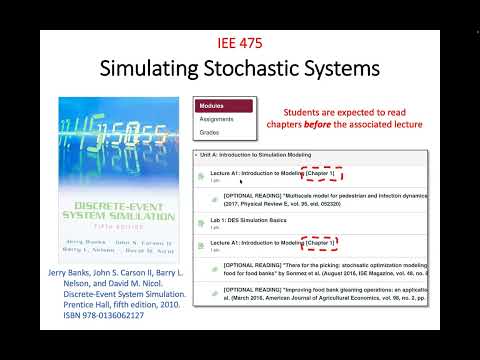
Ted Pavlic introduces IEE 475, Simulating Stochastic Systems, and explains how Canvas modules, optional lab sessions, and a sequence of simulation assignments support the course. Students learn stochastic modeling, Monte Carlo methods, and Arena-based discrete-event simulation, then apply them in a group project; the course uses flexible grading, two-stage exams, and explicit policies for deadlines and individual work.
Key takeaways
- IEE 475 treats lab meetings as an optional resource: lab videos are available in advance, and students can complete work independently if they meet the deadlines.
- Simulation modeling requires selecting system details that affect the question being studied; a theme-park queue model needs ride times and demand, not visitors’ beverage preferences.
- The two-stage exams combine individual mastery and collaborative correction: the individual closed-book score contributes 80%, while the open collaboration stage contributes 20%.
- Most assignments have a no-penalty grace period until 10 a.m. after the 11:59 p.m. due date, but the final project is excluded because peer reviews depend on its submission schedule.
- Arena is taught as graphical, flowchart-based simulation software, so logical process flow is more important than proficiency in a specific programming language.
- Students must complete Unit 0’s lecture and lab activities to unlock the rest of the course, and should register for iClicker before attendance exercises begin.
Chapters
0:00
Canvas Modules, Lecture Recordings, and Optional Lab Sessions
- Canvas Modules is the main course hub; Unit 0 contains two syllabus-related activities that unlock the rest of the course.
- The course meets for two 75-minute lectures each week, with labs Tuesdays and Thursdays at 1:30 p.m. in M11 at the Brickyard.
- Lab attendance is optional: videos are posted ahead of time, and students can work independently or use the scheduled period with a TA.
6:40
Stochastic Models, LLM Sampling, and Simulation Scope
- Pavlic distinguishes stochastic modeling from literal randomness: probability distributions can represent complex real-world variability more simply.
- Large language models such as ChatGPT and Claude generate text by sampling from predicted word distributions.
- The course connects random-number generation to AI watermarking and teaches how to include relevant system details while excluding irrelevant ones, such as visitors’ Coke-versus-Pepsi preferences in a theme-park line model.
11:40
Course Sequence, Arena, and Simulation Software
- Before the midterm, students refresh probability and statistics, study random-number generation, and build probabilistic input models; afterward, the focus shifts to experimental design and credible performance inference.
- Labs progress through simulation fundamentals and Monte Carlo methods, then introduce Arena for discrete-event simulation and the term project.
- Arena uses graphical flowcharts and short expressions rather than conventional object-oriented coding; familiarity with programming logic matters more than Java, Python, or C++.
- Canvas provides course-text access options; early labs use Excel or Google Sheets and free NetLogo, while Arena is Windows-only and can also be accessed through Apporto or campus lab computers.
20:50
Grading Drops and the Real-World Simulation Project
- Attendance is worth 5% of the grade, with three sessions dropped before and three after the midterm; clicker questions are completion-based.
- Canvas activities have seven drops, the five homework assignments generally have one lowest score dropped, and the lowest two lab scores are dropped.
- Groups form after the midterm, usually with four students; teams gather or use public data, model a real system, and recommend improvements.
- The project concludes with a four-page report and a presentation of ten minutes or less; students upload presentations and review assigned classmates’ work.
25:55
Two-Stage Midterm and Final Exams
- Both exams have two stages administered online over separate windows, and students do not have to attend class to take them.
- Stage 1 is an individual, closed-book, proctored attempt with two sheets of notes allowed; answers and scores are withheld until the collaboration stage closes.
- Stage 2 repeats the same exam open-book, open-note, and collaboratively; the final score combines 80% of the individual result with 20% of the group result.
29:20
Assignment Labels, Grace Periods, and Grade Questions
- Homework labels such as B1 correspond to the lecture where the assignment is introduced; Canvas activities such as A2 are due before the matching lecture.
- Most work is due at 11:59 p.m. and remains available until 10 a.m. the next day without a late penalty; the final project is an exception because of peer review.
- Students should notify Pavlic in advance about known religious-holiday absences; the course also aims to provide multi-day exam windows for flexibility.
- Grade concerns should be raised within one week and directed to the relevant TA: the lab TA for labs and the lecture TA for homework.
34:30
Copyright, Individual Work, and Anonymous Questions
- Course materials, assignment solutions, and student notes must not be uploaded, sold, or shared externally; Pavlic identifies this as an academic-misconduct risk.
- Homework and labs are individual assignments; the final project and exam Stage 2 are the specified exceptions, and submitted work must reflect each student’s own understanding.
- Students can submit questions anonymously at links.asu.edu/iee475questions; Pavlic may respond during class or follow up through Canvas discussions or Slack.
38:50
Unit 0 Checklist and Arena Access Options
- Students should register for iClicker and complete both Unit 0 activities to unlock the remaining course modules.
- Chapter 1 begins the following week; the first Unit A Canvas activity is due before its corresponding lecture, and Lab 1 is due the following Sunday.
- Arena’s student edition limits model size, and models saved in a commercial version may not open in the student edition; other access options include Apporto, M11, and Brickyard lab computers.
Summary, takeaways, and chapters were generated by AI from the video's transcript and may contain errors. The video belongs to its creator, Ted Pavlic.