I Gave ChatGPT a Body Part 2
 Watch on YouTube →
Overview
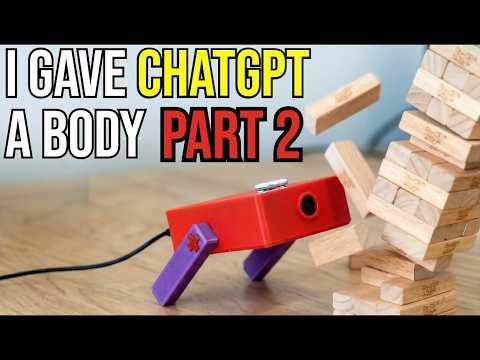
Art of the Problem introduces Grobot, an autonomous robot built around an old smartphone that uses phone sensors, neural networks, and a growing “soul file” to perceive, learn, and control a physical body. The project argues that accessible, inspectable robots built from the bottom up are preferable to closed corporate systems, and demonstrates a low-cost phone-and-pizza-box prototype that community members assembled within a day.
Key takeaways
- An old smartphone can serve as Grobot’s sensing and computing core, reducing the custom electronics needed to build a physical AI prototype.
- Grobot streams phone sensor data to a microcontroller, which controls motors and legs; the demonstrated system produced a slow, stable walk with a roughly trained neural-network policy.
- The creator’s safety argument favors small, owner-controlled robots that people can inspect, modify, and retrain over opaque corporate systems.
- Grobot stores experiences in a growing “soul file” and is designed to periodically dream as a mechanism for self-improvement.
- More than 10,000 people requested a robot after the first project, and Discord community members built working phone-based prototypes on the day instructions were released.
Chapters
0:00
Grobot: An Autonomous AI Creature Inside a Smartphone
- Grobot runs on an old smartphone and uses its sensors—including touch, brightness, sound, and image—to sense its surroundings.
- Neural networks control the system end to end, while a growing memory file stores experiences and supports periodic self-improvement through “dreams.”
- The creator contrasts bottom-up, inspectable robots owners can modify with closed corporate robots whose decisions outsiders cannot examine.
3:00
Replacing a Custom Robot Build with an Old Phone
- After the first robot project attracted more than 10,000 requests for kits or finished robots, parts shortages and costs made manual production difficult to scale.
- The proposed shortcut was to repurpose an old smartphone, whose chip and sensors could replace much of a custom electronics build.
- A rough prototype combined a phone, microcontroller, battery, motors, and pizza-box materials; phone sensor data was streamed to the controller to move the robot’s legs.
6:40
Phone-Controlled Walking, Community Builds, and the Grobot Platform
- The prototype ran a roughly trained neural-network policy to produce a slow, stable walk, and the creator showed access to logs and the robot’s memory file.
- Build instructions shared through Discord led people to assemble working robots the same day—a notably fast result compared with the week of troubleshooting often expected in robotics.
- The creator presents the first robot as a starting platform that can control different bodies and behaviors by adding motors and sensors.
Summary, takeaways, and chapters were generated by AI from the video's transcript and may contain errors. The video belongs to its creator, Art of the Problem.