How We’d Make $10K/Month From SEO Starting Today (From Scratch)
 Watch on YouTube →
Overview
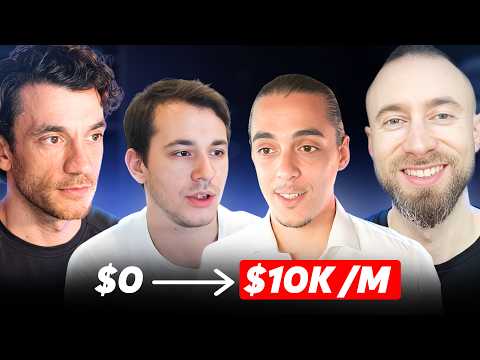
Edward Sturm hosts Julian Goldie, Charles Floate, and Alejandro Meerrens for a tactical breakdown of how to reach $10K/month from SEO starting from scratch in 2026. The core playbook mixes cheap aged-domain site builds, selling links, parasite SEO, high-ticket AI automation offers, and multi-platform content distribution across YouTube, X, LinkedIn, Reddit, and Instagram. The discussion repeatedly returns to one theme: SEO is shifting from single-site optimization to building distributed authority across many assets, publishers, and social signals as Google, LLMs, and social algorithms converge.
Key takeaways
- Cheap aged domains, AI content, and link sales remain a fast path to SEO cashflow; Charles Floate estimates initial site setup can cost only $30-$50 and still produce first-sale revenue within 1-3 months.
- AI automation is not always the best agency service because deliverables become outdated quickly; Julian Goldie treats AI setup more like a software/education product than a traditional retainer.
- X rewards comment chains, quote retweets, and rapid reply behavior more than simple likes, and Charles Floate says replying to replies can deliver a 5-6x visibility boost.
- LinkedIn and Reddit behave more like long-horizon reputation systems than instant viral feeds: LinkedIn distributes over seven days, while Reddit increasingly scores users by long-term behavior and subreddit ownership.
- Google's and LLMs' reliance on grounded sources makes distributed authority more valuable, so SEO is shifting toward many pages, many publishers, reviews, and social proof rather than a single optimized site.
- Thailand is presented as an operational advantage for SEOs because it combines lower living costs, strong networking, safety, and a lifestyle that makes deep work and experimentation easier.
Chapters
- Edward Sturm opens with Julian Goldie, Charles Floate, and Alejandro Meerrens in Thailand for episode 1,000.
- The core question is how to make $10,000 per month from SEO starting today with only a few hundred dollars.
- Alejandro frames the answer around easy-ranking niches, local partnerships, and selling leads into existing businesses.
- Charles Floate proposes buying aged domains for $5-$30 on marketplaces like Namecheap and using them as link-sell properties.
- He describes building cheap blogs with AI content, increasing DR through free links, and selling individual guest post placements.
- He also suggests parasite pages, trendjacking, newsjacking, and launchjacking to generate quick commissions from high-ticket offers.
- Julian Goldie says he would create YouTube content around AI agents and sell setup packages for OpenClaw or Hermes at $500-$1,000 each.
- He prefers combining setup fees with ongoing retainers and maintenance rather than only one-off work.
- The funnel is content-first: publish constantly, then close sales calls once inbound interest grows.
- Julian Goldie explains that AI automation is difficult to scale because deliverables change quickly and boundaries are fuzzy.
- Charles Floate contrasts that with link building, where buyers know exactly what a link is and what they receive.
- Julian says his team often sells a community or education layer instead of fully custom AI services because it scales more cleanly.
- Charles Floate says his network maintains an internal blacklist of major link resellers to block portfolio gaming.
- He describes using honeypots to capture outreach emails and then blacklist aggressive resellers.
- The goal is to protect publisher queues, reduce spam, and keep link marketplaces cleaner.
- Charles Floate says redirect chains are working again, along with aggressive cloaking and old-school stuffing tactics.
- He notes JavaScript-based cloaking that previously got cleaned up is ranking well again.
- Julian Goldie adds that high keyword density and relevant entities helped an OpenClaw-generated page rank for 'best SEO speaker 2026.'
- Charles Floate and Julian Goldie point to Binance ranking for unrelated keywords because of massive backlinks and broad authority.
- Charles says Binance’s root domain authority and digital PR profile let it rank across many niches beyond crypto.
- The example is used to show how generic authority can outcompete topical relevance when link profiles are huge.
- Julian Goldie compares OpenClaw and Claude Code, saying Claude Code is more stable but more constrained.
- OpenClaw can run 24/7 through Telegram and gives fewer guardrails, which speeds up execution.
- He warns that bad permission handling can create serious failures, including a reported $40K crypto transfer error.
- The group discusses Screen Pipe, an open-source tool that records computer activity and audio for deep personalization.
- They emphasize the privacy danger: it can capture passwords, bank details, and other sensitive data.
- Alejandro frames the human role as choosing not to open dangerous permissions in the first place.
- Charles Floate says he has been reverse-engineering platform algorithms such as X, Amazon A10, TikTok, Snapchat, and LinkedIn.
- He argues Google's algorithm is much more complex than social algorithms, which often have more linear manipulation signals.
- The discussion highlights that many platform leaks and public details make off-platform algorithm optimization increasingly actionable.
- Charles Floate says on X, replying to comments within the time window can yield a 5-6x boost over simply receiving replies.
- Quote retweets can amplify a post by roughly 3x, and one tweet reportedly reached 25,000 views with only about 200 engagements.
- The team discusses using multiple accounts and timing gaps to repeatedly amplify underperforming posts.
- Edward Sturm says LinkedIn generated 200,000 weekly impressions before growing to 1.4 million per week, then falling back as more creators piled in.
- Charles Floate says LinkedIn tends to deliver strong leads in serious sectors like education, universities, and regulated industries.
- They note LinkedIn’s algorithm rewards consistency over a seven-day window and favors media-heavy posts more than plain reposts.
- Charles Floate compares Reddit moderation to SEO quality scoring, saying inactive accounts and spammy patterns are easier to detect now.
- He describes AI summaries for user behavior and subreddit-level anti-spam systems that analyze long-term engagement patterns.
- The group notes that owning a subreddit is more powerful than owning only a profile, since sidebar links can be dofollow and comments can be approved manually.
- Charles Floate says Google appears to use Reddit engagement signals directly, including upvotes and comment activity.
- A Reddit thread can outrank another thread by accumulating more engagement even without traditional SEO strength.
- They describe a partnership-era shift where Reddit moderation is effectively trusted by Google as part of the ranking ecosystem.
- Julian Goldie explains a workflow where trending AI keywords are fed into a Claude project that writes a script in one click.
- The script uses third-grade language, strong hooks, open loops, and a topic-specific CTA to maximize retention.
- A 7-minute teleprompter recording plus editor upload is enough to publish, and one video reached about 8,000 views the same day.
- The team discusses Instagram trial reels, which can be abused by reposting high-performing content to non-followers.
- Tools that slightly alter filters, aspect ratios, or metadata can make old clips look new to the platform.
- They argue brands should rewrite and resize content for each platform instead of cross-posting identical TikTok files everywhere.
- Edward Sturm and Charles Floate discuss how LLM search fan-outs increasingly use site: queries to inspect candidate brands.
- The models appear to do follow-up searches for reviews, pricing, and supporting pages before selecting answers.
- Alejandro emphasizes that SEO landing pages and product pages matter because they provide explicit evidence of fit during grounding searches.
- Charles Floate argues Google hopes AI Mode will become the default search experience because it can keep users on-site and raise ad prices.
- He thinks Anthropic has outperformed Google in model quality, while OpenAI's broad user base burns cash quickly.
- The panel predicts consolidation: Anthropic for enterprise, Google for image/video, OpenAI as the default consumer interface.
- Charles Floate says AI Mode still depends on underlying search results, so manipulation remains possible if the source layer is weak.
- He argues the long-term opportunity is building consensus across many publishers because AI systems will need more grounded sources.
- The consequence is a bigger role for off-page SEO, publisher networks, and distributed authority instead of single-site technical optimization.
- Julian Goldie, Charles Floate, and Alejandro Meerrens credit Thailand with cheap luxury living, easy focus, and a strong network effect.
- They compare $5,000 monthly Thai lifestyles to $25,000+ in London or New York for similar quality of life.
- The discussion highlights safety, kindness, visa flexibility, and a growing influx of Chinese, Singaporean, and Indian talent as major draw factors.
- Alejandro Meerrens says the winners are the sober operators who test aggressively on their own projects and then apply reliable tactics to client work.
- Charles Floate argues black hats usually win on most SERPs because they can rank faster, compound traffic, and outspend white hats before enforcement catches up.
- He uses a Search Engine Land exposure and DMCA removal example to show how black-hat operators can even weaponize takedowns against competitors.
Summary, takeaways, and chapters were generated by AI from the video's transcript and may contain errors. The video belongs to its creator, Edward Sturm.