How to Use the Law of Sines in Trigonometry (Precalculus - Trigonometry 32)
 Watch on YouTube →
Overview
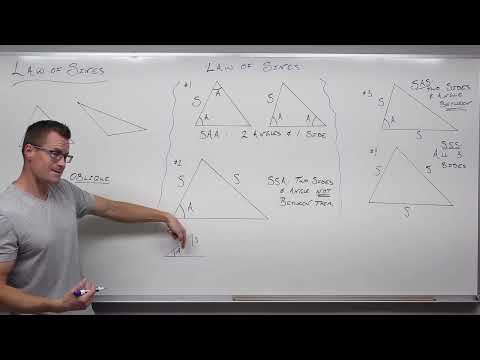
Professor Leonard explains the Law of Sines, a trigonometric tool for solving oblique (non-right) triangles, contrasting it with right-triangle trigonometry. He details the four cases where the Law of Sines is applicable: two angles and a side (AAS/ASA), or two sides and a non-included angle (SSA). Professor Leonard emphasizes that the SSA case is 'ambiguous' and can yield zero, one, or two valid triangles, depending on the side lengths and angles, and demonstrates how to identify these possibilities through calculations and checking for valid triangle angle sums (all positive and summing to 180 degrees).
Key takeaways
- Law of Sines is essential for solving oblique triangles, complementing right-triangle trigonometry.
- The AAS/ASA case (two angles, one side) is straightforward, while the SSA case (two sides, non-included angle) is ambiguous and can yield 0, 1, or 2 triangles.
- The ambiguity in the SSA case arises because sin(θ) = sin(180° - θ), meaning two different angles can produce the same sine value.
- Validating triangle solutions in the SSA case involves checking if the sum of angles remains positive and below 180° for all potential angles.
- When solving for an angle using Law of Sines, if the calculated sine value exceeds 1, it indicates no triangle can be formed.
- In practical applications, Law of Sines can be used in multi-step problems, such as finding a distance needed for right-triangle trigonometry calculations.
Chapters
- Right triangle trigonometry is insufficient for non-right triangles (oblique triangles).
- Law of Sines and Law of Cosines are introduced as solutions for oblique triangles.
- Oblique triangles are classified as acute (all angles < 90°) or obtuse (one angle > 90°).
- Right triangles have one 90° angle.
- Acute triangles have all angles less than 90°.
- Obtuse triangles have one angle greater than 90°.
- Four cases can be solved: two angles/one side, two sides/one angle, or three sides.
- Right triangle trigonometry requires knowing three pieces of information (including the 90° angle) to find a fourth.
- Oblique triangles require knowing three pieces of information to find a fourth.
- Law of Sines applies to two cases: knowing two angles and one side (AAS/ASA), or two sides and a non-included angle (SSA).
- Finding a missing angle is best done with interior angle sum (180°), not Law of Sines.
- The SSA case (two sides and a non-included angle) can result in zero, one, or two possible triangles.
- Possible outcomes: no solution (side too short), one right triangle, one oblique triangle (acute or obtuse), or two oblique triangles.
- Law of Sines states: sin(A)/a = sin(B)/b = sin(C)/c.
- It's used for non-right triangles because right-triangle trig is insufficient.
- Interior angle sum (180°) should be used first if two angles are known.
- Law of Sines creates a proportion, not an equation to solve all at once.
- Only use two fractions at a time (e.g., sin(A)/a = sin(B)/b).
- Requires knowing two angles and one side, or two sides and one angle (non-included).
- Given two angles and one side (AAS), find the missing angle using 180° sum.
- Set up a Law of Sines proportion using the known angle-side pair and the angle with the unknown side.
- Solve for the unknown side by cross-multiplying and dividing.
- Do not use Pythagorean theorem on non-right triangles or with rounded values.
- Avoid using rounded intermediate results in subsequent calculations to minimize error.
- Use exact values or the full calculator expression when possible.
- Identify the triangle type (not right, AAS case).
- Calculate the missing angle using the 180° interior angle sum.
- Set up a Law of Sines proportion with a known angle-side pair and an angle to find its opposite side.
- Given two sides and a non-included angle (SSA), Law of Sines is used to find an angle.
- This case can lead to one or two possible triangles.
- Set up the proportion: sin(known angle)/known side = sin(unknown angle)/unknown side.
- Sine inverse can yield two possible angles between 0° and 180° (e.g., θ and 180° - θ).
- These two angles represent potential solutions for the unknown angle in the SSA case.
- Check validity by ensuring the sum of angles in the triangle does not exceed 180°.
- If the second potential angle (180° - θ) results in a valid triangle (positive angles summing to 180°), two solutions exist.
- If the second potential angle leads to a negative angle or exceeds 180°, only the first angle is valid, yielding one triangle.
- If the initial sine value is > 1, no solution exists.
Summary, takeaways, and chapters were generated by AI from the video's transcript and may contain errors. The video belongs to its creator, Professor Leonard.