How to Use the Law of Cosines in Trigonometry (Precalculus - Trigonometry 33)
 Watch on YouTube →
Overview
Professor Leonard introduces the Law of Cosines as a method for solving oblique triangles, particularly when the Law of Sines is insufficient (SAS and SSS cases). He details the formula, its derivation from the Pythagorean theorem, and its application in finding missing sides and angles, emphasizing its role in avoiding the ambiguous case present in the Law of Sines.
Key takeaways
- The Law of Cosines is essential for solving oblique triangles in Side-Angle-Side (SAS) and Side-Side-Side (SSS) configurations, where the Law of Sines is insufficient.
- The Law of Cosines formula (a² = b² + c² - 2bc cos(A)) is a generalization of the Pythagorean theorem, reducing to it when the angle is 90 degrees.
- When solving for a missing side in an SAS triangle, the Law of Cosines is applied first to find that side.
- When solving for a missing angle in an SSS triangle, the Law of Cosines is used, and it's often strategic to find the angle opposite the smallest side first if subsequently using the Law of Sines to avoid the ambiguous case.
- Using rounded numbers in intermediate steps can lead to inaccuracies; it's best to keep exact values or perform calculations in one step on a calculator.
- In flight navigation, the Law of Cosines can determine distances and angles for course corrections and speed adjustments based on deviations from the intended path.
Chapters
0:00
Introduction to the Law of Cosines
- Addresses cases where the Law of Sines fails for oblique triangles (SAS and SSS).
- Introduces the Law of Cosines as a more straightforward alternative.
- Explains its applicability for Side-Angle-Side (SAS) and Side-Side-Side (SSS) triangle problems.
1:47
The Law of Cosines Formula and Its Structure
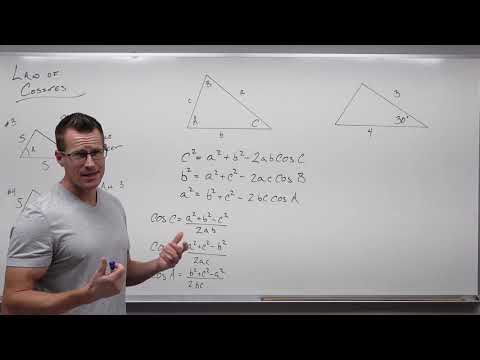
- Presents the formula: a² = b² + c² - 2bc cos(A).
- Highlights the relationship between a side and its opposite angle.
- Explains that the formula works for finding any side when two sides and the included angle are known (SAS).
4:59
Rearranging the Law of Cosines for Different Sides
- Demonstrates how to rearrange the formula to solve for side 'b' (b² = a² + c² - 2ac cos(B)).
- Shows the rearrangement for solving for side 'a' (a² = b² + c² - 2bc cos(A)).
- Emphasizes the conceptual understanding: the side squared equals the sum of the other two sides squared minus twice their product and the cosine of the angle between them.
8:13
Law of Cosines as a Generalization of the Pythagorean Theorem
- Explains that if the angle is 90 degrees, cos(90°) = 0, simplifying the formula to the Pythagorean theorem (a² + b² = c²).
- Demonstrates how the Law of Cosines inherently includes the Pythagorean theorem as a special case for right triangles.
9:53
Solving for Angles Using the Law of Cosines
- Shows how to rearrange the Law of Cosines to solve for an angle (e.g., cos(C) = (a² + b² - c²) / 2ab).
- Explains the process of plugging in values and using the inverse cosine function.
- Highlights that this is used when all three sides are known (SSS).
10:13
Step-by-Step Process for Solving Triangles
- For Side-Angle-Side (SAS): Use Law of Cosines to find the missing side first.
- After finding the side, use Law of Sines or Law of Cosines to find another angle.
- For Side-Side-Side (SSS): Use Law of Cosines to find an angle.
- Use interior angle sum or Law of Sines/Cosines to find remaining angles.
10:41
Example 1: Solving a SAS Triangle
- Given two sides (3, 4) and the included angle (30°).
- Explains why Law of Sines fails (no complete fraction).
- Applies Law of Cosines to find the missing side (a² = 3² + 4² - 2*3*4*cos(30°)).
- Calculates the missing side to be approximately 2.05 units.
23:30
Finding Remaining Angles in Example 1
- After finding the third side, either Law of Sines or Law of Cosines can be used for the remaining angles.
- Demonstrates using Law of Cosines to find angle C (cos(C) = (2.05² + 3² - 4²) / (2 * 2.05 * 3)).
- Calculates angle C to be approximately 46.9°.
- Uses interior angle sum (180° - 30° - 46.9°) to find angle B (approx. 103.1°).
34:13
Example 2: Solving an SSS Triangle
- Given three sides (4, 5, 8).
- Explains why Law of Sines fails (no known angles).
- Applies Law of Cosines to find the largest angle (opposite the largest side, 8).
- Calculates angle A (cos(A) = (4² + 5² - 8²) / (2 * 4 * 5)) to be approximately 125.1°.
43:24
Finding Remaining Angles in Example 2
- Discusses options: Law of Cosines twice, or Law of Cosines then Law of Sines/interior angle sum.
- Recommends finding the angle opposite the smallest side using Law of Sines to avoid the ambiguous case (sine inverse of an acute angle).
- Calculates angle C (opposite side 4) using Law of Sines: sin(C)/4 = sin(125.1°)/8, yielding C ≈ 24.1°.
- Uses interior angle sum to find angle B: 180° - 125.1° - 24.1° ≈ 30.8°.
55:12
Example 3: Application - Flight Navigation
- A plane travels 220 mph for 15 minutes (0.25 hr), covering 55 miles, but is 10° off course.
- Calculates the distance traveled off course: 55 miles.
- Uses Law of Cosines to find the direct distance to the destination (approx. 276 miles) given the initial course (330 miles) and the deviation (55 miles, 10°).
- Calculates the angle of deviation at the destination using Law of Cosines (approx. 168.0°).
Summary, takeaways, and chapters were generated by AI from the video's transcript and may contain errors. The video belongs to its creator, Professor Leonard.