How to Use Product to Sum and Sum to Product Formulas in Trig (Precalculus - Trigonometry 29)
 Watch on YouTube →
Overview
Professor Leonard explains and demonstrates the trigonometric product-to-sum and sum-to-product formulas. He derives these formulas by manipulating the angle addition and subtraction identities for sine and cosine, showing how to convert products of trigonometric functions into sums or differences, and vice versa. The video includes examples of finding exact values for complex trigonometric expressions and solving trigonometric equations using these identities.
Key takeaways
- Product-to-sum formulas convert products like cos(α)cos(β) into sums like 1/2[cos(α - β) + cos(α + β)], useful for simplifying expressions.
- Sum-to-product formulas convert sums like cos(α) + cos(β) into products like 2cos((α + β)/2)cos((α - β)/2), crucial for solving equations.
- The even property of cosine (cos(-x) = cos(x)) allows the removal of negative signs from arguments, while the odd property of sine (sin(-x) = -sin(x)) requires a sign change in the function's output.
- Transforming sums into products enables the use of the zero product property to solve trigonometric equations, by setting individual factors containing variables to zero.
- When solving equations like sin(nθ) = 0, it's necessary to find solutions for the argument 'nθ' over an extended range (e.g., 0 to 2πn) before dividing by 'n' to find solutions for θ within the standard [0, 2π] interval.
Chapters
0:00
Introduction to Product-to-Sum and Sum-to-Product Formulas
- These formulas transform products of trigonometric functions into sums or differences, and vice versa.
- They are useful for simplifying expressions and solving trigonometric equations.
- Professor Leonard will prove the formulas and then demonstrate their application with examples.
0:51
Derivation of Product-to-Sum Formulas (Cosine-Cosine)
- Derived by adding and subtracting the cosine angle addition and subtraction formulas.
- Adding cos(α - β) + cos(α + β) yields 2cos(α)cos(β).
- Subtracting cos(α - β) - cos(α + β) yields -2sin(α)sin(β), leading to sin(α)sin(β) = 1/2[cos(α - β) - cos(α + β)].
10:43
Derivation of Product-to-Sum Formulas (Sine-Cosine)
- Derived by adding the sine angle addition and subtraction formulas.
- Adding sin(α + β) + sin(α - β) yields 2sin(α)cos(β).
- This results in sin(α)cos(β) = 1/2[sin(α + β) + sin(α - β)].
15:16
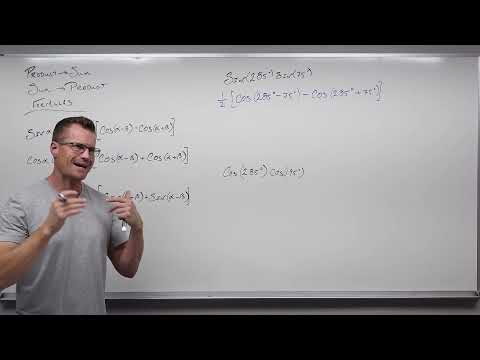
Example 1: Evaluating sin(285°)sin(75°)
- Uses the formula sin(α)sin(β) = 1/2[cos(α - β) - cos(α + β)].
- Calculates cos(210°) and cos(360°).
- Simplifies to 1/2[-√3/2 - 1] = -1/4(√3 + 2).
22:27
Example 2: Evaluating cos(285°)cos(195°)
- Uses the formula cos(α)cos(β) = 1/2[cos(α - β) + cos(α + β)].
- Calculates cos(90°) and cos(480°), reducing 480° to 120°.
- Simplifies to 1/2[0 + (-1/2)] = -1/4.
29:06
Example 3: Expressing sin(4θ)cos(6θ) as a Sum
- Uses the formula sin(α)cos(β) = 1/2[sin(α + β) + sin(α - β)].
- Applies the formula to get 1/2[sin(10θ) + sin(-2θ)].
- Utilizes the odd property of sine: sin(-x) = -sin(x), resulting in 1/2[sin(10θ) - sin(2θ)].
35:34
Example 4: Expressing cos(3θ)cos(4θ) as a Sum
- Uses the formula cos(α)cos(β) = 1/2[cos(α - β) + cos(α + β)].
- Applies the formula to get 1/2[cos(-θ) + cos(7θ)].
- Utilizes the even property of cosine: cos(-x) = cos(x), resulting in 1/2[cos(θ) + cos(7θ)].
40:58
Introduction to Sum-to-Product Formulas
- These formulas are the reverse of product-to-sum formulas.
- They are useful for factoring trigonometric expressions and solving equations.
- Formulas are presented for sums/differences of sines and cosines.
43:52
Example 5: Evaluating cos(2θ) + cos(4θ)
- Uses the formula cos(α) + cos(β) = 2cos((α + β)/2)cos((α - β)/2).
- Applies the formula to get 2cos(3θ)cos(-θ).
- Uses the even property of cosine to simplify to 2cos(3θ)cos(θ).
Summary, takeaways, and chapters were generated by AI from the video's transcript and may contain errors. The video belongs to its creator, Professor Leonard.