How to rigorously prove that a limit is WRONG!
 Watch on YouTube →
Overview
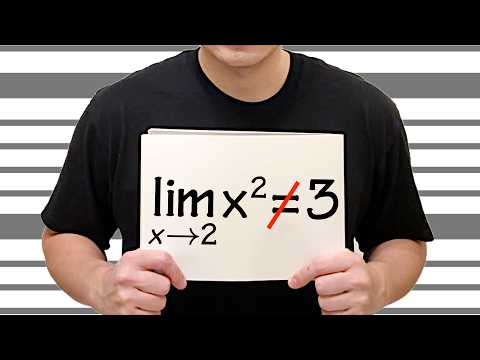
blackpenredpen uses the negated epsilon–delta definition to rigorously prove that \(\lim_{x\to2}x^2\) is not 3, even though its actual value is 4. The proof chooses \(\epsilon=1\), then for every \(\delta>0\) selects \(x=2+\delta/2\), making \(0<|x-2|<\delta\) while \(|x^2-3|>1\).
Key takeaways
- To disprove that a function tends to \(L\), it is enough to find one fixed \(\epsilon>0\) such that every \(\delta>0\) admits a point within delta of the approach value whose function value stays at least epsilon from \(L\).
- The exact negation of the epsilon–delta definition is \(\exists\epsilon>0\;\forall\delta>0\;\exists x\): \(0<|x-a|<\delta\) and \(|f(x)-L|\ge\epsilon\).
- For \(\lim_{x\to2}x^2\ne3\), choosing \(\epsilon=1\) works because the true limit 4 is one unit from the proposed value 3.
- The delta-dependent choice \(x=2+\delta/2\) always satisfies the required neighborhood condition, since its distance from 2 is exactly half of delta.
- Substitution yields \((2+\delta/2)^2-3=1+2\delta+\delta^2/4>1\) for every positive delta, completing the counterexample without needing a particular delta size.
Chapters
0:00
Negating the Epsilon–Delta Definition of a Limit
- The claim under examination is \(\lim_{x\to2}x^2=3\), while the actual limit is 4.
- A limit equals \(L\) when, for every \(\epsilon>0\), some \(\delta>0\) ensures every \(x\) with \(0<|x-a|<\delta\) satisfies \(|f(x)-L|<\epsilon\).
- Its negation is: there exists \(\epsilon>0\) such that for every \(\delta>0\), there is an \(x\) with \(0<|x-a|<\delta\) and \(|f(x)-L|\ge\epsilon\).
- Negating the implication keeps its condition true and makes its conclusion false; the universal quantifiers over epsilon and x become existential.
5:38
Choose Epsilon 1 and Locate a Counterexample Near x = 2
- Choose \(\epsilon=1\), the difference between the actual limit 4 and the proposed limit 3.
- For each arbitrary \(\delta>0\), the proof must construct an \(x\) depending on that delta.
- The choice \(x=2+\delta/2\) gives \(|x-2|=\delta/2\), which is strictly between 0 and delta.
- The graph of \(y=x^2\) helps select the right-hand side of 2: values there rise above 4, keeping their distance from 3 greater than 1.
10:47
Verify the Inequality and Rule Out the Proposed Limit
- Substitute \(x=2+\delta/2\): \(x^2-3=1+2\delta+\delta^2/4\).
- Since \(\delta>0\), both added terms are positive, so \(|x^2-3|>1=\epsilon\), satisfying the negated definition for every delta.
- The constructed point meets both requirements—\(0<|x-2|<\delta\) and \(|x^2-3|\ge1\)—so the proposed limit cannot equal 3.
- For a proposed limit of 5, blackpenredpen notes that the construction is trickier and suggests testing a point to the left, such as \(x=2-\delta/2\).
Summary, takeaways, and chapters were generated by AI from the video's transcript and may contain errors. The video belongs to its creator, blackpenredpen.