How to Find the Area of a Triangle with Trigonometry (Precalculus - Trigonometry 34)
 Watch on YouTube →
Overview
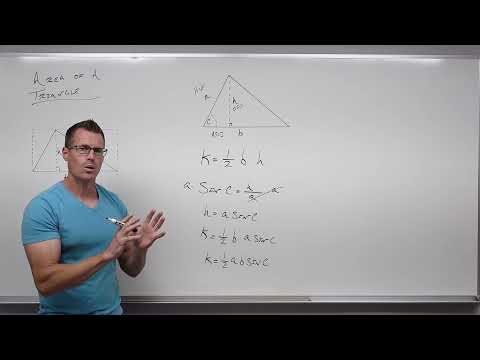
Professor Leonard explains how to calculate the area of a triangle using trigonometry, moving beyond the traditional base-times-height formula. He demonstrates how to find the area using two sides and the included angle (SAS) by substituting trigonometric relationships into the area formula, and introduces Heron's formula for cases where all three sides (SSS) are known.
Key takeaways
- The area of a triangle can be found using the formula Area = 1/2 * a * b * sin(C), where 'a' and 'b' are two sides and 'C' is the angle between them.
- This SAS (Side-Angle-Side) area formula is derived by substituting the height (h = side * sin(angle)) into the traditional base-height formula.
- Heron's formula provides a method to calculate the area of a triangle when only the lengths of all three sides (SSS) are known.
- Heron's formula requires calculating the semi-perimeter 's' first, then applying Area = sqrt(s * (s - a) * (s - b) * (s - c)).
- These trigonometric and Heron's formulas offer alternatives to finding the height explicitly, simplifying area calculations in specific scenarios.
Chapters
0:00
Introduction to Triangle Area Formulas
- Traditional area formula requires base and height (1/2 * base * height).
- New methods allow area calculation without explicitly knowing the height.
- Two scenarios covered: knowing two sides and the included angle (SAS), or knowing all three sides (SSS).
5:15
Area Calculation with Two Sides and Included Angle (SAS)
- Derivation uses a right triangle formed by the height, leading to h = hypotenuse * sin(angle).
- Substituting this into the area formula (1/2 * base * height) yields Area = 1/2 * a * b * sin(C).
- This formula applies when knowing two sides and the angle between them (SAS).
Summary, takeaways, and chapters were generated by AI from the video's transcript and may contain errors. The video belongs to its creator, Professor Leonard.