How to Convert From Rectangular Equations to Polar Equations (Precalculus - Trigonometry 39)
 Watch on YouTube →
Overview
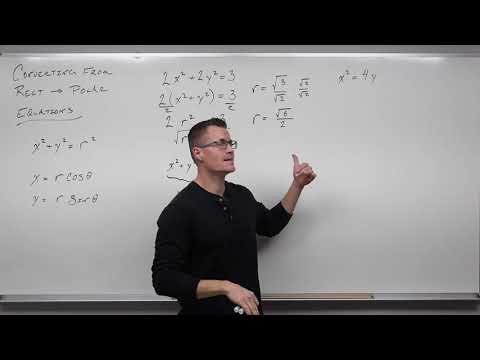
Professor Leonard explains how to convert rectangular equations (x, y) into polar equations (r, theta) to simplify graphing, particularly for non-function curves like circles and ellipses. The core strategies involve substituting x² + y² with r² and replacing individual x and y with r cos(theta) and r sin(theta), respectively. He demonstrates this with examples like 2x² + 2y² = 3, x² + y² = x, x² = 4y, 2xy = 1, and (x-3)² + y² = 9, also covering how to handle lines.
Key takeaways
- The primary strategy for converting rectangular to polar equations is to identify and substitute x² + y² with r².
- When x² + y² is not present, substitute x with r cos(theta) and y with r sin(theta).
- Dividing by r is a common simplification technique, but requires careful consideration of the r=0 solution.
- Equations like 2xy = 1 can be simplified using trigonometric identities, such as 2 sin(theta) cos(theta) = sin(2*theta).
- Shifted conic sections, like (x-3)² + y² = 9, can be converted to polar form, resulting in equations like r = 6 cos(theta).
- Lines (vertical, horizontal, diagonal) have simpler polar representations: x = a becomes r = a sec(theta), y = b becomes r = b csc(theta), and y = mx becomes theta = arctan(m).
Chapters
0:00
Introduction to Rectangular vs. Polar Coordinates and Conversion Goals
- Rectangular equations use x and y for graphing on an XY plane.
- Polar equations use r and theta for graphing on a polar coordinate system.
- Conversion simplifies graphing of non-function curves like circles and ellipses.
2:06
Key Substitution: x² + y² = r²
- The primary goal is to find and replace x² + y² with r².
- This often involves factoring or algebraic manipulation.
- Example: 2x² + 2y² = 3 is factored to 2(x² + y²) = 3, then 2r² = 3.
13:20
Handling Individual x and y Variables: x = r cos(theta), y = r sin(theta)
- When x² + y² cannot be formed, substitute x with r cos(theta) and y with r sin(theta).
- Example: x² + y² = x becomes r² = r cos(theta).
- Discusses options for simplifying, including dividing by r (if r=0 is excluded) or factoring.
18:50
Converting x² = 4y and 2xy = 1 to Polar Form
- x² = 4y becomes r² cos²(theta) = 4r sin(theta).
- 2xy = 1 becomes 2(r cos(theta))(r sin(theta)) = 1, simplifying to r² sin(2*theta) = 1.
Summary, takeaways, and chapters were generated by AI from the video's transcript and may contain errors. The video belongs to its creator, Professor Leonard.