How to Convert From Rectangular Coordinates to Polar Coordinates (Precalculus - Trigonometry 38)
 Watch on YouTube →
Overview
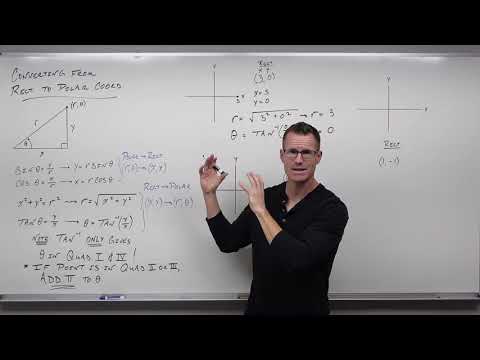
Professor Leonard explains how to convert rectangular coordinates (x, y) to polar coordinates (r, θ). He details the formulas r = √(x² + y²) and θ = tan⁻¹(y/x), emphasizing the critical need to adjust the angle θ based on the point's quadrant, as tan⁻¹ has a limited range (-π/2 to π/2). Adjustments involve adding π for quadrants II and III, and 2π for positive angles in quadrant IV.
Key takeaways
- To convert rectangular (x, y) to polar (r, θ), use r = √(x² + y²) and θ = tan⁻¹(y/x).
- The range of tan⁻¹ is limited to (-π/2, π/2), covering quadrants I and IV.
- For points in quadrant II or III, add π to the angle obtained from tan⁻¹.
- For points in quadrant IV that require a positive angle, add 2π to the negative angle from tan⁻¹.
- When dealing with decimal or non-unit circle values, use a calculator for θ and adjust based on the plotted quadrant.
- Always plot the point first to determine the correct quadrant and necessary angle adjustments.
Chapters
0:00
Introduction to Rectangular to Polar Conversion
- Previous video covered polar to rectangular conversion.
- This video focuses on rectangular to polar conversion.
- Ambiguity exists in rectangular to polar conversion, unlike polar to rectangular.
1:43
Formulas for Polar Coordinate Conversion
- Rectangular to polar uses r = √(x² + y²) and θ = tan⁻¹(y/x).
- r represents the distance from the origin (radius).
- θ represents the angle from the positive x-axis.
3:33
Understanding tan⁻¹ Limitations and Quadrant Adjustments
- tan⁻¹ is defined only for angles between -π/2 and π/2 (quadrants I and IV).
- Points in quadrants I and IV are handled directly by tan⁻¹.
- Points in quadrants II and III require adding π to the tan⁻¹ result.
- Points in quadrant IV may yield negative angles; add 2π for a positive angle.
7:01
Example 1: Converting (3, 0) to Polar Coordinates
- Identify x=3, y=0.
- Calculate r = √(3² + 0²) = 3.
- Calculate θ = tan⁻¹(0/3) = tan⁻¹(0) = 0.
- Point (3, 0) is on the positive x-axis, θ=0 is correct.
15:38
Example 2: Converting (0, 2) to Polar Coordinates
- Identify x=0, y=2.
- Calculate r = √(0² + 2²) = 2.
- tan⁻¹(2/0) is undefined; consider angles where tangent is undefined (π/2, 3π/2).
- Plotting (0, 2) shows it's on the positive y-axis, so θ = π/2 is correct.
28:24
Example 3: Converting (1, -1) to Polar Coordinates
- Identify x=1, y=-1.
- Plotting shows the point is in quadrant IV.
- Calculate r = √(1² + (-1)²) = √2.
- Calculate θ = tan⁻¹(-1/1) = tan⁻¹(-1) = -π/4.
- Since the point is in quadrant IV, -π/4 is the correct angle.
- For a positive angle, add 2π: -π/4 + 2π = 7π/4.
41:45
Example 4: Converting (-3, 3) to Polar Coordinates
- Identify x=-3, y=3.
- Plotting shows the point is in quadrant II.
- Calculate r = √((-3)² + 3²) = √18 = 3√2.
- Calculate θ = tan⁻¹(3/-3) = tan⁻¹(-1) = -π/4.
- Since the point is in quadrant II, add π to -π/4: -π/4 + π = 3π/4.
Summary, takeaways, and chapters were generated by AI from the video's transcript and may contain errors. The video belongs to its creator, Professor Leonard.