How to Convert From Polar Equations to Rectangular Equations (Precalculus - Trigonometry 40)
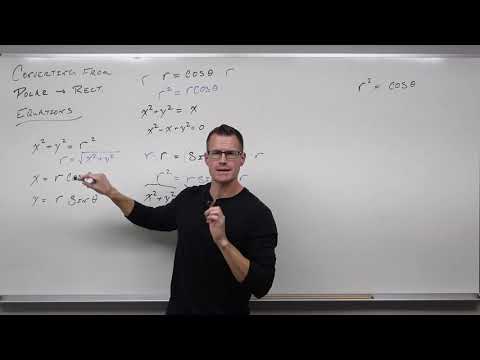 Watch on YouTube →
Overview
Professor Leonard explains how to convert polar equations to rectangular equations using fundamental relationships like $r^2 = x^2 + y^2$, $x = r \cos \theta$, and $y = r \sin \theta$. He emphasizes the strategy of multiplying both sides of an equation by $r$ to create $r^2$ or $r \cos \theta$/$r \sin \theta$ terms, and demonstrates how to handle equations with fractions or those requiring solving for $r$ using the square root of $x^2 + y^2$. The lesson covers various examples, including circles, parabolas, and more complex forms, illustrating techniques to simplify and transform polar representations into their Cartesian equivalents.
Key takeaways
- The core relationships for polar to rectangular conversion are $r^2 = x^2 + y^2$, $x = r \cos \theta$, and $y = r \sin \theta$.
- Multiplying both sides of a polar equation by $r$ is a crucial technique to generate terms like $r^2$ or $r \cos \theta$ that can be directly converted.
- When $r$ remains isolated after initial conversions, it can be replaced by $\sqrt{x^2 + y^2}$.
- Fractions in polar equations should often be cleared by multiplying by the denominator before applying other conversion strategies.
- Reciprocal trigonometric functions (like $\csc \theta$, $\sec \theta$) should be converted to their base forms ($\sin \theta$, $\cos \theta$) early in the process.
- Squaring both sides of an equation is a valid operation that can help convert $r$ to $r^2$ (e.g., $r=2$ becomes $r^2=4$).
Chapters
- Key relationships: $r^2 = x^2 + y^2$, $x = r \cos \theta$, $y = r \sin \theta$.
- Conversion involves replacing polar components with their rectangular equivalents.
- Multiplying both sides by $r$ is a common strategy to create usable terms.
- Multiply by $r$ to get $r^2 = r \cos \theta$.
- Substitute $r^2$ with $x^2 + y^2$ and $r \cos \theta$ with $x$.
- Resulting equation: $x^2 + y^2 = x$.
- Multiply by $r$ to get $r^2 = r \sin \theta + r$.
- Substitute $r^2$ with $x^2 + y^2$ and $r \sin \theta$ with $y$.
- Handle the remaining $r$ by substituting $\sqrt{x^2 + y^2}$.
- Multiply by $r$ to get $r^3 = r \cos \theta$.
- Rewrite as $r^2 \cdot r = x$.
- Substitute $r^2$ with $x^2 + y^2$ and $r$ with $\sqrt{x^2 + y^2}$.
- Rewrite as $r = \tan \theta \sec \theta$.
- Multiply by $\cos^2 \theta$ to get $r \cos^2 \theta = \sin \theta$.
- Rewrite as $r \cos \theta \cdot \cos \theta = \sin \theta$.
- Substitute $r \cos \theta$ with $x$ and $\sin \theta / \cos \theta$ with $\tan \theta$ (or $y/x$).
- Rewrite $\csc \theta$ as $1/\sin \theta$, yielding $r = 3/\sin \theta$.
- Multiply by $\sin \theta$ to get $r \sin \theta = 3$.
- Substitute $r \sin \theta$ with $y$, resulting in $y = 3$.
Summary, takeaways, and chapters were generated by AI from the video's transcript and may contain errors. The video belongs to its creator, Professor Leonard.