How to Convert From Polar Coordinates to Rectangular Coordinates (Precalculus - Trigonometry 37)
 Watch on YouTube →
Overview
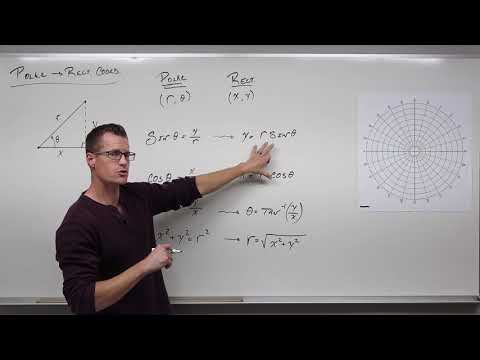
Professor Leonard explains the conversion from polar coordinates (r, θ) to rectangular coordinates (x, y) using fundamental trigonometric relationships: x = r cos(θ) and y = r sin(θ). He emphasizes that this conversion is straightforward as it doesn't require quadrant adjustments, unlike the reverse process. The explanation is illustrated with multiple examples, including those with negative radii and non-unit circle angles, demonstrating the application of these formulas and the importance of checking quadrant alignment.
Key takeaways
- The conversion from polar (r, θ) to rectangular (x, y) coordinates relies on the trigonometric identities x = r cos(θ) and y = r sin(θ).
- Unlike converting from rectangular to polar, converting from polar to rectangular does not require special quadrant adjustments because the signs of r and θ inherently determine the correct quadrant.
- When dealing with negative radii in polar coordinates, the negative sign effectively reverses the direction along the angle's ray, leading to a point in a different quadrant than if the radius were positive.
- Angles can be given in degrees or radians; ensure the correct mode is used on a calculator for non-unit circle values.
- When converting polar coordinates with non-unit circle angles or decimal radii, calculators are necessary for approximation, and quadrant checking remains a valuable verification step.
Chapters
0:00
Introduction to Polar and Rectangular Coordinates
- Polar coordinates are defined as (r, θ), representing distance from a pole and an angle.
- Rectangular coordinates are defined as (x, y), the standard Cartesian system.
- The goal is to convert from the (r, θ) format to the (x, y) format.
1:56
Deriving Conversion Formulas from Trigonometry
- Superimposing a polar point on an xy-plane forms a right triangle.
- Using sine and cosine relationships: sin(θ) = y/r and cos(θ) = x/r.
- Rearranging these gives the conversion formulas: y = r sin(θ) and x = r cos(θ).
12:11
Example 1: Converting (4, 3π/2) to Rectangular Coordinates
- Identify r = 4 and θ = 3π/2.
- Calculate y = 4 * sin(3π/2) = 4 * (-1) = -4.
- Calculate x = 4 * cos(3π/2) = 4 * 0 = 0.
- The rectangular coordinate is (0, -4).
18:49
Example 2: Converting (-2, 0) to Rectangular Coordinates
- Identify r = -2 and θ = 0.
- Calculate x = -2 * cos(0) = -2 * 1 = -2.
- Calculate y = -2 * sin(0) = -2 * 0 = 0.
- The rectangular coordinate is (-2, 0).
23:40
Example 3: Converting (6, 150°) to Rectangular Coordinates
- Identify r = 6 and θ = 150° (or 5π/6 radians).
- Calculate x = 6 * cos(150°) = 6 * (-√3/2) = -3√3.
- Calculate y = 6 * sin(150°) = 6 * (1/2) = 3.
- The rectangular coordinate is (-3√3, 3).
30:18
Example 4: Converting (-2, 3π/4) with Negative Radius
- Identify r = -2 and θ = 3π/4.
- Determine the quadrant: 3π/4 with negative r places the point in Quadrant IV.
- Calculate x = -2 * cos(3π/4) = -2 * (-√2/2) = √2.
- Calculate y = -2 * sin(3π/4) = -2 * (√2/2) = -√2.
- The rectangular coordinate is (√2, -√2).
Summary, takeaways, and chapters were generated by AI from the video's transcript and may contain errors. The video belongs to its creator, Professor Leonard.