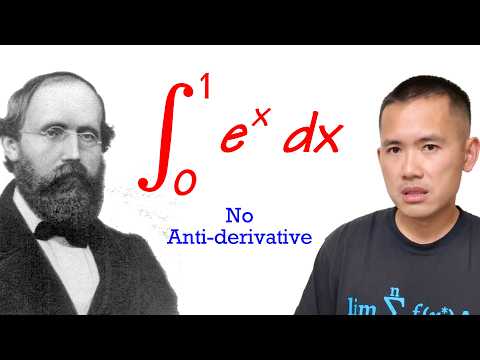
How Riemann would probably integrate e^x from 0 to 1
 Watch on YouTube →
Overview
blackpenredpen derives the area under e^x from 0 to 1 without using the Fundamental Theorem of Calculus, approximating it with n equal-width right-endpoint rectangles. The resulting Riemann sum is a geometric series with ratio e^(1/n); its limit simplifies to (e − 1) times limits equal to 1, giving the area e − 1.
Key takeaways
- The right-endpoint Riemann sum for e^x on [0,1] is (1/n)Σ(k=1 to n)e^(k/n), with n rectangles of width 1/n.
- Successive terms in the sum have common ratio e^(1/n), making the finite geometric-series identity directly applicable.
- Since (e^(1/n))^n = e, the sum reduces to (e − 1)e^(1/n) · [(1/n)/(e^(1/n) − 1)].
- The substitution t = 1/n converts the remaining ratio into t/(e^t − 1), whose limit as t approaches 0 is 1.
- The Riemann-sum limit gives the area under e^x from 0 to 1 as e − 1 without evaluating an antiderivative or invoking the Fundamental Theorem of Calculus.
Chapters
0:00
Build the Right-Endpoint Riemann Sum for e^x
- Divide the interval [0,1] into n equal subintervals, each with width 1/n.
- Use the right endpoints k/n, for k = 1 through n, as rectangle heights' input values.
- Write the approximation as (1/n)(e^(1/n) + e^(2/n) + ... + e^(n/n)); because e^x is increasing, these right-endpoint rectangles overestimate the area for finite n.
2:50
Sum the Geometric Series and Extract e − 1
- The terms form a geometric series with common ratio e^(1/n), since each successive exponent increases by 1/n.
- Apply the finite geometric-series formula to obtain (1/n) · e^(1/n) · ((e^(1/n))^n − 1)/(e^(1/n) − 1).
- Use (e^(1/n))^n = e to rewrite the expression as (e − 1)e^(1/n) · [(1/n)/(e^(1/n) − 1)].
7:20
Evaluate the Limits Using t = 1/n
- As n approaches infinity, e^(1/n) approaches 1, so the remaining nonconstant factor is the limit of (1/n)/(e^(1/n) − 1).
- Set t = 1/n; then t approaches 0 from above and the ratio becomes t/(e^t − 1).
- Use the standard exponential limit (e^t − 1)/t → 1, so the reciprocal also tends to 1 and the Riemann sum converges to e − 1.
Summary, takeaways, and chapters were generated by AI from the video's transcript and may contain errors. The video belongs to its creator, blackpenredpen.