How Research Works | Understanding Medical Research
 Watch on YouTube →
Overview
This lecture from YaleCourses outlines the complex journey of medical research from hypothesis to publication, emphasizing the critical role of peer review and the challenges posed by paywalls and predatory journals. It highlights the significant financial investment in research, such as the $3.8 billion Human Genome Project yielding a trillion dollars in economic growth, and contrasts the academic grant-writing process with industry's direct funding model. The discussion also addresses the 'black box' nature of published studies, where raw data is often inaccessible, and the 'perverse incentives' that can compromise research integrity.
Key takeaways
- Medical research publications are the final product of a long, often opaque process, akin to a 'black box' where raw data is rarely visible.
- The U.S. invests over $100 billion annually in medical research, with the NIH alone having a $33 billion budget, demonstrating substantial financial commitment.
- Academic research relies heavily on grant writing, a time-consuming process involving detailed proposals reviewed by peers, often leading to rejection or revision cycles.
- Peer review, while crucial for quality control, can be inconsistent, with some critiques being unconstructive, yet it generally improves manuscript quality.
- Paywalls hinder access to research, but strategies like utilizing library resources, PubMed Central, Google Scholar, or directly emailing authors can provide access.
- Predatory open access journals exploit researchers by publishing papers for a fee without genuine peer review, highlighting the need to assess journal reputation via metrics like impact factor.
Chapters
- Medical research progresses from a hypothesis to a published manuscript through a lengthy process.
- The 'black box' analogy illustrates that published studies often hide the underlying data.
- Significant global investment in medical research, with the US spending over $100 billion annually, primarily through the NIH ($33 billion budget).
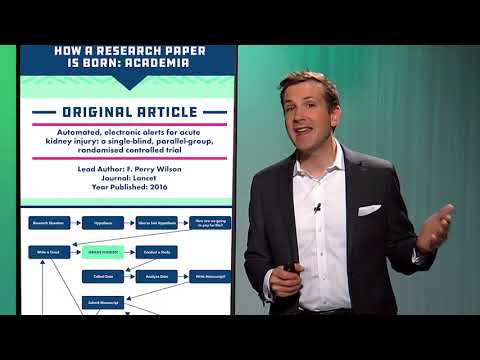
- Academic research involves grant writing (up to 150 pages) to secure funding, followed by data collection, analysis, and manuscript submission.
- Industry research bypasses grant writing, directly funding studies to evaluate promising compounds.
- Peer review involves anonymous experts critiquing manuscripts, a process that can be iterative and sometimes harsh but aims to improve paper quality.
- Paywalls restrict access to published research, though methods like contacting librarians, PubMed Central, Google Scholar, and emailing authors can bypass them.
- Open access journals offer free access but can incur high publication fees ($2,000-$5,000), leading to predatory journals that publish for a fee without rigorous review.
- Perverse incentives, such as academic pressure to publish and industry focus on drug promotion, can affect research reliability, necessitating critical evaluation of published studies.
Summary, takeaways, and chapters were generated by AI from the video's transcript and may contain errors. The video belongs to its creator, YaleCourses.