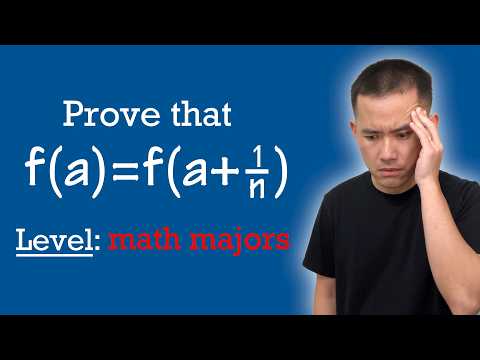
How math majors use the intermediate value theorem!
 Watch on YouTube →
Overview
blackpenredpen proves that for every continuous function f on [0,1] with f(0)=f(1), and every integer n≥2, some a∈[0,1−1/n] satisfies f(a)=f(a+1/n). The proof defines g(x)=f(x)−f(x+1/n), telescopes its values on the n-point grid to show their sum is zero, then uses either a grid-point zero or the Intermediate Value Theorem between grid points of opposite signs.
Key takeaways
- Rolle’s Theorem cannot be applied from continuity and equal endpoint values alone, since differentiability is a separate required assumption.
- The transformation g(x)=f(x)−f(x+1/n) converts the desired equality into the root condition g(a)=0.
- Summing g(k/n) over k=0,…,n−1 telescopes exactly to f(0)−f(1), so the grid values sum to zero.
- A finite collection of nonzero real numbers summing to zero must contain both positive and negative values, creating the sign change needed for the Intermediate Value Theorem.
- The selected grid points and the resulting root stay within [0,1−1/n], ensuring both f(a) and f(a+1/n) are evaluated inside the original domain [0,1].
Chapters
0:00
Why the Intermediate Value Theorem Fits Better Than Rolle’s Theorem
- The goal is to find a∈[0,1−1/n] such that f(a)=f(a+1/n), given continuity on [0,1] and f(0)=f(1).
- Rolle’s Theorem suggests a zero derivative because the endpoint values match, but it requires differentiability, which the assumptions do not provide.
- The Intermediate Value Theorem requires only continuity; its sign-change form guarantees a root when endpoint values have opposite signs.
6:00
Define a Shift-Difference Function and Telescope Its Grid Values
- Set g(x)=f(x)−f(x+1/n), which is continuous wherever both shifted inputs lie in [0,1].
- Evaluate g at k/n for k=0,1,…,n−1; each term is f(k/n)−f((k+1)/n).
- Adding the n grid values cancels all intermediate terms, leaving g(0)+g(1/n)+…+g((n−1)/n)=f(0)−f(1)=0.
10:21
Use a Grid-Point Zero or an Opposite-Sign Pair to Finish
- If g(k/n)=0 for any k∈{0,…,n−1}, then a=k/n directly satisfies f(a)=f(a+1/n).
- If no grid value is zero, their sum being zero forces at least one positive value and one negative value.
- For grid indices j<k with g(j/n)g(k/n)<0, continuity and the Intermediate Value Theorem give a root between j/n and k/n.
- Because 0≤j<k≤n−1, that root lies in [0,1−1/n], and g(a)=0 yields the required equality.
Summary, takeaways, and chapters were generated by AI from the video's transcript and may contain errors. The video belongs to its creator, blackpenredpen.