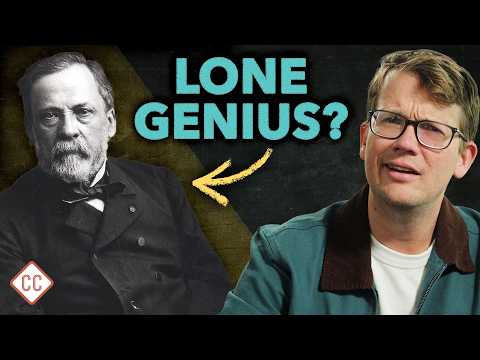
How Does Science Really Work? The Myth of the Great Experiment: Crash Course Scientific Thinking #3
 Watch on YouTube →
Overview
Science progresses not through isolated genius, but through community collaboration and iterative refinement, as demonstrated by Louis Pasteur's work on germ theory. While Pasteur's swan-neck flask experiment was pivotal in disproving spontaneous generation, it was built upon prior hypotheses and refined through peer skepticism, highlighting the importance of both experimental and observational science, and the ethical considerations in research.
Key takeaways
- Scientific breakthroughs are rarely the product of a single individual; they emerge from a collaborative community building on prior research and facing peer critique.
- Louis Pasteur's swan-neck flask experiment was a crucial step in disproving spontaneous generation, but it was refined through scientific debate and skepticism.
- Science employs both experimental methods (controlled environments) and observational methods (real-world data collection), each suited to different research questions.
- Ethical considerations, such as patient well-being in medical studies, dictate the types of experiments that can be performed.
- Confounding variables can obscure relationships in observational studies, highlighting the need for diverse evidence and careful analysis.
- The scientific process is iterative, with findings constantly being tested, refined, and built upon by subsequent research and collaboration.
Chapters
0:00
The Myth of the Lone Genius vs. Scientific Community
- Louis Pasteur's work on germ theory is often presented as the result of a single, revolutionary experiment.
- Isaac Newton's quote, 'standing on the shoulders of giants,' emphasizes the cumulative nature of scientific progress.
- Brilliant scientists like Marie Curie and George Washington Carver also relied on the support of their scientific communities.
2:00
Pasteur's Experiments and the Challenge of Spontaneous Generation
- Early 19th-century scientists knew of microbes but believed in spontaneous generation.
- Pasteur's initial experiment with a sterilized broth exposed to air showed microbial growth, supporting the idea that microbes came from the air.
- Skepticism from scientists like Félix Pouchet, who questioned the role of 'fresh air,' spurred further refinement.
- Pasteur's swan-neck flask experiment demonstrated that microbes were trapped in the flask's neck, not spontaneously generated, disproving the theory.
10:05
Experimental vs. Observational Science and Ethical Considerations
- Experimental science, like Pasteur's work, involves controlled environments and manipulating variables (independent and dependent).
- Observational science gathers data from real-world events, crucial for studying complex systems like Earth's climate or human health.
- Ethical considerations are paramount, influencing study design, such as using 'standard of care' in medical trials instead of a placebo.
- Confounding variables can complicate observational studies, necessitating the collection of evidence from multiple study types.
Summary, takeaways, and chapters were generated by AI from the video's transcript and may contain errors. The video belongs to its creator, CrashCourse.