How (and why) to take a logarithm of an image
 Watch on YouTube →
Overview
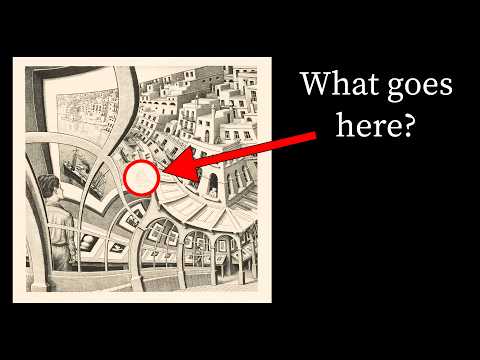
3Blue1Brown visually unpacks the mathematical analysis of M.C. Escher's 'Print Gallery' by De Smit and Lenstra, demonstrating how a Droste effect (self-similar image recursion) can be transformed into a continuous loop using conformal maps derived from complex functions. The process involves taking the logarithm of the image to linearize scaling, rotating and scaling this representation in log-space, and then exponentiating to create the warped loop, mirroring Escher's intuitive mesh warp technique with complex analysis.
Key takeaways
- M.C. Escher's 'Print Gallery' can be mathematically deconstructed using complex analysis, specifically by transforming a Droste effect into a continuous loop.
- The process involves taking the natural logarithm of the image to linearize the recursive scaling, performing a rotation and scaling in this log-space, and then applying the exponential function.
- Complex functions are special because they act as conformal maps, preserving shape at infinitesimal scales, which is crucial for Escher's technique of local undistortion within a globally warped image.
- The complex exponential function e^z maps vertical lines to circles, and its inverse, the complex logarithm ln(z), maps circles back to vertical lines, providing the mechanism to 'unwarp' the image.
- The doubly periodic nature of the logarithm of a Droste image connects to elliptic functions, highlighting deep mathematical structures intuitively explored by Escher.
- By understanding the underlying complex functions, one gains a deeper appreciation for Escher's genius in solving visual puzzles that align with advanced mathematical concepts.
Chapters
0:00
Introduction to Escher's 'Print Gallery' and the Droste Effect
- M.C. Escher's 1956 lithograph 'The Print Gallery' features a mind-bending self-contained loop.
- Mathematicians De Smit and Lenstra analyzed the artwork, revealing deep mathematical concepts.
- The core concept is the Droste effect: a self-similar image recursively contained within itself, with a scaling factor of 256 in Escher's work.
5:02
Intuitive Steps to Create a Droste Loop: Straightened Image and Warped Grid
- Step 1: Visualize a straightened-out version of the Droste effect for easier analysis.
- Step 2: Create a warped grid that distributes the scaling factor (e.g., 16x or 256x) across the image.
- Escher's grid encodes scaling by a factor of 4 between corners for his 256x zoom.
13:39
Mesh Warp: Using a Warped Grid to Transform an Image
- Step 3: Copy contents from tiny squares of the original image to corresponding squares in the warped grid.
- This mesh warp process allows for a piece-by-piece, undistorted transfer at a local scale.
- The warped grid automatically handles the scaling and distortion required for the loop effect.
17:24
The Origin of the Warped Grid: Conformal Maps and Complex Numbers
- The warped grid's structure is constrained by the requirement that tiny squares remain approximately square.
- This property defines a conformal map, crucial in complex analysis.
- Complex functions (e.g., z^2, z^3) inherently produce conformal maps, preserving shape at infinitesimal scales.
21:45
Complex Numbers and Functions: Scaling, Rotation, and Conformality
- Complex numbers (z = x + iy) extend the real number line to a plane.
- Functions of complex numbers, like f(z) = cz (scaling/rotation) or f(z) = z^2 (non-linear distortion), are explored.
- Conformal maps, where tiny squares remain approximately square, are a special property of complex differentiable functions.
35:03
The Complex Exponential (e^z) and Natural Logarithm (ln(z))
- The complex exponential e^z transforms vertical lines into circles and scales them exponentially.
- e^z is many-to-one: e.g., e^0 = e^(2πi) = 1.
- The natural logarithm ln(z) is the inverse, straightening circles back into vertical lines, and is multi-valued.
Summary, takeaways, and chapters were generated by AI from the video's transcript and may contain errors. The video belongs to its creator, 3Blue1Brown.