Glycolysis, BIO105 Introductory Biology, David Champlin, USM
 Watch on YouTube →
Overview
David Champlin introduces cellular respiration as the oxidation of glucose to carbon dioxide, with cells capturing released energy in ATP rather than losing it all as heat. He maps glycolysis, the citric acid cycle, and oxidative phosphorylation to their cellular locations, then emphasizes glycolysis’s outputs and how ATP and NADH shuttle energy between metabolic reactions.
Key takeaways
- Cellular respiration comprises glycolysis, the citric acid cycle, and oxidative phosphorylation; glucose breakdown releases carbon dioxide, and oxygen is required for the overall pathway.
- Glycolysis occurs in the cytoplasm and splits one six-carbon glucose into two three-carbon pyruvate molecules.
- Glycolysis also generates ATP and two NADH per glucose, with NADH carrying electrons onward to oxidative phosphorylation.
- ATP and NADH function as recyclable energy intermediates, linking energy-releasing catabolism to processes such as muscle contraction and molecule synthesis.
- Glycolysis and the citric acid cycle occur outside the inner mitochondrial membrane, while oxidative phosphorylation takes place within it.
- Pyruvate is converted to acetyl-CoA before entering the citric acid cycle, releasing the first carbon dioxide from glucose during respiration.
Chapters
0:00
Cellular Respiration: Oxidizing Glucose to Capture Energy
- Cellular respiration oxidizes glucose’s carbon–hydrogen bonds toward carbon dioxide’s carbon–oxygen bonds; oxygen is required for the overall process.
- The pathway has three stages: glycolysis, the citric acid cycle (Krebs cycle), and oxidative phosphorylation.
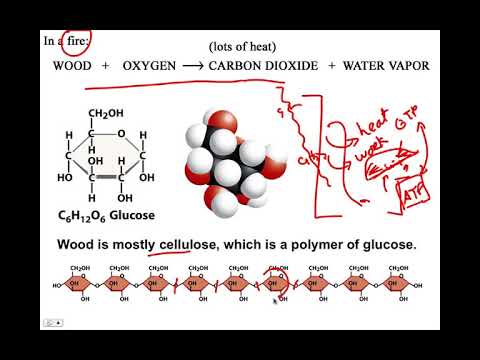
- Unlike a wood fire, which releases energy mainly as heat, cells capture energy from glucose breakdown to synthesize ATP for work such as muscle contraction and protein synthesis.
4:30
ATP, NADH, and the Mitochondrial Stages of Respiration
- Glycolysis takes place in the cytoplasm; its products enter the mitochondrial matrix for the citric acid cycle.
- Oxidative phosphorylation occurs in the mitochondrion’s inner membrane, whose folds provide surface area for its components.
- ATP is recycled between ATP and ADP rather than created from scratch, while NADH carries high-energy electrons that can be used to produce ATP.
- Dietary fats and excess amino acids can also feed into cellular respiration, connecting other forms of metabolism to the pathway.
8:20
Glycolysis Outputs and Pyruvate’s Entry into the Krebs Cycle
- Glycolysis splits one six-carbon glucose molecule into two three-carbon pyruvate molecules.
- The pathway produces ATP and two NADH molecules per glucose; NADH transfers electrons to oxidative phosphorylation.
- NADH and NAD⁺, like ATP and ADP, are recycled energy intermediates that couple energy-releasing reactions to cellular work.
- Before the citric acid cycle, pyruvate enters the mitochondrial matrix and is converted to acetyl-CoA, releasing the first carbon dioxide.
Summary, takeaways, and chapters were generated by AI from the video's transcript and may contain errors. The video belongs to its creator, The New Evolution for Everyone.