Gibbs Free energy, BIO105 Introductory Biology, David Champlin, USM
 Watch on YouTube →
Overview
David Champlin explains how Gibbs free energy (ΔG) predicts reaction direction and how enzymes and energy coupling make cellular work possible. He connects enzyme-lowered activation barriers, ATP hydrolysis at about −7.3 kcal/mol, and stepwise energy release in metabolism to protein synthesis, physical work, and energy flow through food chains.
Key takeaways
- A negative ΔG means a reaction releases free energy and is thermodynamically favorable in the forward direction, while the sign and size of ΔG do not indicate how fast it proceeds.
- Enzymes speed reactions by lowering activation energy and the transition-state barrier; they do not change the reaction’s overall ΔG or the amount of energy released.
- Cells couple endergonic work to exergonic reactions by adding their ΔG values; the combined process proceeds forward when the net ΔG is negative.
- ATP hydrolysis releases about 7.3 kcal/mol in the lecture’s accounting, so a reaction coupled to ATP synthesis must provide more than 7.3 kcal/mol of energy per ATP formed.
- Breaking cellular respiration into multiple enzyme-controlled steps lets cells capture some released energy in ATP and NADH instead of losing it all as heat.
Chapters
0:00
ΔG, Reaction Progress, and Enzymes Lowering Activation Energy
- A reaction that drops from 9 to 3 energy units has ΔG = −6 kcal/mol; a negative value indicates energy release and favors the forward direction.
- Enzymes A and B increase reaction rate without changing the total energy released or the reaction’s ΔG.
- Enzymes lower the activation-energy barrier and transition-state energy, helping substrates cross the barrier faster; a noncompetitive inhibitor can raise the barrier and slow the reaction.
4:03
Protein Synthesis and Coupling Endergonic Cellular Work
- Ribosomes catalyze protein synthesis by joining amino acids with peptide bonds through dehydration reactions; building proteins requires energy.
- Champlin distinguishes exergonic, energy-releasing reactions from endergonic, work-requiring reactions, using water flowing downhill to power milk being pumped uphill as an analogy.
- Cells capture energy released from food in intermediates such as ATP and GTP, which can help drive chemical synthesis and physical work such as muscle contraction or macrophage movement.
8:01
Energy Flow from Sunlight Through Food Chains
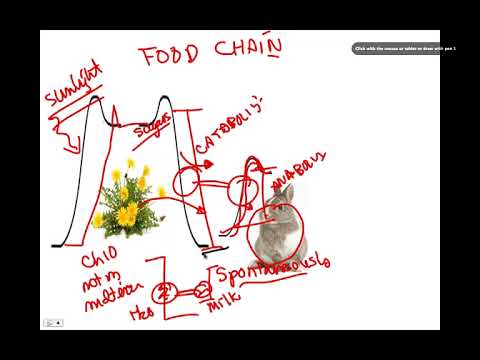
- Sunlight drives endergonic sugar synthesis in plants; a rabbit can then release some of that stored energy by digesting plant material.
- Building an organism requires coupling anabolic synthesis to a larger energy-releasing catabolic process, so the combined reaction retains a negative net ΔG and can proceed spontaneously.
- Energy continues through a food chain when a predator digests prey, but it must consume more energy-rich material than it retains as new body mass.
12:37
ATP Coupling, Cellular Respiration, and Stepwise Energy Capture
- Coupled reactions add their ΔG values: an endergonic reaction of +3.4 kcal/mol combined with ATP hydrolysis at −7.3 kcal/mol yields a net ΔG of −3.9 kcal/mol.
- ATP hydrolysis can drive a reaction requiring up to about 7.3 kcal/mol; to synthesize ATP, a coupled reaction must release more than 7.3 kcal/mol.
- Champlin describes cellular respiration as a sequence of enzyme-catalyzed steps that release glucose-derived energy in controlled portions, allowing some energy to be captured in ATP and NADH.
- The lecture estimates that NADH breakdown can support synthesis of three ATP molecules, requiring an energy drop greater than 21.9 kcal/mol; ATP then powers processes such as protein synthesis and muscle contraction.
Summary, takeaways, and chapters were generated by AI from the video's transcript and may contain errors. The video belongs to its creator, The New Evolution for Everyone.