Get Rich Or Die Tryin' ... Literally
 Watch on YouTube →
Overview
Economics Explained argues that wealth is a powerful determinant of lifespan in the US, with the richest 1% living 14.6 years longer than the poorest 1%. This disparity is exacerbated by wealth's ability to compound over time, creating a cycle where longer life means more accumulated wealth. Factors contributing to this gap include access to better nutrition, healthcare, safer environments, and crucially, control over one's work life, as highlighted by the Whitehall study on civil servants.
Key takeaways
- In the US, a person's bank account is a more powerful predictor of lifespan than genetics, diet, or healthcare access.
- The life expectancy gap between the richest and poorest 1% of American men is 14.6 years, a disparity that is widening.
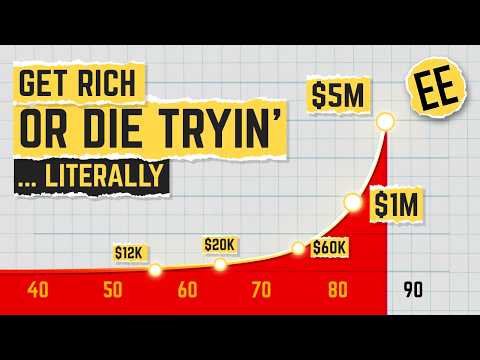
- Wealth enables compounding financial growth over longer lifespans; an extra 14 years of life can add $13 million to a $5 million portfolio at a 7% annual return.
- Lack of control over one's work life, as demonstrated by the Whitehall study, leads to chronic stress and significantly shorter lifespans.
- Baby bonds, which provide government-funded investment accounts at birth, are proposed as a generational solution to interrupt the cycle of wealth and lifespan inequality.
- Raising the retirement age universally, without considering job type or health-adjusted life expectancy, disproportionately harms individuals in physically demanding lower-income jobs.
Chapters
0:00
Wealth as a Predictor of Lifespan and Compounding Inequality
- A 40-year-old man in US poverty has a life expectancy similar to someone in Pakistan or Sudan.
- The life expectancy gap between the richest and poorest 1% of American men is 14.6 years.
- Wealth buys time, which allows for wealth to compound, as seen with Warren Buffett's wealth accumulation after age 50.
- Conversely, shorter lifespans for the poor mean less to pass on, perpetuating inequality.
5:00
Factors Driving the Wealth-Lifespan Disparity
- Access to better food, hospitals, safer neighborhoods, and less physically damaging work contribute to longer lives for the wealthy.
- Poorer individuals face challenges affording healthy diets (50% of disposable income in the UK) and have higher rates of smoking (3x).
- Location matters: proximity to industrial plants leads to worse air quality and higher disease rates for lower-income families.
- Even in universal healthcare systems like the UK's, private insurance offers faster access to specialists and earlier diagnosis, creating a two-speed system.
10:35
The Role of Control, Stress, and Financial Compounding
- The Whitehall study found that lower-ranking civil servants died at three times the rate of senior officials, attributed to lack of control and chronic stress.
- Lack of agency over one's time leads to unrelenting stress, damaging health over years.
- Extra years of life for the wealthy translate to more years of compound growth; $5 million can grow by an additional $13 million with 14 extra years of life at 7% annual return.
- Wealthy households benefit from appreciating assets like equities (S&P 500 up 2,300% since 1995) compared to home equity or pensions.
Summary, takeaways, and chapters were generated by AI from the video's transcript and may contain errors. The video belongs to its creator, Economics Explained.