Geometry: Hyperbolic space - the upper half-space and Poincaré disk models. 2nd Year Student Lecture
 Watch on YouTube →
Overview
This lecture introduces two models of hyperbolic space: the upper half-space and the Poincaré disk, demonstrating their equivalence to the hyperboloid model via isometries. It details the metric, isometry group (Mobius group), and geodesics for both the upper half-space (vertical lines and semicircles) and the Poincaré disk (lines and circles through the origin/boundary). The lecture highlights surprising properties like dilation invariance and the non-intuitive behavior of distances near boundaries.
Key takeaways
- The hyperboloid model, upper half-space model, and Poincaré disk model are all isometric representations of hyperbolic space.
- The distance metric in hyperbolic space causes distances to grow infinitely large as one approaches the boundary of the space.
- The isometry group for both the upper half-space and the Poincaré disk is the Mobius group, comprising specific transformations preserving the metric.
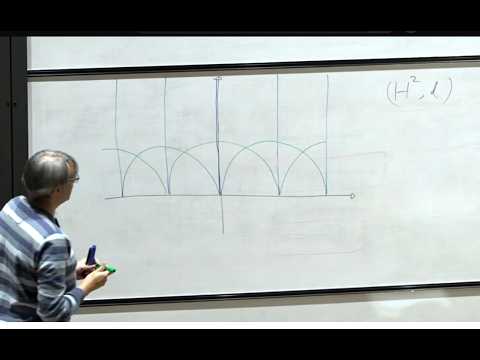
- Geodesics in the upper half-space are vertical lines and semicircles meeting the real axis orthogonally.
- Geodesics in the Poincaré disk are arcs of circles meeting the boundary circle orthogonally, including straight lines passing through the origin.
- Dilation (scaling) is an isometry in hyperbolic space, meaning distances remain invariant under uniform scaling of the entire space.
Chapters
0:12
Mapping the Hyperboloid to the Upper Half-Space
- Defines a map T from the hyperboloid H2 in R^1,2 to the complex plane C.
- The map T(X0, X1, X2) = (-X2 + i) / (X0 - X1) projects points onto the upper half-space (Im(z) > 0).
- This map is a bijection, allowing the transfer of the metric from the hyperboloid to the upper half-space.
8:21
Defining the Metric on the Upper Half-Space
- The distance in the upper half-space is derived from the hyperbolic metric on H2 via the inverse map.
- The distance D(z1, z2) = arccosh(1 + |z1 - z2|^2 / (2 * Im(z1) * Im(z2))) is established.
- This metric space is shown to be an isometry with the hyperboloid model.
12:38
Distance Example: Points on the Imaginary Axis
- Calculates the distance between two points i*y1 and i*y2 on the imaginary axis.
- The distance simplifies to log(y2/y1) for y2 > y1.
- Demonstrates that distances tend to infinity as points approach the real axis (y -> 0), implying the boundary is never reached.
22:11
Isometry Group of the Upper Half-Space
- The orientation-preserving isometry group of the upper half-space H2 is the Mobius group.
- This group consists of transformations z -> (az+b)/(cz+d) where a,b,c,d are real and ad-bc=1 (PSL(2,R)).
- The full isometry group includes orientation-reversing maps like z -> -z_bar.
29:13
Examples of Isometries in the Upper Half-Space
- Translations (z -> z+b) are orientation-preserving isometries.
- Dilations (z -> a*z for real a != 0) are also orientation-preserving isometries, a surprising result compared to Euclidean space.
- These isometries preserve the hyperbolic metric.
32:34
Geodesics of the Upper Half-Space
- Geodesics are images of hyperboloid geodesics under the isometry map T.
- They consist of vertical half-lines (Re(z) = constant) and semicircles centered on the real axis.
- These curves meet the real axis orthogonally.
42:34
Mapping the Hyperboloid to the Poincaré Disk
- Introduces the Poincaré disk model D as another representation of hyperbolic space.
- A map T(X0, X1, X2) = (X1 + i*X2) / (1 + X0) projects points from the hyperboloid into the unit disk |z| < 1.
- This map is a bijection, enabling metric transfer.
Summary, takeaways, and chapters were generated by AI from the video's transcript and may contain errors. The video belongs to its creator, Oxford Mathematics.