Geometry: Hyperbolic space - the hyperboloid model. Oxford Mathematics 2nd Year Student Lecture
 Watch on YouTube →
Overview
Oxford Mathematics introduces hyperbolic space using the hyperboloid model, defining its geodesics and isometries. This geometry, discovered by Bolyai and Lobachevsky, arises from questioning Euclid's parallel postulate. The lecture defines hyperbolic space H2 as a subset of R1,2 with a Lorentz inner product, identifies geodesics as intersections of Lorentz planes with H2, and establishes that isometries are represented by orthochronous Lorentz transformations (O+1,2), with proper orthochronous transformations (SO+1,2) preserving orientation.
Key takeaways
- Hyperbolic space H2 is modeled as a hyperboloid of two sheets in R1,2, defined by the Lorentz inner product X.X = 1.
- Geodesics in this model are intersections of Lorentz planes (planes through the origin with at least one timelike vector) with H2, forming hyperbolic curves.
- Any two points in H2 have a unique geodesic connecting them, a property that fails for antipodal points on a sphere.
- The distance between two points X and Y in H2 is defined as arccosh(X.Y), where X.Y is the Lorentz inner product.
- The isometry group of hyperbolic 2-space is O+1,2, the group of orthochronous Lorentz transformations, analogous to the orthogonal group for Euclidean space.
Chapters
0:00
Introduction to Hyperbolic Space and its Origins
- Hyperbolic geometry emerged from challenges to Euclid's parallel postulate.
- Discovered independently by Bolyai and Lobachevsky in the 1830s.
- The course will define hyperbolic 2-space (H2), its geodesics, and isometries.
0:40
Defining Hyperbolic Space: The Lorentz Inner Product
- R3's Euclidean inner product is defined as U1V1 + U2V2 + U3V3.
- The sphere is the set of points X in R3 with X.X = 1.
- Hyperbolic space H2 is defined in R1,2 (R3 with a special first coordinate) using a Lorentz inner product: U0V0 - U1V1 - U2V2.
7:01
The Hyperboloid Model of H2
- H2 is the set of points X in R1,2 such that the Lorentz inner product X.X = 1.
- This forms a hyperboloid of two sheets.
- The lecture focuses on the sheet where the special coordinate (X0) is positive.
13:37
Geodesics in Hyperbolic Space: Lorentz Planes and Hyperbolas
- On a sphere, geodesics (great circles) are intersections of planes through the origin with the sphere.
- A Lorentz plane in R1,2 through the origin is defined by having at least one point X with X.X > 0.
- Geodesic hyperbolas in H2 are the intersection of Lorentz planes with H2.
21:51
Example of a Geodesic Hyperbola
- Consider the plane P where X2 = 0 in R1,2.
- This is a Lorentz plane because it contains the point (1,0,0) which has X.X = 1.
- The intersection of P with H2 is the geodesic hyperbola defined by (cosh t, sinh t, 0).
26:40
Uniqueness of Geodesics Between Two Points
- Given two distinct points X and Y in H2, there exists a unique Lorentz plane containing them.
- The intersection of this unique Lorentz plane with H2 yields a unique geodesic hyperbola.
- The arc on this hyperbola between X and Y is the unique geodesic.
30:55
Intersections of Geodesic Hyperbolas
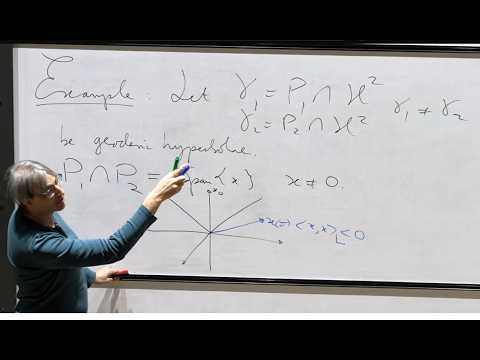
- Two geodesic hyperbolas (gamma1, gamma2) intersect based on the relationship between their defining Lorentz planes.
- This relationship is determined by the Lorentz inner product of a vector X spanning the intersection line of the planes.
- Three cases arise: X is spacelike (hyperbolas diverge), timelike (hyperbolas intersect at a point), or null/light-like (hyperbolas approach each other at infinity, termed 'ultra parallel').
43:53
Defining Distance in Hyperbolic Space
- A key lemma states that any two points X, Y in H2 can be represented as X=(1,0,0) and Y=(cosh T, sinh T, 0) by preserving the Lorentz inner product.
- The Lorentz inner product of X and Y is cosh T, which is always >= 1 and equals 1 iff X=Y.
- The hyperbolic distance is defined as arccosh(X.Y), which simplifies to T in the canonical coordinate system.
Summary, takeaways, and chapters were generated by AI from the video's transcript and may contain errors. The video belongs to its creator, Oxford Mathematics.