Genes have Two Parts, BIO105 Introductory Biology, David Champlin, USM
 Watch on YouTube →
Overview
David Champlin explains that a gene has two functional parts: a transcription unit that provides the sequence used to make a product, and a promoter that regulates where, when, and how much of that product is made. A skin-cancer mutation that links a collagen-gene promoter to the PDGF transcription unit illustrates how misregulated PDGF production can drive cell growth; the lecture also connects gene expression to genotype, phenotype, inheritance, and DNA sequencing.
Key takeaways
- A gene has a transcription unit that provides the sequence for its product and a promoter that regulates where, when, and how much of that product is made.
- Joining a collagen-gene promoter to the PDGF transcription unit can cause PDGF production in skin cells, illustrating how altered gene regulation may contribute to cancer.
- Inherited mutations and mutations arising from DNA damage, including ultraviolet exposure, are distinct possible origins of a genetic change.
- In diploid cells, DNA copies inherited from each parent remain separate, while their contributions can combine in the phenotype.
- The effect of having about 50% of a protein’s normal function cannot be predicted universally; Champlin’s aquaporin example shows that consequences depend on the specific gene and trait.
- DNA sequencing enables researchers to search genome databases for particular sequences, such as the insulin gene in a pig genome.
Chapters
0:00
A Collagen Promoter Can Misregulate PDGF in Skin Cells
- A DNA rearrangement joins the skin collagen-gene promoter to the PDGF transcription unit, leading skin cells to produce PDGF.
- Champlin describes uncontrolled cell growth as a possible result of PDGF production in skin cells.
- The mutation could be inherited from a parent or arise during life after DNA damage, such as exposure to ultraviolet rays.
3:00
DNA, Gene Expression, and the Difference Between Genotype and Phenotype
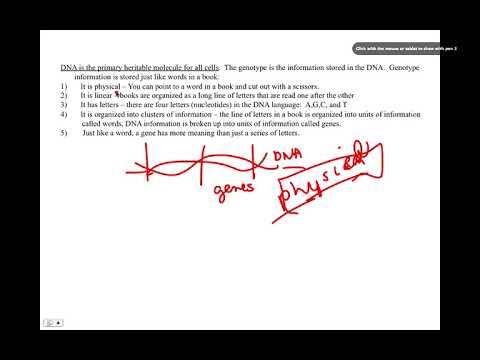
- Champlin divides genes into a transcription unit, which supplies the sequence for a product, and a promoter, which regulates its expression.
- Gene expression moves information from DNA to RNA; messenger RNA binds ribosomes, which use it to make proteins.
- DNA is built from A, G, C, and T nucleotides, while RNA uses U instead of T; a genotype is inherited DNA information, and a phenotype is its expressed outcome.
- Diploid cells generally carry one DNA copy from each parent; the copies remain separate in inheritance even when their effects contribute jointly to traits.
7:00
Aquaporin Effects, DNA Sequencing, and Promoter Control
- Aquaporin proteins let water move across cell membranes by osmosis; RNA made from both parental DNA copies can contribute to the cell’s overall aquaporin function.
- A hypothetical cell with one fully functional and one nonfunctional aquaporin copy could average about 50% function, but the health effect depends on the gene and trait.
- DNA sequencing makes genome letters searchable in databases, allowing researchers to find sequences such as the insulin gene in a pig genome.
- Champlin compares DNA to continuous text without spaces: the transcription unit is the functional sequence, while the promoter helps determine where, when, and how much it is used.
Summary, takeaways, and chapters were generated by AI from the video's transcript and may contain errors. The video belongs to its creator, The New Evolution for Everyone.